
Official statement
Other statements from this video 43 ▾
- □ Does the 15 MB Googlebot crawl limit really kill your indexation, and how can you fix it?
- □ Has mobile page weight tripled in 10 years? Why should SEO professionals care about this trend?
- □ Is your structured data bloating your pages too much to be worth the SEO investment?
- □ Is your mobile site missing critical content that exists on desktop?
- □ Is your desktop content disappearing from Google rankings because it's missing on mobile?
- □ Does page speed really impact conversions according to Google?
- □ Is Google really processing 40 billion spam URLs every single day?
- □ Does network compression really improve your site's crawl budget?
- □ Is lazy loading really essential to optimize your initial page weight and boost Core Web Vitals?
- □ Does Googlebot really stop crawling after 15 MB per URL?
- □ Has mobile page weight really tripled in just one decade?
- □ Does page weight really affect user experience and SEO performance?
- □ Does structured data really bloat your HTML and hurt page performance?
- □ Is mobile-desktop parity really costing you search rankings more than you think?
- □ Should you still worry about page weight for SEO in 2024?
- □ Is resource size really the make-or-break factor for your website's speed?
- □ Is Google really enforcing a strict 1 MB limit on images—and what does that tell you about SEO priorities?
- □ Does optimizing page size actually benefit users more than it benefits your search rankings?
- □ Does Googlebot really cap crawling at 15 MB per URL?
- □ Is exploding web page weight hurting your SEO? Here's what you need to know
- □ Is page size really still hurting your SEO in 2024?
- □ Are structured data slowing down your pages enough to harm your SEO?
- □ Does page loading speed really impact your conversion rates?
- □ Does network compression really optimize user device storage space, or is it just a temporary fix?
- □ Is content disparity between mobile and desktop killing your rankings in mobile-first indexing?
- □ Is lazy loading really a must-have SEO performance lever you should activate systematically?
- □ Does Google really block 40 billion spam URLs daily—and how does your site avoid the filter?
- □ Can image optimization really cut your page weight by 90%?
- □ Does Googlebot really stop at 15 MB per URL?
- □ Why is mobile-desktop parity sabotaging your rankings in Mobile-First Indexing?
- □ Is your page weight really slowing down your SEO performance?
- □ Does structured data really slow down your crawl budget?
- □ Does Google really block 40 billion spam URLs every single day?
- □ Should you really cap your images at 1 MB to satisfy Google?
- □ Does Googlebot really stop crawling after 15 MB per URL?
- □ Does site speed really impact your conversion rates?
- □ Is mobile-desktop mismatch really destroying your SEO rankings right now?
- □ Do structured data markups really bloat your HTML pages?
- □ Does page size really matter for SEO when internet connections keep getting faster?
- □ Is network compression really enough to optimize your site's crawlability?
- □ Can lazy loading really boost your performance without hurting crawlability?
- □ Does your website's overall size really hurt your SEO performance?
- □ Why does Google enforce a strict 1MB image size limit across its developer documentation?
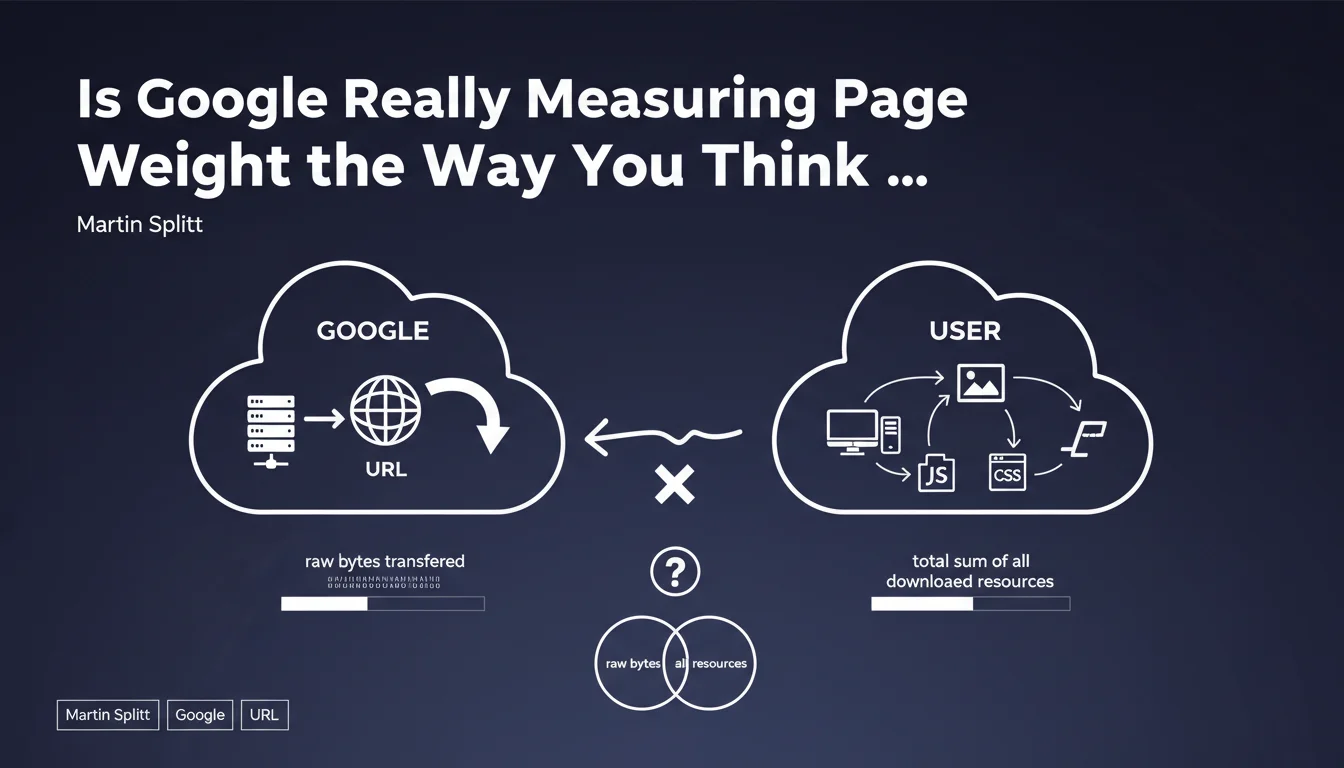
Google defines page weight solely as the raw bytes transferred by the HTML URL itself, not the sum of all resources (CSS, JS, images). This technical distinction changes how you should monitor and optimize your pages for crawling and indexation.
What you need to understand
What's the Difference Between Google's Definition and the User Definition?
Most web analytics tools (PageSpeed Insights, GTmetrix, DevTools) display a total page weight including HTML, stylesheets, scripts, images, fonts, and all third-party resources. This is the metric you've probably been monitoring for years.
Google, on the other hand, isolates only the raw bytes of the HTML URL — the source document before it triggers the download of associated resources. It's this HTML file alone that counts for their definition of "page weight".
Why Is This Technical Distinction Important?
Because Google crawls and indexes the HTML before deciding whether to load the associated resources. The weight of this HTML document directly influences crawl budget: the heavier it is, the more bandwidth and time Googlebot consumes to retrieve it.
External resources (images hosted on a CDN, third-party scripts) don't factor into this equation for Googlebot at the time of initial crawl. They matter for user experience, but not for Google's measurement of "page size".
- Raw HTML weight impacts crawl speed and crawl budget allocation
- External resources (JS, CSS, images) influence Core Web Vitals but not Google's page weight definition
- A 2 MB HTML file is problematic for Googlebot even if images are lightweight
- Optimizing the source HTML remains crucial for discoverability and indexation
SEO Expert opinion
Does This Definition Change Our Optimization Practices?
Not fundamentally — but it clarifies where to focus effort. If your raw HTML exceeds 500 KB because of massive JSON-LD, dozens of unnecessary meta tags, or thousands of lines of inline CSS, that's a red flag for crawl.
On the other hand, a page with 80 KB of HTML but 4 MB of optimized lazy-loaded images poses no crawl problem for Google. The issue lies elsewhere (LCP, CLS) but not at the page weight level as Google defines it.
Should We Stop Monitoring Total Page Weight?
No, of course not. Total page weight remains crucial for UX and Core Web Vitals. A page that loads 10 MB of resources will be penalized on user metrics, which indirectly impacts SEO.
But you need to separate two issues: crawling and indexation (where only HTML counts) and user experience (where everything counts). Googlebot doesn't suffer from a site with heavy images; your visitors do.
Why Is Google Clarifying This Nuance Now?
Because third-party tools create confusion. Sites receive alerts about "page too heavy" when their HTML is lightweight and the problem comes from external assets. Google wants to clarify that their robots measure something different from what your dashboards measure.
It's also a reminder: optimization for crawling and optimization for users don't completely overlap. You need to think about both separately.
Practical impact and recommendations
How Do You Measure the True HTML Weight Seen by Googlebot?
Forget classic tools that aggregate everything. Use curl or DevTools to isolate the raw HTTP response. In Chrome DevTools (Network tab), filter by "Doc" and look at the "Size" column — that's the HTML weight alone.
You can also inspect server logs: the response size of the HTML document (without resources) gives you the Google metric. Automate this monitoring for your strategic pages.
What Concrete Actions Can You Take to Reduce Raw HTML Weight?
- Remove redundant or unnecessary meta tags (duplicated Open Graph, obsolete Dublin Core)
- Externalize CSS: avoid thousands of lines of inline styles in the
<head> - Limit JSON-LD to essentials: no need for 200 KB of structured data per page
- Compress HTML (gzip, Brotli) on the server side — even if Google decompresses, it accelerates transfer
- Audit PHP/CMS includes: an overloaded header can weigh 50 KB on its own
- Clean up HTML comments and unnecessary whitespace in production
Should You Still Optimize External Resources?
Yes, absolutely. External images, scripts, and CSS don't impact Google's "page size" but remain critical for Core Web Vitals. An LCP of 6 seconds degrades your rankings, even if your HTML is 20 KB.
Google's distinction doesn't change anything about UX optimizations: lazy loading, CDN, WebP compression, JS minification. It simply tells you where to prioritize if your crawl budget is under pressure.
In summary: monitor two distinct metrics. Raw HTML weight for crawl health, and total weight for user experience. Both matter, but for different reasons.
These optimizations often touch on server architecture, front-end builds, and CMS configuration — all technical layers where a mistake can break indexation or degrade performance. If your stack is complex or you lack internal resources, support from a technical SEO agency can avoid weeks of trial and error and secure your gains.
❓ Frequently Asked Questions
Le poids des images compte-t-il dans la définition Google du poids de page ?
Un HTML de 400 Ko pose-t-il un problème pour Google ?
Comment vérifier le poids HTML vu par Googlebot ?
Cette définition change-t-elle l'importance des Core Web Vitals ?
Faut-il externaliser le CSS inline pour réduire le poids HTML ?
🎥 From the same video 43
Other SEO insights extracted from this same Google Search Central video · published on 30/03/2026
🎥 Watch the full video on YouTube →
💬 Comments (0)
Be the first to comment.