
Official statement
Other statements from this video 43 ▾
- □ Does the 15 MB Googlebot crawl limit really kill your indexation, and how can you fix it?
- □ Is Google Really Measuring Page Weight the Way You Think It Does?
- □ Has mobile page weight tripled in 10 years? Why should SEO professionals care about this trend?
- □ Is your structured data bloating your pages too much to be worth the SEO investment?
- □ Is your mobile site missing critical content that exists on desktop?
- □ Is your desktop content disappearing from Google rankings because it's missing on mobile?
- □ Does page speed really impact conversions according to Google?
- □ Is Google really processing 40 billion spam URLs every single day?
- □ Does network compression really improve your site's crawl budget?
- □ Is lazy loading really essential to optimize your initial page weight and boost Core Web Vitals?
- □ Does Googlebot really stop crawling after 15 MB per URL?
- □ Has mobile page weight really tripled in just one decade?
- □ Does structured data really bloat your HTML and hurt page performance?
- □ Is mobile-desktop parity really costing you search rankings more than you think?
- □ Should you still worry about page weight for SEO in 2024?
- □ Is resource size really the make-or-break factor for your website's speed?
- □ Is Google really enforcing a strict 1 MB limit on images—and what does that tell you about SEO priorities?
- □ Does optimizing page size actually benefit users more than it benefits your search rankings?
- □ Does Googlebot really cap crawling at 15 MB per URL?
- □ Is exploding web page weight hurting your SEO? Here's what you need to know
- □ Is page size really still hurting your SEO in 2024?
- □ Are structured data slowing down your pages enough to harm your SEO?
- □ Does page loading speed really impact your conversion rates?
- □ Does network compression really optimize user device storage space, or is it just a temporary fix?
- □ Is content disparity between mobile and desktop killing your rankings in mobile-first indexing?
- □ Is lazy loading really a must-have SEO performance lever you should activate systematically?
- □ Does Google really block 40 billion spam URLs daily—and how does your site avoid the filter?
- □ Can image optimization really cut your page weight by 90%?
- □ Does Googlebot really stop at 15 MB per URL?
- □ Why is mobile-desktop parity sabotaging your rankings in Mobile-First Indexing?
- □ Is your page weight really slowing down your SEO performance?
- □ Does structured data really slow down your crawl budget?
- □ Does Google really block 40 billion spam URLs every single day?
- □ Should you really cap your images at 1 MB to satisfy Google?
- □ Does Googlebot really stop crawling after 15 MB per URL?
- □ Does site speed really impact your conversion rates?
- □ Is mobile-desktop mismatch really destroying your SEO rankings right now?
- □ Do structured data markups really bloat your HTML pages?
- □ Does page size really matter for SEO when internet connections keep getting faster?
- □ Is network compression really enough to optimize your site's crawlability?
- □ Can lazy loading really boost your performance without hurting crawlability?
- □ Does your website's overall size really hurt your SEO performance?
- □ Why does Google enforce a strict 1MB image size limit across its developer documentation?
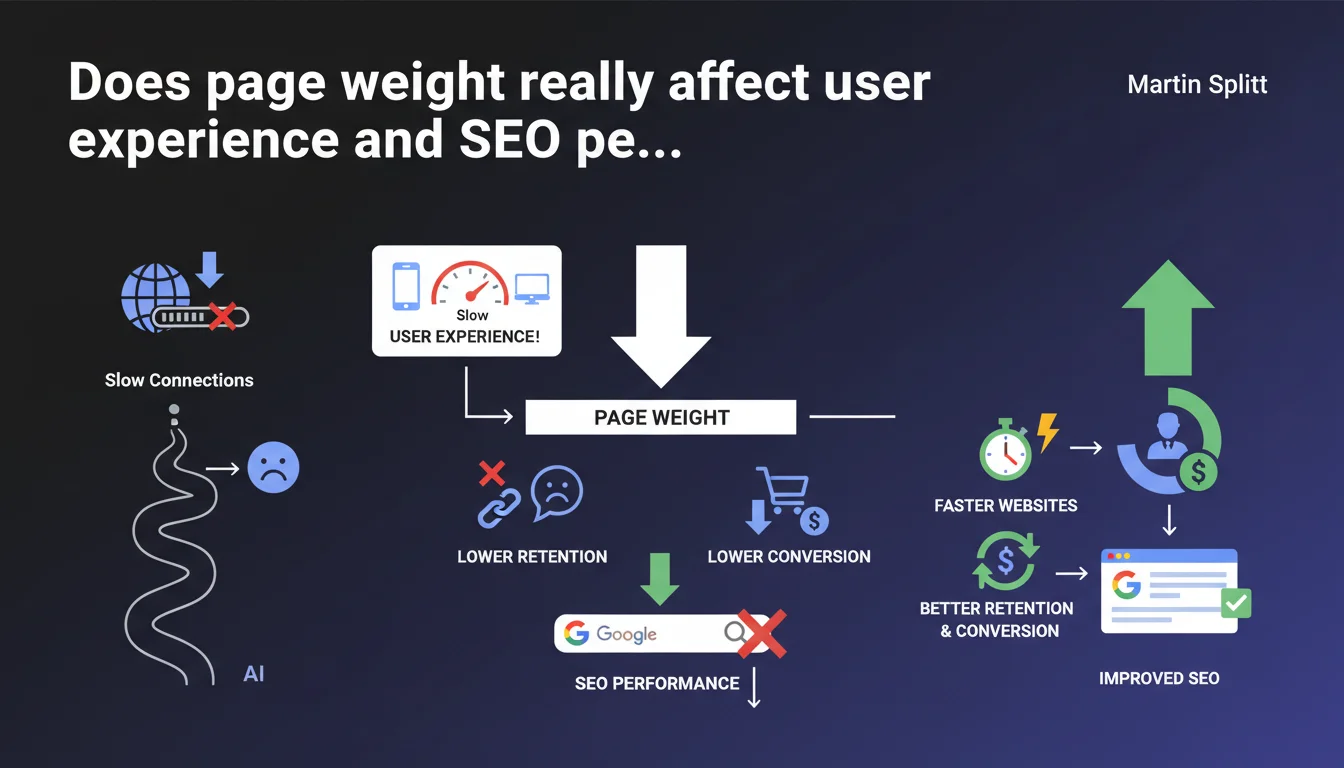
Google confirms that page weight remains a major issue for user experience, especially on slow connections. Faster websites record better retention rates and conversion rates, according to studies mentioned. Optimizing weight is not just a technical matter — it's a direct business lever.
What you need to understand
Why does Google keep emphasizing page weight?
Martin Splitt reminds us of an obvious truth we forget too often: page weight remains problematic for a significant portion of users. Even though fiber is becoming more widespread, millions of internet users still browse on slow mobile networks or in poorly covered areas.
Google isn't talking here about a direct ranking factor, but about an impact on behavioral metrics. Heavy pages = high loading times = users who abandon before even seeing the content. And Google measures that.
What's the connection between page weight and conversion rates?
All the studies mentioned point in the same direction: fast sites = better retention, superior conversion rates. Concretely, every additional second of loading time drives away a significant percentage of visitors.
It's less a pure SEO question than a business performance question. But since user signals indirectly influence ranking (bounce rate, session duration), everything ultimately connects.
Is this really a new message?
No. Google has been hammering home this message for years — Core Web Vitals, Page Experience, all of that follows the same logic. What's changing is that Splitt is reformulating it in simple terms: weight bogs down UX.
- Page weight remains a major barrier for slow connections
- Fast sites = better retention and higher conversion rates
- Indirect user signals: loading time impacts behavior, potentially ranking
- Consistent messaging with Core Web Vitals and Page Experience
SEO Expert opinion
Is this statement consistent with what we observe in the real world?
Yes, absolutely. Since Core Web Vitals were integrated as a ranking factor, we clearly see that Google rewards fast-loading sites. But be careful — rewards doesn't mean automatically pushing to the first page.
In real life, a site with mediocre content but ultra-fast loading will never outrank a competitor with solid content but slightly slower speed. Page weight plays a role, but remains one criterion among many. Google never states this explicitly in communications like this, and that's unfortunate.
What nuances should be added to this message?
Splitt mentions studies showing impact on retention and conversion. Which ones? No specifics. [To be verified] — we'd like numbers, sources, not just generalities. This kind of vague wording lets everyone interpret it their own way.
Another point: "page weight" is too broad a metric. Are we talking about total weight (MB), number of HTTP requests, rendering time? A site can weigh a lot but load fast thanks to lazy loading, CDN, compression. The opposite exists too.
In what cases doesn't this rule really apply?
For certain types of sites, weight is incompressible without sacrificing added value. Example: e-commerce platforms with high-definition visuals, photo/video sites, feature-rich SaaS tools. In these cases, better to invest in critical rendering optimization than cut everything down.
And let's be honest: on some ultra-specialized queries with little competition, a slow but comprehensive site can dominate easily. Google won't penalize rare and relevant content just because it loads in 4 seconds instead of 2.
Practical impact and recommendations
What should you concretely do to reduce your page weight?
Start with a complete performance audit: PageSpeed Insights, Lighthouse, WebPageTest. Identify the heaviest resources — uncompressed images, unnecessary JavaScript, exotic web fonts weighing hundreds of KB.
Then take action: image compression (WebP, AVIF), lazy loading for everything below the fold, CSS/JS minification, removal of superfluous WordPress plugins. Every KB counts, especially on mobile.
What mistakes should you avoid in this optimization?
Don't sacrifice visual quality to the point of making the site look ugly. An over-compressed image gives the impression of a cheap site, and that kills conversion as much as slow loading. Find the right balance.
Another trap: removing useful content to lighten the load. If your explainer videos or infographics genuinely enrich the experience, keep them — optimize them, but don't remove them. Weight should serve a purpose, not be reduced blindly.
How do you verify that your optimizations are working?
Measure before/after with reliable tools: GTmetrix, PageSpeed Insights, Chrome DevTools. Especially monitor Core Web Vitals in real-world conditions via Search Console — lab tests don't always reflect actual field experience.
Also analyze behavioral metrics: bounce rate, average session duration, pages per visit. If your optimizations boost these indicators, it's working. If not, dig deeper.
- Audit current weight of key pages (PageSpeed, Lighthouse)
- Compress images and switch to modern formats (WebP, AVIF)
- Implement lazy loading on images and videos
- Minify CSS, JS and remove unused code
- Enable server compression (Gzip, Brotli)
- Test rendering on simulated slow connections
- Track Core Web Vitals in real conditions (Search Console)
- Measure impact on behavioral metrics and conversions
❓ Frequently Asked Questions
Le poids des pages est-il un critère de classement direct chez Google ?
À partir de quel poids une page est-elle considérée comme trop lourde ?
Faut-il sacrifier la qualité visuelle pour réduire le poids ?
Les sites e-commerce avec nombreux visuels sont-ils désavantagés ?
Comment mesurer l'impact réel du poids sur mes conversions ?
🎥 From the same video 43
Other SEO insights extracted from this same Google Search Central video · published on 30/03/2026
🎥 Watch the full video on YouTube →
💬 Comments (0)
Be the first to comment.