
Official statement
Other statements from this video 43 ▾
- □ Does the 15 MB Googlebot crawl limit really kill your indexation, and how can you fix it?
- □ Is Google Really Measuring Page Weight the Way You Think It Does?
- □ Has mobile page weight tripled in 10 years? Why should SEO professionals care about this trend?
- □ Is your structured data bloating your pages too much to be worth the SEO investment?
- □ Is your mobile site missing critical content that exists on desktop?
- □ Is your desktop content disappearing from Google rankings because it's missing on mobile?
- □ Does page speed really impact conversions according to Google?
- □ Is Google really processing 40 billion spam URLs every single day?
- □ Does network compression really improve your site's crawl budget?
- □ Is lazy loading really essential to optimize your initial page weight and boost Core Web Vitals?
- □ Does Googlebot really stop crawling after 15 MB per URL?
- □ Has mobile page weight really tripled in just one decade?
- □ Does page weight really affect user experience and SEO performance?
- □ Does structured data really bloat your HTML and hurt page performance?
- □ Is mobile-desktop parity really costing you search rankings more than you think?
- □ Should you still worry about page weight for SEO in 2024?
- □ Is resource size really the make-or-break factor for your website's speed?
- □ Is Google really enforcing a strict 1 MB limit on images—and what does that tell you about SEO priorities?
- □ Does optimizing page size actually benefit users more than it benefits your search rankings?
- □ Does Googlebot really cap crawling at 15 MB per URL?
- □ Is exploding web page weight hurting your SEO? Here's what you need to know
- □ Is page size really still hurting your SEO in 2024?
- □ Are structured data slowing down your pages enough to harm your SEO?
- □ Does page loading speed really impact your conversion rates?
- □ Does network compression really optimize user device storage space, or is it just a temporary fix?
- □ Is content disparity between mobile and desktop killing your rankings in mobile-first indexing?
- □ Does Google really block 40 billion spam URLs daily—and how does your site avoid the filter?
- □ Can image optimization really cut your page weight by 90%?
- □ Does Googlebot really stop at 15 MB per URL?
- □ Why is mobile-desktop parity sabotaging your rankings in Mobile-First Indexing?
- □ Is your page weight really slowing down your SEO performance?
- □ Does structured data really slow down your crawl budget?
- □ Does Google really block 40 billion spam URLs every single day?
- □ Should you really cap your images at 1 MB to satisfy Google?
- □ Does Googlebot really stop crawling after 15 MB per URL?
- □ Does site speed really impact your conversion rates?
- □ Is mobile-desktop mismatch really destroying your SEO rankings right now?
- □ Do structured data markups really bloat your HTML pages?
- □ Does page size really matter for SEO when internet connections keep getting faster?
- □ Is network compression really enough to optimize your site's crawlability?
- □ Can lazy loading really boost your performance without hurting crawlability?
- □ Does your website's overall size really hurt your SEO performance?
- □ Why does Google enforce a strict 1MB image size limit across its developer documentation?
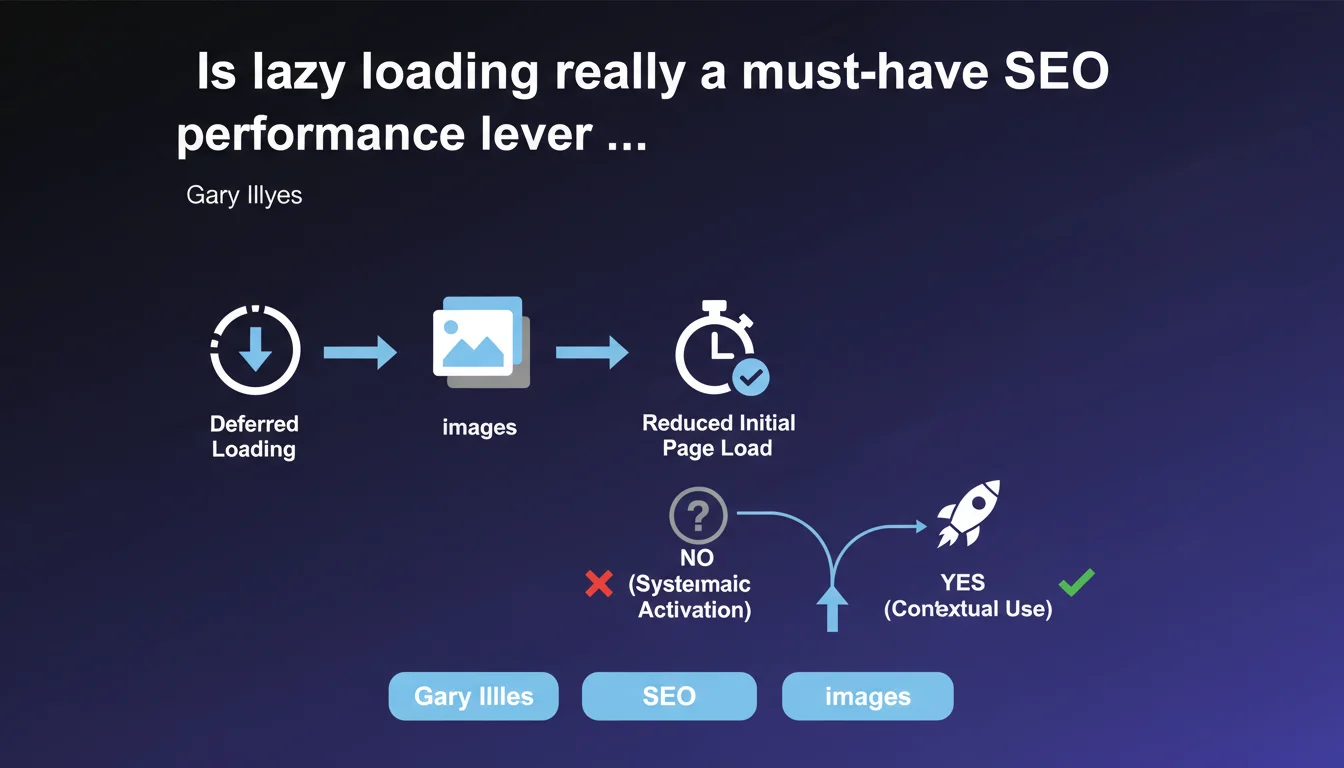
Gary Illyes confirms that lazy loading reduces initial page load by loading heavy resources only on scroll. This technique improves perceived loading time, but its implementation must be carefully managed to avoid penalizing image indexation.
What you need to understand
What is lazy loading and why is Google talking about it now?
Lazy loading (or deferred loading) consists of loading resources — images, videos, iframes — only when the user scrolls toward them. Instead of downloading all content when the page displays, the browser waits for the right moment.
This technique is not new, but its adoption exploded with the native loading="lazy" attribute in HTML5. Google mentions it here in a performance context: reducing initial weight improves Time to Interactive (TTI) and can positively impact Core Web Vitals.
How does lazy loading reduce initial page load?
A page with 50 images of 200 KB each weighs 10 MB. If the user never scrolls to the bottom of the page, why download these 10 MB? Lazy loading limits initial weight to visible content (the "above the fold").
Concretely, the browser loads only resources within the viewport. As soon as the user scrolls, the following images load with a slight delay. The impact on Largest Contentful Paint (LCP) can be significant — provided the LCP image itself isn't lazy-loaded, obviously.
What are the risks for SEO?
Google indexes pages by simulating user behavior, but Googlebot does not scroll systematically like a human would. If your critical images (logos, product visuals, infographics) are lazy-loaded, they may not be indexed — or with a delay.
The crawler loads the HTML, executes JavaScript, but doesn't always trigger scroll events. Result: some images remain invisible to Google Images. This is an arbitrage to manage between user performance and SEO visibility.
- Lazy loading = deferred loading of resources outside viewport
- Improves TTI and can boost LCP if properly implemented
- Risk: images not indexed if Googlebot doesn't scroll
- Never lazy-load the LCP image or critical above-the-fold visuals
SEO Expert opinion
Is this recommendation consistent with real-world observations?
Yes, but with a significant caveat. Google has been preaching lazy loading for years, especially since native integration in Chrome. Tests show that the loading="lazy" attribute does effectively improve performance metrics — when used below the initial viewport.
The problem is that many developers apply lazy loading everywhere, including on critical images. Result: disastrous LCP, images that only display after 2 seconds, and Core Web Vitals scores that plummet. Google says "manage heavy content," but doesn't specify where to draw the line.
What nuances should be added to this statement?
Gary Illyes remains deliberately vague about SEO impact. He talks about "reducing initial load," but says nothing about image indexation. Yet, this is the crucial point for an SEO professional.
If you have an e-commerce site with 20 product visuals per page, lazy-loading everything except the first 3 can improve perceived loading time. But if your images aren't indexed in Google Images, you lose a traffic channel. [To verify]: Google claims Googlebot handles lazy loading, but real-world feedback shows significant indexation delays.
In what cases can this technique be counterproductive?
Lazy loading becomes toxic in three situations. First, if you apply it above the fold: the LCP image loads deferred, the browser waits, LCP explodes. Second, on pages with little content: if you only have 3-4 images, performance gain is negligible and partial indexation risk increases.
Finally, on high-stakes SEO Images sites — fashion, decor, stock photography. If your business relies on Google Images, lazy-loading without selective preload strategy is like shooting yourself in the foot.
Practical impact and recommendations
What should you do concretely to implement lazy loading without breaking anything?
First step: identify above-the-fold images. Use Chrome DevTools to simulate different viewports (mobile, tablet, desktop) and spot visuals visible immediately. These images must load in eager mode (default) or with a preload.
Next, apply loading="lazy" only to images below the fold. If your CMS (WordPress, Shopify) lazy-loads everything by default, force eager behavior on the first X images. Then test with Lighthouse and verify your LCP hasn't regressed.
What mistakes must you avoid at all costs?
Never lazy-load the hero banner image, primary product logo, or any visual critical to immediate user experience. Some WordPress themes apply lazy loading blindly — audit your source code.
Also avoid lazy-loading images in carousels or sliders above the fold. The user can click before the next image loads, creating a degraded experience. And most importantly, don't rely solely on Lighthouse scores: verify actual indexation in Google Search Console and Google Images.
How do you verify your implementation is optimal?
Test with PageSpeed Insights and check that the "Defer offscreen images" audit doesn't flag critical images. Use Search Console to track your image indexation: if indexed images drop after lazy loading activation, that's a red flag.
Also analyze server logs to verify Googlebot loads your images. If you see HTTP requests for HTML but not for images, lazy loading is blocking the crawler. Finally, compare actual performance (CrUX) to lab tests: the gap can reveal implementation issues.
- Identify above-the-fold images and exempt them from lazy loading
- Apply loading="lazy" only to resources outside the initial viewport
- Verify the LCP image loads in eager mode or with preload
- Audit image indexation in Google Search Console after deployment
- Test on multiple viewports (mobile/desktop) to avoid regressions
- Monitor Core Web Vitals in real conditions (CrUX)
❓ Frequently Asked Questions
Le lazy loading pénalise-t-il l'indexation des images par Google ?
Faut-il lazy-loader toutes les images d'une page ?
Comment identifier l'image LCP de ma page ?
Le lazy loading améliore-t-il toujours les Core Web Vitals ?
Peut-on combiner lazy loading et preload sur la même page ?
🎥 From the same video 43
Other SEO insights extracted from this same Google Search Central video · published on 30/03/2026
🎥 Watch the full video on YouTube →
💬 Comments (0)
Be the first to comment.