
Official statement
Other statements from this video 43 ▾
- □ Does the 15 MB Googlebot crawl limit really kill your indexation, and how can you fix it?
- □ Is Google Really Measuring Page Weight the Way You Think It Does?
- □ Has mobile page weight tripled in 10 years? Why should SEO professionals care about this trend?
- □ Is your structured data bloating your pages too much to be worth the SEO investment?
- □ Is your mobile site missing critical content that exists on desktop?
- □ Is your desktop content disappearing from Google rankings because it's missing on mobile?
- □ Does page speed really impact conversions according to Google?
- □ Is Google really processing 40 billion spam URLs every single day?
- □ Does network compression really improve your site's crawl budget?
- □ Is lazy loading really essential to optimize your initial page weight and boost Core Web Vitals?
- □ Does Googlebot really stop crawling after 15 MB per URL?
- □ Has mobile page weight really tripled in just one decade?
- □ Does page weight really affect user experience and SEO performance?
- □ Does structured data really bloat your HTML and hurt page performance?
- □ Is mobile-desktop parity really costing you search rankings more than you think?
- □ Should you still worry about page weight for SEO in 2024?
- □ Is resource size really the make-or-break factor for your website's speed?
- □ Is Google really enforcing a strict 1 MB limit on images—and what does that tell you about SEO priorities?
- □ Does optimizing page size actually benefit users more than it benefits your search rankings?
- □ Does Googlebot really cap crawling at 15 MB per URL?
- □ Is exploding web page weight hurting your SEO? Here's what you need to know
- □ Is page size really still hurting your SEO in 2024?
- □ Are structured data slowing down your pages enough to harm your SEO?
- □ Does page loading speed really impact your conversion rates?
- □ Does network compression really optimize user device storage space, or is it just a temporary fix?
- □ Is content disparity between mobile and desktop killing your rankings in mobile-first indexing?
- □ Is lazy loading really a must-have SEO performance lever you should activate systematically?
- □ Does Google really block 40 billion spam URLs daily—and how does your site avoid the filter?
- □ Can image optimization really cut your page weight by 90%?
- □ Does Googlebot really stop at 15 MB per URL?
- □ Why is mobile-desktop parity sabotaging your rankings in Mobile-First Indexing?
- □ Is your page weight really slowing down your SEO performance?
- □ Does structured data really slow down your crawl budget?
- □ Does Google really block 40 billion spam URLs every single day?
- □ Should you really cap your images at 1 MB to satisfy Google?
- □ Does Googlebot really stop crawling after 15 MB per URL?
- □ Does site speed really impact your conversion rates?
- □ Is mobile-desktop mismatch really destroying your SEO rankings right now?
- □ Does page size really matter for SEO when internet connections keep getting faster?
- □ Is network compression really enough to optimize your site's crawlability?
- □ Can lazy loading really boost your performance without hurting crawlability?
- □ Does your website's overall size really hurt your SEO performance?
- □ Why does Google enforce a strict 1MB image size limit across its developer documentation?
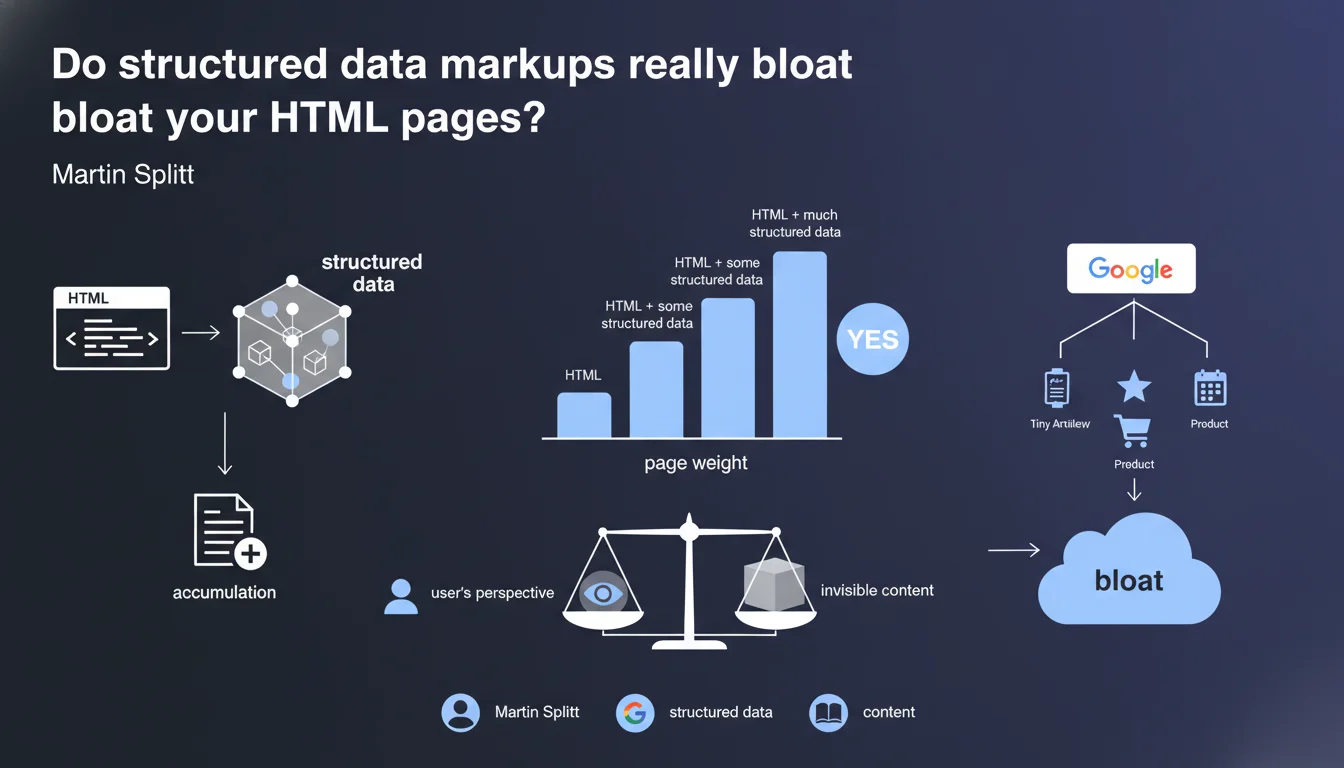
Martin Splitt reminds us that accumulating structured data can significantly increase a page's HTML weight, while this content remains invisible to users. With dozens of types supported by Google, the risk of bloating is real if you stack markups without discernment. A balance between semantic richness and technical performance is necessary.
What you need to understand
Why does Google mention the HTML weight of structured data?
Structured data (Schema.org, JSON-LD) enriches a page's semantic understanding for search engines. But it adds code — sometimes massive — that users never see.
Google documents dozens of types (Article, Product, FAQ, HowTo, BreadcrumbList, LocalBusiness, Event, Review, etc.). Combining multiple types on the same page can easily add 10 to 30 KB of JSON-LD, or more if the data is repetitive or poorly optimized.
What's the real impact on page weight?
An e-commerce page with Product + Review + FAQ + BreadcrumbList + Organization can exceed 20 KB of structured data. On mobile, every kilobyte counts for loading time and Core Web Vitals.
The problem arises mainly when the markup duplicates content already present in visible HTML, or when you add types "just in case" without verifying their actual usefulness for rich results.
Does Google prioritize performance or semantic richness?
Both — and that's where it gets tricky. Google encourages the use of structured data for rich snippets, but regularly reminds us that speed matters. The tradeoff is up to the SEO practitioner.
- Each type of structured data added increases HTML weight, sometimes by several kilobytes
- JSON-LD content is invisible to users but impacts loading time
- Combining many types (FAQ, Product, Review, BreadcrumbList) can easily add 10 to 30 KB to a page
- Google documents dozens of supported types, creating temptation to add them "just in case"
- The tradeoff between semantic richness and technical performance is unavoidable
SEO Expert opinion
Is this statement consistent with real-world practices?
Yes — and it puts a finger on a paradox rarely acknowledged by Google. On one hand, official documentation presents each structured data type as an opportunity to earn rich results. On the other, we're constantly hammered with the importance of Core Web Vitals and loading speed.
In practice, many e-commerce and editorial sites stack Schema.org markups without measuring the real impact on LCP or FID. HTML weight explodes, visibility gains remain hypothetical.
What nuances should we add to this statement?
Splitt isn't saying don't use structured data — he's reminding us it has a weight cost. The real question: is that cost offset by gains in CTR, impression rate for rich snippets, organic traffic?
[To verify] Google publishes no metrics on the average impact of a given structured data type on organic traffic. We navigate blind, empirically testing which types generate exploitable rich results.
In what cases does this weight become truly problematic?
On mobile, with slow connections (3G), each additional kilobyte delays LCP. If your page already weighs 200 KB of HTML + inline CSS, adding 20 KB of JSON-LD can push LCP beyond 2.5 seconds.
Another case: sites with thousands of SKUs. If each product page carries Product + Review + FAQ + Offer with hundreds of lines of JSON-LD duplicating visible HTML, the cumulative impact on crawl budget and bandwidth becomes measurable.
Practical impact and recommendations
What should you do concretely to limit structured data weight?
Audit what exists. Identify which types of structured data are present on each page template. Measure their actual weight (DevTools > Network, filter by HTML document).
Then verify which types actually trigger rich results in Google Search Console or via real-world tests (searches in your sector). Remove useless types — those that bring no enriched display or measurable benefit.
What mistakes should you avoid when implementing Schema.org markups?
Don't unnecessarily duplicate visible HTML content in JSON-LD. For example, if your HTML already contains a well-marked Q&A list, the FAQ Schema.org markup should reference these elements, not re-copy all the text.
Avoid adding types "just in case" without validation. FAQ, HowTo, Speakable, etc.: some types are rarely exploited by Google in your sector's SERPs. Test before rolling out at scale.
How do you verify that structured data weight remains reasonable?
Set a threshold: for example, JSON-LD should never represent more than 10% of a page's total HTML weight. If a page weighs 150 KB, the markup shouldn't exceed 15 KB.
Use PageSpeed Insights or WebPageTest to measure the real impact on LCP and TBT. Compare a version with and without certain structured data types — if the performance gain is clear and rich results don't change, simplify.
- Audit the structured data types present on each page template
- Measure the actual weight of JSON-LD (DevTools > Network, HTML document)
- Check in Google Search Console which types trigger rich results
- Remove useless types that bring no enriched display
- Don't duplicate visible HTML content in JSON-LD
- Set a threshold: JSON-LD < 10% of total HTML weight
- Test the impact on LCP and TBT with and without certain markups
- Prioritize high-impact types (Product, Review, validated FAQ) and eliminate others
❓ Frequently Asked Questions
Faut-il supprimer certaines données structurées pour alléger mes pages ?
Le JSON-LD est-il plus lourd que les microdonnées intégrées dans le HTML ?
Google pénalise-t-il les pages trop lourdes à cause des données structurées ?
Quels types de données structurées sont prioritaires à conserver ?
Peut-on compresser ou minifier le JSON-LD pour réduire son poids ?
🎥 From the same video 43
Other SEO insights extracted from this same Google Search Central video · published on 30/03/2026
🎥 Watch the full video on YouTube →
💬 Comments (0)
Be the first to comment.