
Official statement
Other statements from this video 43 ▾
- □ Does the 15 MB Googlebot crawl limit really kill your indexation, and how can you fix it?
- □ Is Google Really Measuring Page Weight the Way You Think It Does?
- □ Has mobile page weight tripled in 10 years? Why should SEO professionals care about this trend?
- □ Is your structured data bloating your pages too much to be worth the SEO investment?
- □ Is your mobile site missing critical content that exists on desktop?
- □ Is your desktop content disappearing from Google rankings because it's missing on mobile?
- □ Does page speed really impact conversions according to Google?
- □ Is Google really processing 40 billion spam URLs every single day?
- □ Does network compression really improve your site's crawl budget?
- □ Is lazy loading really essential to optimize your initial page weight and boost Core Web Vitals?
- □ Does Googlebot really stop crawling after 15 MB per URL?
- □ Has mobile page weight really tripled in just one decade?
- □ Does page weight really affect user experience and SEO performance?
- □ Does structured data really bloat your HTML and hurt page performance?
- □ Is mobile-desktop parity really costing you search rankings more than you think?
- □ Should you still worry about page weight for SEO in 2024?
- □ Is resource size really the make-or-break factor for your website's speed?
- □ Is Google really enforcing a strict 1 MB limit on images—and what does that tell you about SEO priorities?
- □ Does optimizing page size actually benefit users more than it benefits your search rankings?
- □ Does Googlebot really cap crawling at 15 MB per URL?
- □ Is exploding web page weight hurting your SEO? Here's what you need to know
- □ Is page size really still hurting your SEO in 2024?
- □ Are structured data slowing down your pages enough to harm your SEO?
- □ Does page loading speed really impact your conversion rates?
- □ Is content disparity between mobile and desktop killing your rankings in mobile-first indexing?
- □ Is lazy loading really a must-have SEO performance lever you should activate systematically?
- □ Does Google really block 40 billion spam URLs daily—and how does your site avoid the filter?
- □ Can image optimization really cut your page weight by 90%?
- □ Does Googlebot really stop at 15 MB per URL?
- □ Why is mobile-desktop parity sabotaging your rankings in Mobile-First Indexing?
- □ Is your page weight really slowing down your SEO performance?
- □ Does structured data really slow down your crawl budget?
- □ Does Google really block 40 billion spam URLs every single day?
- □ Should you really cap your images at 1 MB to satisfy Google?
- □ Does Googlebot really stop crawling after 15 MB per URL?
- □ Does site speed really impact your conversion rates?
- □ Is mobile-desktop mismatch really destroying your SEO rankings right now?
- □ Do structured data markups really bloat your HTML pages?
- □ Does page size really matter for SEO when internet connections keep getting faster?
- □ Is network compression really enough to optimize your site's crawlability?
- □ Can lazy loading really boost your performance without hurting crawlability?
- □ Does your website's overall size really hurt your SEO performance?
- □ Why does Google enforce a strict 1MB image size limit across its developer documentation?
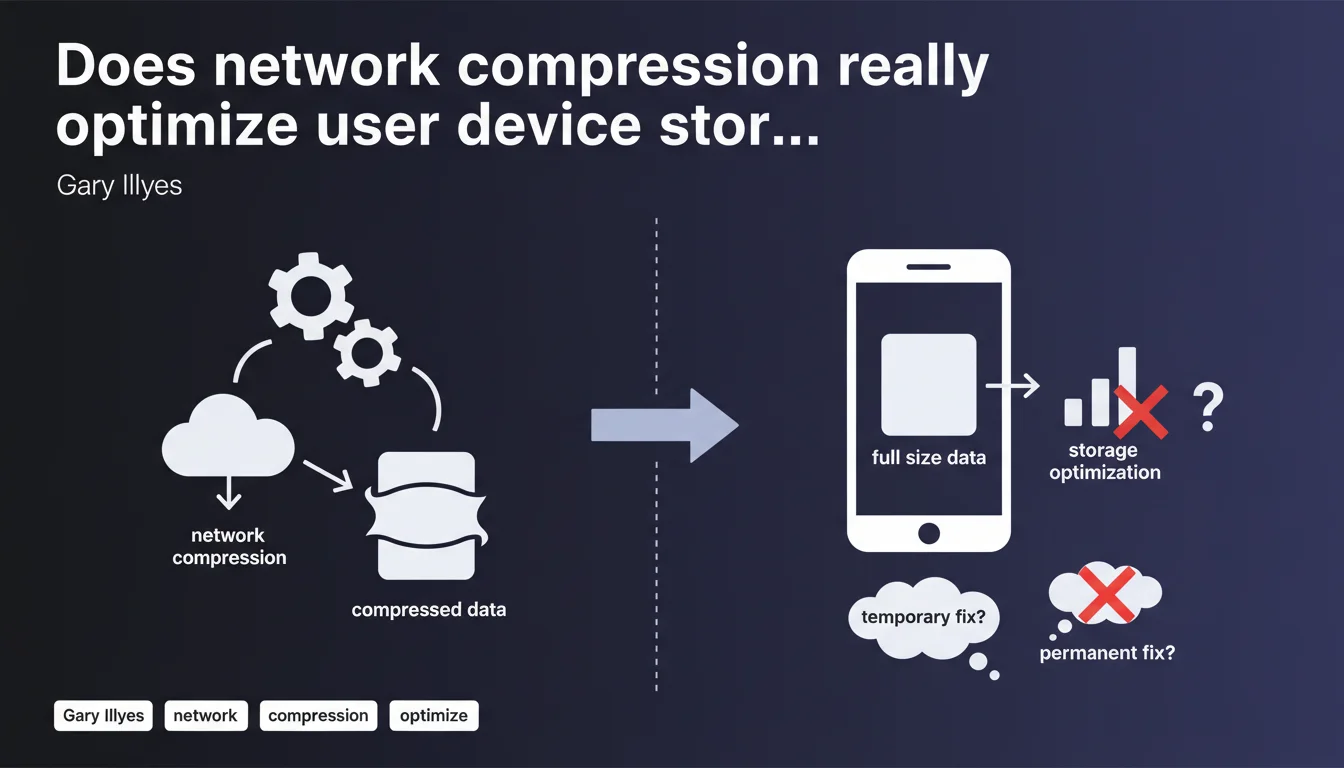
Network compression accelerates data transfer but does not reduce the space occupied on the user's device once files are decompressed. This distinction is crucial to understanding the real impact of your resources on user experience, especially on mobile where storage is limited.
What you need to understand
Why does this distinction between network compression and local storage matter so much?
Network compression (gzip, Brotli) compresses files as they transit between server and browser. It reduces bandwidth consumption and speeds up initial loading.
But once the browser receives these files — JavaScript, CSS, images — it decompresses them in memory to use them. On local disk (browser cache, PWAs, app data), they occupy their actual, uncompressed size.
How does this affect SEO?
Core Web Vitals measure perceived performance in part. If your resources are heavy once decompressed, they saturate RAM and local cache, especially on mobile.
Concretely: a 500 KB compressed JavaScript file can expand to 2 MB when decompressed. The browser must manage these 2 MB in memory. If the device lacks resources, the site slows down, even if network transfer was fast.
What's the difference with image compression?
Modern image formats (WebP, AVIF) compress the source file permanently. A 50 KB WebP image stays 50 KB on disk and in memory.
Network compression only reduces weight during transfer. It's a temporary gain, not a structural one.
- Network compression (gzip, Brotli) only applies during HTTP transfer
- Files occupy their full size in local cache and memory
- On mobile, limited storage can force the browser to clear cache more often, degrading UX
- Images should be optimized at source (WebP, AVIF), not just compressed at network level
- Core Web Vitals can suffer if decompressed resources saturate device memory
SEO Expert opinion
Does this statement challenge current best practices?
No. It clarifies a common misconception: enabling gzip or Brotli does not eliminate the need to optimize the actual weight of your source files. Many believe that once compression is activated, the performance problem is solved. That's wrong.
Tools like Lighthouse or PageSpeed Insights measure actual performance, including memory used and JavaScript parsing. A compressed but poorly written or originally bloated JS file will remain a drag, even with Brotli enabled.
Where does this rule apply most concretely?
On Progressive Web Apps and sites storing resources in local cache via Service Workers. If you cache 10 MB of compressed JS/CSS, it will occupy its decompressed size on the device — potentially 30-40 MB.
On a mid-range Android smartphone with 32 GB of saturated storage, the browser will clear this cache quickly. The user will have to re-download resources on each visit, canceling any caching benefit.
Are there cases where this distinction is negligible?
On desktop with abundant storage and comfortable RAM, yes. But mobile-first indexing from Google requires reasoning first for constrained devices. [To verify]: Google has never clarified whether Googlebot simulates these local storage constraints during mobile crawling, but UX signals (bounce rate, engagement) suffer from it, and Google measures that.
Practical impact and recommendations
What exactly needs to be optimized beyond network compression?
First, reduce the source weight of your JavaScript and CSS files. Tree-shaking, code splitting, removal of unnecessary dependencies. A lighter source file stays light everywhere — in transit, in cache, in memory.
Next, adopt modern image formats (WebP, AVIF) that integrate permanent compression into the file itself. A 200 KB JPEG image can drop to 50 KB in WebP with no visible loss, and this reduction persists everywhere.
How do you verify the real impact on storage and memory?
Use Chrome DevTools: the Performance tab records memory consumed during loading. The Application > Cache Storage tab shows the actual weight of locally cached files.
Test on a low-end Android device with saturated storage. If cache is regularly cleared, your resources are too heavy.
What common mistakes should you avoid?
Don't confuse network compression (gzip/Brotli) and source optimization. Enabling Brotli does not exempt you from minifying, optimizing images at source, or reducing JS bundles.
Don't ignore mobile constraints: a site fast on desktop with fiber optic can be catastrophic on 4G with a 150-dollar smartphone. Google indexes mobile first.
- Enable gzip or Brotli on all text files (HTML, CSS, JS, JSON, XML)
- Minify and tree-shake JavaScript at source to reduce decompressed weight
- Convert images to WebP or AVIF for permanent compression
- Audit the weight of locally cached files via DevTools > Application
- Test performance on a low-end Android device with saturated storage
- Monitor memory consumed via DevTools > Performance
- Limit the total weight of resources cached by Service Workers (max 10-15 MB decompressed)
- Regularly re-evaluate npm dependencies: many libraries are heavy once decompressed
❓ Frequently Asked Questions
La compression Brotli est-elle meilleure que gzip pour réduire le stockage local ?
Les images WebP sont-elles compressées uniquement au niveau réseau ?
Les Service Workers cachent-ils les fichiers compressés ou décompressés ?
Google pénalise-t-il les sites dont les ressources occupent trop d'espace en cache ?
Faut-il désactiver la compression réseau si on optimise déjà les fichiers sources ?
🎥 From the same video 43
Other SEO insights extracted from this same Google Search Central video · published on 30/03/2026
🎥 Watch the full video on YouTube →
💬 Comments (0)
Be the first to comment.