
Official statement
Other statements from this video 43 ▾
- □ Pourquoi Googlebot s'arrête-t-il à 15 Mo par URL et comment cela impacte-t-il votre crawl ?
- □ Google mesure-t-il vraiment le poids de page comme vous le pensez ?
- □ Le poids des pages mobiles a triplé en 10 ans : faut-il s'inquiéter pour le SEO ?
- □ Les données structurées alourdissent-elles trop vos pages pour être rentables en SEO ?
- □ Votre site mobile contient-il autant de contenu que votre version desktop ?
- □ Pourquoi votre contenu desktop disparaît-il des résultats Google s'il manque sur mobile ?
- □ La vitesse de page impacte-t-elle réellement les conversions selon Google ?
- □ Google traite-t-il vraiment 40 milliards d'URLs de spam par jour ?
- □ La compression réseau améliore-t-elle réellement le crawl budget de votre site ?
- □ Le lazy loading est-il vraiment indispensable pour optimiser le poids initial de vos pages ?
- □ Googlebot s'arrête-t-il vraiment après 15 Mo par URL ?
- □ Pourquoi le poids des pages mobiles a-t-il triplé en une décennie ?
- □ Le poids des pages impacte-t-il vraiment l'expérience utilisateur et le SEO ?
- □ Les données structurées alourdissent-elles vraiment vos pages HTML ?
- □ Pourquoi la parité mobile-desktop reste-t-elle un facteur de déclassement majeur ?
- □ Faut-il encore se préoccuper du poids des pages pour le SEO ?
- □ La taille des ressources est-elle le facteur déterminant de la vitesse de votre site ?
- □ Pourquoi Google impose-t-il une limite stricte de 1 Mo pour les images ?
- □ L'optimisation de la taille des pages profite-t-elle vraiment plus aux utilisateurs qu'au SEO ?
- □ Googlebot limite-t-il vraiment le crawl à 15 Mo par URL ?
- □ Le poids des pages web explose : faut-il s'inquiéter pour son SEO ?
- □ La taille des pages web nuit-elle encore vraiment à votre SEO ?
- □ Les structured data alourdissent-elles vos pages au point de nuire au SEO ?
- □ La vitesse de chargement influence-t-elle vraiment les conversions de vos pages ?
- □ La compression réseau suffit-elle à optimiser l'espace de stockage des utilisateurs ?
- □ Pourquoi la disparité mobile/desktop tue-t-elle votre référencement en indexation mobile-first ?
- □ Le lazy loading est-il vraiment un levier de performance SEO à activer systématiquement ?
- □ Google bloque 40 milliards d'URLs de spam par jour : comment votre site échappe-t-il au filtre ?
- □ L'optimisation des images peut-elle vraiment diviser par 10 le poids de vos pages ?
- □ Googlebot s'arrête-t-il vraiment à 15 Mo par URL ?
- □ Pourquoi la parité mobile-desktop impacte-t-elle autant votre classement en Mobile-First Indexing ?
- □ Le poids de vos pages freine-t-il vraiment votre référencement ?
- □ Les données structurées ralentissent-elles vraiment votre crawl ?
- □ Google intercepte vraiment 40 milliards d'URLs de spam par jour ?
- □ Faut-il limiter vos images à 1 Mo pour plaire à Google ?
- □ Googlebot s'arrête-t-il vraiment à 15 Mo par URL crawlée ?
- □ La vitesse d'un site impacte-t-elle vraiment la conversion ?
- □ Pourquoi la disparité mobile-desktop ruine-t-elle encore tant de classements SEO ?
- □ Les données structurées alourdissent-elles vraiment vos pages HTML ?
- □ Pourquoi la taille des pages reste-t-elle un facteur SEO critique malgré l'amélioration des connexions Internet ?
- □ La compression réseau suffit-elle à optimiser le crawl de votre site ?
- □ Le lazy loading peut-il vraiment booster vos performances sans impacter le crawl ?
- □ Pourquoi Google limite-t-il la taille des images à 1Mo sur sa documentation développeur ?
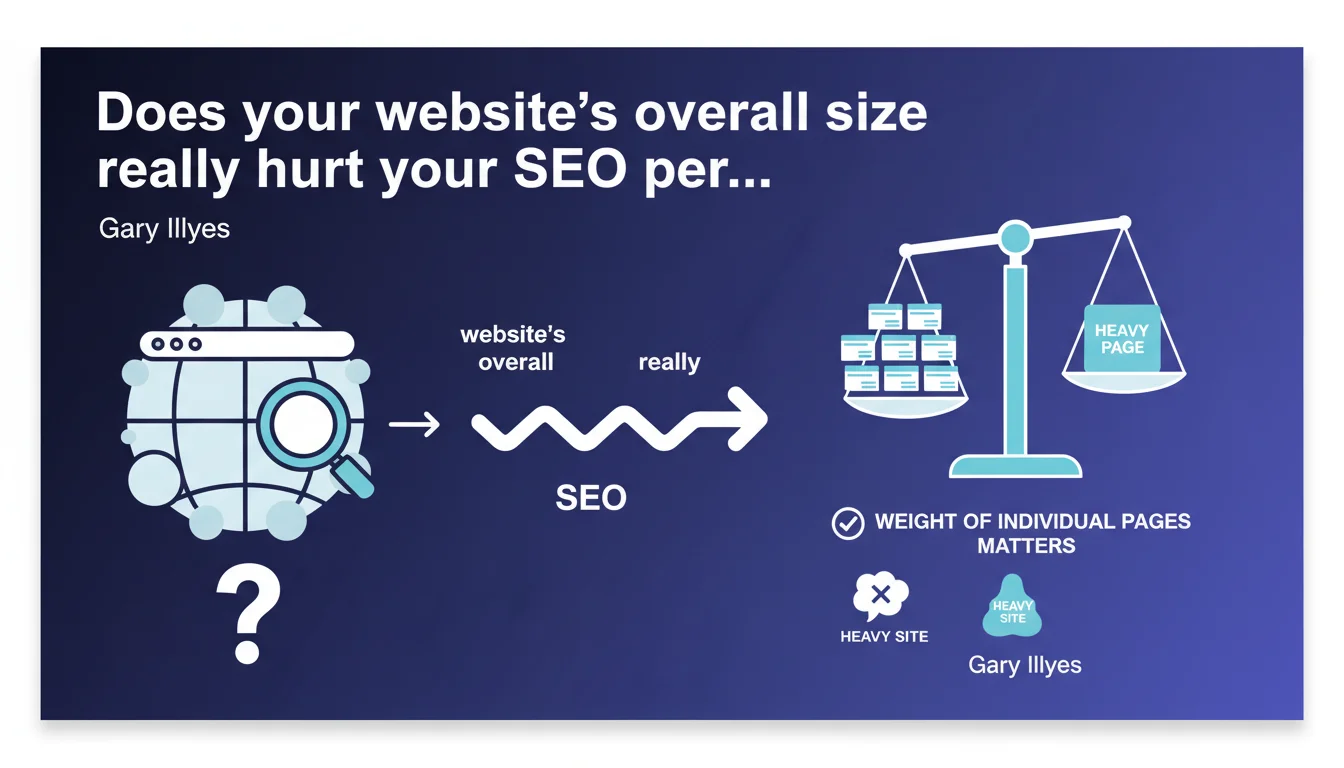
Google doesn't consider the notion of a 'large site' in its ranking criteria. It's the weight of each individual page that matters, not the overall volume of a domain. This webpage vs website distinction changes how you should approach technical optimization.
What you need to understand
Why does Google make this distinction between site and page?
Gary Illyes sweeps away a persistent misconception: the idea that a 'heavy' site would be penalized globally. Google evaluates performance at the page level, not at the domain level. A site can have 50,000 URLs — if each page remains performant individually, there's no problem.
This clarification reveals how Google's indexing and ranking engine works: it doesn't reason in terms of 'this site is large so it must be slow', but rather 'does this specific page load quickly, does it offer a good user experience'. The granularity of analysis occurs at the URL level, not the domain level.
What does this actually change for optimization?
Rather than worrying about the total number of pages on a site, you should focus on optimizing each page template individually. A product sheet, a category page, a blog post — each must meet technical performance criteria.
This approach also enables better prioritization: an e-commerce site with 10,000 product pages doesn't need to optimize all 10,000 pages in the same way. Concentrate on critical templates and pages with high traffic potential.
Does this statement call the crawl budget concept into question?
Not really. Crawl budget remains a reality, especially for very large sites. But this statement clarifies that a page's weight influences how quickly it will be crawled and evaluated, regardless of the site's overall size.
If your pages are fast, lightweight, and well-structured, Google will be able to crawl more of them in the same timeframe. Crawl budget thus becomes a consequence of per-page optimization, not a constraint tied to the domain's overall volume.
- Google analyzes individual pages, not sites as a whole
- A large site is not penalized if each page remains performant
- A page's weight directly impacts its crawl speed and evaluation
- Optimization must be done at the template level, not at the domain level
SEO Expert opinion
Is this statement consistent with real-world observations?
Yes, largely. We've observed for years that Google can very well index and rank massive sites (Amazon, Wikipedia) without penalizing them for their size. Conversely, sites with just a few hundred pages can suffer if each page is heavy or poorly optimized.
But — and this is where it gets complicated — this statement remains silent on indirect effects. A poorly structured massive site will have crawl budget problems, duplication issues, and link equity dilution. It's not the volume that's the problem, but the organizational and technical consequences of that volume.
What nuances should be added to this assertion?
Gary Illyes is talking about 'weight' in the technical sense — load time, resource size. But he says nothing about other dimensions that can be impacted by a site's size: thematic consistency, crawl depth, average content quality. [To verify]: does Google apply an average quality threshold at the domain level?
In practice: a site that publishes 1,000 mediocre pages per month risks seeing its overall quality score (assumed, not officially documented) decline, even if technically each page loads quickly. This statement doesn't cover this angle.
In what cases doesn't this rule fully apply?
Small sites with very few backlinks can benefit from a concentration of link equity effect: fewer pages = more juice per page. A large site naturally dilutes its authority across more URLs, even if technically each page is optimized.
Practical impact and recommendations
What should you do concretely to optimize your page weight?
Start with a Core Web Vitals audit at the main template level: homepage, category pages, product sheets, articles. Identify slowness patterns: unoptimized images, render-blocking JavaScript, unused CSS. Fix template by template.
Next, segment your crawl budget by prioritizing strategic URLs. Use the robots.txt file and meta robots tags to prevent Google from wasting time on low-value-added pages (filters, sorts, unnecessary variants).
What mistakes should you avoid in this page-by-page optimization logic?
Don't fall into the trap of manual page-by-page optimization. That would be unmanageable beyond a few dozen URLs. Instead, work on optimization rules at the template level: one good template = thousands of optimized pages at once.
Also avoid neglecting 'secondary' pages on the grounds that they generate little traffic. A slow page in your sitemap structure can slow down overall crawl and indirectly affect how frequently Googlebot visits your entire site.
How do you verify that your pages meet weight and performance criteria?
Use PageSpeed Insights, Lighthouse, and Search Console to monitor Core Web Vitals for your main templates. Set up alerts on critical metrics: LCP > 2.5s, CLS > 0.1, FID > 100ms.
Implement continuous monitoring with a tool like Screaming Frog or OnCrawl to catch pages that degrade over time (progressive addition of third-party scripts, uncompressed images, etc.).
- Audit Core Web Vitals template by template, not page by page
- Optimize images (WebP, lazy loading, compression)
- Reduce render-blocking JavaScript and unused CSS
- Segment crawl budget with robots.txt and meta robots
- Monitor performance continuously with automated alerts
- Prioritize strategic URLs in your optimization roadmap
❓ Frequently Asked Questions
Un site de 10 000 pages est-il désavantagé face à un site de 100 pages ?
Le poids total d'un site (en Mo) compte-t-il pour Google ?
Cette règle s'applique-t-elle aussi aux sites avec beaucoup de duplication de contenu ?
Faut-il supprimer des pages pour améliorer le SEO d'un gros site ?
Comment prioriser l'optimisation des pages sur un site de plusieurs milliers d'URLs ?
🎥 From the same video 43
Other SEO insights extracted from this same Google Search Central video · published on 30/03/2026
🎥 Watch the full video on YouTube →
💬 Comments (0)
Be the first to comment.