
Official statement
Other statements from this video 43 ▾
- □ Does the 15 MB Googlebot crawl limit really kill your indexation, and how can you fix it?
- □ Is Google Really Measuring Page Weight the Way You Think It Does?
- □ Has mobile page weight tripled in 10 years? Why should SEO professionals care about this trend?
- □ Is your structured data bloating your pages too much to be worth the SEO investment?
- □ Is your mobile site missing critical content that exists on desktop?
- □ Is your desktop content disappearing from Google rankings because it's missing on mobile?
- □ Does page speed really impact conversions according to Google?
- □ Is Google really processing 40 billion spam URLs every single day?
- □ Does network compression really improve your site's crawl budget?
- □ Is lazy loading really essential to optimize your initial page weight and boost Core Web Vitals?
- □ Does Googlebot really stop crawling after 15 MB per URL?
- □ Has mobile page weight really tripled in just one decade?
- □ Does page weight really affect user experience and SEO performance?
- □ Does structured data really bloat your HTML and hurt page performance?
- □ Is mobile-desktop parity really costing you search rankings more than you think?
- □ Should you still worry about page weight for SEO in 2024?
- □ Is resource size really the make-or-break factor for your website's speed?
- □ Is Google really enforcing a strict 1 MB limit on images—and what does that tell you about SEO priorities?
- □ Does optimizing page size actually benefit users more than it benefits your search rankings?
- □ Does Googlebot really cap crawling at 15 MB per URL?
- □ Is exploding web page weight hurting your SEO? Here's what you need to know
- □ Is page size really still hurting your SEO in 2024?
- □ Are structured data slowing down your pages enough to harm your SEO?
- □ Does network compression really optimize user device storage space, or is it just a temporary fix?
- □ Is content disparity between mobile and desktop killing your rankings in mobile-first indexing?
- □ Is lazy loading really a must-have SEO performance lever you should activate systematically?
- □ Does Google really block 40 billion spam URLs daily—and how does your site avoid the filter?
- □ Can image optimization really cut your page weight by 90%?
- □ Does Googlebot really stop at 15 MB per URL?
- □ Why is mobile-desktop parity sabotaging your rankings in Mobile-First Indexing?
- □ Is your page weight really slowing down your SEO performance?
- □ Does structured data really slow down your crawl budget?
- □ Does Google really block 40 billion spam URLs every single day?
- □ Should you really cap your images at 1 MB to satisfy Google?
- □ Does Googlebot really stop crawling after 15 MB per URL?
- □ Does site speed really impact your conversion rates?
- □ Is mobile-desktop mismatch really destroying your SEO rankings right now?
- □ Do structured data markups really bloat your HTML pages?
- □ Does page size really matter for SEO when internet connections keep getting faster?
- □ Is network compression really enough to optimize your site's crawlability?
- □ Can lazy loading really boost your performance without hurting crawlability?
- □ Does your website's overall size really hurt your SEO performance?
- □ Why does Google enforce a strict 1MB image size limit across its developer documentation?
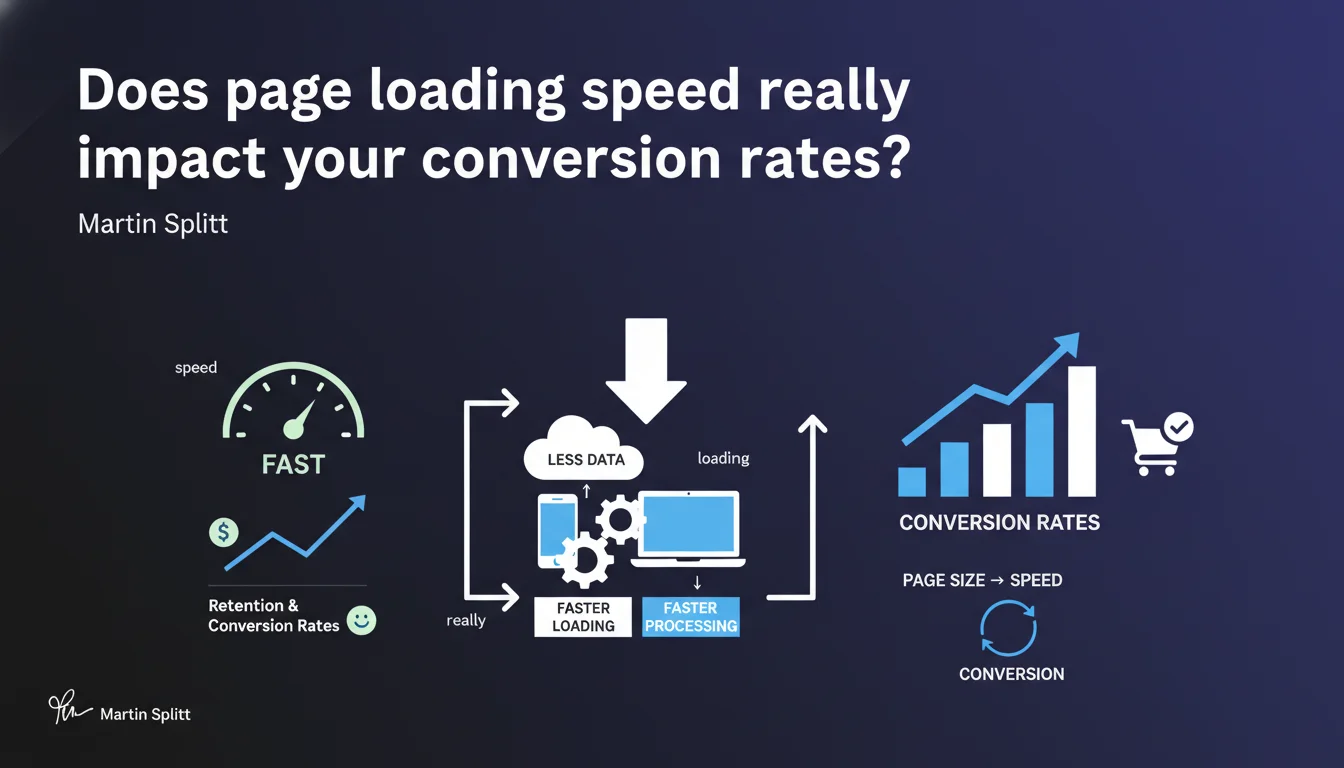
Google confirms what CRO studies have shown for years: a fast website converts better. Reducing page weight remains the most direct lever to improve speed, since less data equals faster loading and processing. For SEO professionals, it's a reminder that technical performance isn't just about rankings.
What you need to understand
Why does Google mix speed and conversion in an SEO statement?
At first glance, this statement seems outside the strict scope of search engine optimization. But Martin Splitt reminds us here that a site's performance shouldn't be measured only by Google rankings — it directly impacts business metrics.
Search engines have every reason to send users toward satisfying experiences. A slow site creates frustration, abandonment, and high bounce rates. These behavioral signals can indirectly affect your visibility.
What sets this position apart from typical Core Web Vitals statements?
Google is talking about overall perceived speed, not just CWV metrics (LCP, FID, CLS). The nuance matters: you can have decent LCP but catastrophic Time to Interactive if your JavaScript is bloated.
The statement emphasizes page weight as a concrete action lever. Less data to transfer equals gains across the board (network, parsing, execution). It's a return to fundamentals: payload optimization remains the priority initiative.
Which studies validate this speed-to-conversion link?
Google doesn't cite specific sources here — typical. But public case studies abound: Amazon documented that one second of latency costs 1% in conversion. Walmart published similar figures.
The consensus has been established for a long time in the CRO industry. What's interesting is that Google is formalizing this correlation in an SEO context, which strengthens the urgency of treating performance as a cross-functional criterion.
- Speed directly impacts conversion, not just rankings
- Page weight is the first optimization lever to activate
- Core Web Vitals only cover part of the perceived performance spectrum
- Behavioral signals tied to slow experiences can indirectly influence SEO
- Google is officially anchoring technical performance in business logic
SEO Expert opinion
Is this statement really new for an experienced SEO practitioner?
No. It's even a basic reminder. Any SEO working seriously on e-commerce or SaaS sites knows that speed influences conversion from years of experience. What's useful is that Google officially restates it, which helps justify technical budgets with decision-makers.
The problem is that this statement remains vague on concrete thresholds. At what latency point does conversion drop significantly? What gain margin can you expect moving from 3s to 1s LCP? No quantified data here. [To verify] with your own A/B tests on your audience segment.
Is page weight still the main limiting factor?
Not necessarily. On average mobile 4G, yes, network transfer is often the bottleneck. But on fiber desktop or mobile 5G, JavaScript parsing and execution quickly become the blocking factor — even with lightweight payload.
Reducing weight is a good starting point, but it's not sufficient if you're delivering 2 MB of poorly optimized JavaScript. Real gains come from a combined approach: compression, lazy loading, code splitting, reduction of main thread work.
In what cases does this rule not apply strictly?
With captive audiences or restricted-access tools (intranets, niche B2B SaaS with little competition), latency tolerance is higher. The user has no choice, they wait. Conversion doesn't depend on speed in these contexts.
Similarly, in certain high-value niche sectors (premium consulting, ultra-premium products), technical friction has marginal impact compared to other criteria (trust, demonstrated expertise, referrals). But these cases remain minority.
Practical impact and recommendations
What should you audit first to identify quick wins?
Start by measuring the actual weight of your key pages (homepage, product sheets, landing pages). Use WebPageTest or Lighthouse to get a detailed breakdown (HTML, CSS, JS, images, fonts, third-party scripts).
Classic quick wins: image compression (WebP, AVIF), native lazy loading for below-the-fold assets, removal of non-essential third-party scripts (redundant marketing pixels, unnecessary social widgets). These actions don't require heavy technical rework.
How do you verify real impact on conversion after optimization?
Set up an A/B or A/A/B test if your traffic allows. Compare conversion rates before/after optimization while controlling other variables (seasonality, marketing campaigns, parallel UX changes).
Also track intermediate metrics: bounce rate, time spent, pages per session. If speed improves but conversion stalls, the problem may be elsewhere (value proposition, funnel friction, pricing).
What mistakes should you avoid when optimizing page weight?
Don't sacrifice visual quality to the point of degrading your brand perception. Overly aggressive compression on product images can harm e-commerce conversion. Find the right balance.
Also avoid breaking critical functionality by removing scripts without testing. Some third-party tools are necessary (live chat support, payment solutions, personalization tools). Instead, prioritize their asynchronous or deferred loading.
- Measure total weight and breakdown by resource type (HTML, CSS, JS, images, fonts, third-party)
- Compress images to WebP/AVIF with quality level suited to your industry
- Enable native lazy loading for below-the-fold images and iframes
- Audit and remove non-essential third-party scripts, or load them asynchronously
- Minify and compress (Gzip/Brotli) text resources (HTML, CSS, JS)
- Implement an A/B test to measure actual impact on conversion
- Monitor behavioral metrics (bounce, time spent, pages per session)
- Verify that optimizations don't degrade user experience or brand perception
❓ Frequently Asked Questions
La vitesse de chargement est-elle un facteur de classement Google direct ?
Quel est le poids de page idéal pour maximiser les conversions ?
Faut-il prioriser le poids des pages ou les Core Web Vitals ?
Les scripts tiers peuvent-ils vraiment tuer les conversions ?
Comment mesurer l'impact vitesse vs conversion de manière fiable ?
🎥 From the same video 43
Other SEO insights extracted from this same Google Search Central video · published on 30/03/2026
🎥 Watch the full video on YouTube →
💬 Comments (0)
Be the first to comment.