
Official statement
Other statements from this video 43 ▾
- □ Does the 15 MB Googlebot crawl limit really kill your indexation, and how can you fix it?
- □ Is Google Really Measuring Page Weight the Way You Think It Does?
- □ Has mobile page weight tripled in 10 years? Why should SEO professionals care about this trend?
- □ Is your structured data bloating your pages too much to be worth the SEO investment?
- □ Is your mobile site missing critical content that exists on desktop?
- □ Is your desktop content disappearing from Google rankings because it's missing on mobile?
- □ Does page speed really impact conversions according to Google?
- □ Is Google really processing 40 billion spam URLs every single day?
- □ Does network compression really improve your site's crawl budget?
- □ Is lazy loading really essential to optimize your initial page weight and boost Core Web Vitals?
- □ Does Googlebot really stop crawling after 15 MB per URL?
- □ Has mobile page weight really tripled in just one decade?
- □ Does page weight really affect user experience and SEO performance?
- □ Does structured data really bloat your HTML and hurt page performance?
- □ Is mobile-desktop parity really costing you search rankings more than you think?
- □ Should you still worry about page weight for SEO in 2024?
- □ Is resource size really the make-or-break factor for your website's speed?
- □ Is Google really enforcing a strict 1 MB limit on images—and what does that tell you about SEO priorities?
- □ Does optimizing page size actually benefit users more than it benefits your search rankings?
- □ Does Googlebot really cap crawling at 15 MB per URL?
- □ Is exploding web page weight hurting your SEO? Here's what you need to know
- □ Is page size really still hurting your SEO in 2024?
- □ Are structured data slowing down your pages enough to harm your SEO?
- □ Does page loading speed really impact your conversion rates?
- □ Does network compression really optimize user device storage space, or is it just a temporary fix?
- □ Is content disparity between mobile and desktop killing your rankings in mobile-first indexing?
- □ Is lazy loading really a must-have SEO performance lever you should activate systematically?
- □ Can image optimization really cut your page weight by 90%?
- □ Does Googlebot really stop at 15 MB per URL?
- □ Why is mobile-desktop parity sabotaging your rankings in Mobile-First Indexing?
- □ Is your page weight really slowing down your SEO performance?
- □ Does structured data really slow down your crawl budget?
- □ Does Google really block 40 billion spam URLs every single day?
- □ Should you really cap your images at 1 MB to satisfy Google?
- □ Does Googlebot really stop crawling after 15 MB per URL?
- □ Does site speed really impact your conversion rates?
- □ Is mobile-desktop mismatch really destroying your SEO rankings right now?
- □ Do structured data markups really bloat your HTML pages?
- □ Does page size really matter for SEO when internet connections keep getting faster?
- □ Is network compression really enough to optimize your site's crawlability?
- □ Can lazy loading really boost your performance without hurting crawlability?
- □ Does your website's overall size really hurt your SEO performance?
- □ Why does Google enforce a strict 1MB image size limit across its developer documentation?
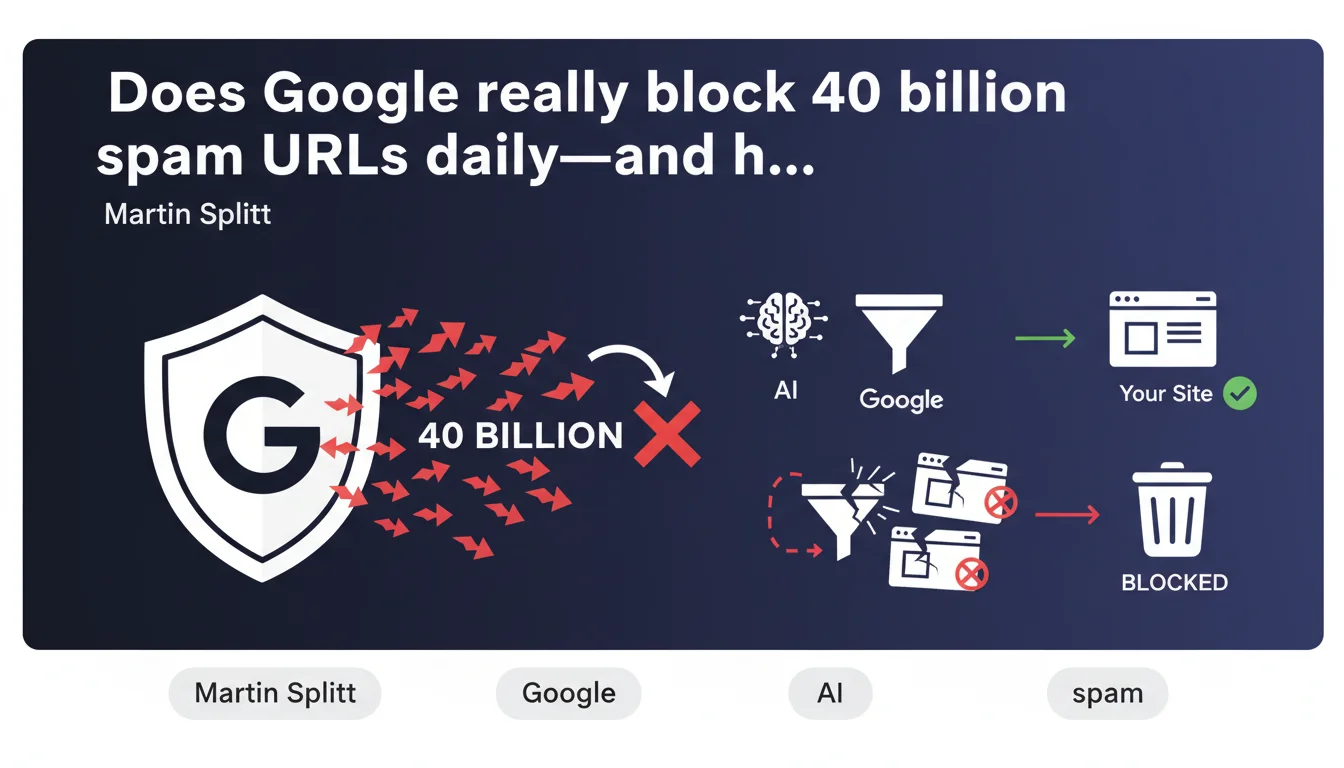
Google processes and blocks approximately 40 billion spam URLs every single day. This staggering figure illustrates the scale of web pollution and Google's massive filtering capacity. For legitimate websites, it's a stark reminder of the critical importance of never resembling spam—or risk being caught in the net.
What you need to understand
What does this colossal volume of blocked spam reveal?
40 billion URLs per day equals 463,000 URLs blocked every single second. This isn't a marketing claim—it's a reflection of an ecosystem poisoned by malicious actors, auto-generated content, and parasitic link networks.
Google invests heavily in automated systems capable of detecting and neutralizing spam before it ever reaches the index. Most of these URLs never get indexed at all—they're blocked at the crawl stage or during quality assessment.
What types of spam are targeted by these blocking mechanisms?
Google doesn't disclose the exact breakdown, but the primary vectors include: content scraping, link farms, automatically generated satellite pages, phishing sites, malicious injections in compromised domains, and increasingly, mass-produced AI-generated content with zero added value.
Poorly secured WordPress sites, expired domains repurchased for spamming, PBNs (Private Blog Networks), and negative SEO campaigns are all prime targets. Spam isn't always intentional—a hacked website can generate thousands of toxic URLs without the owner knowing.
How does Google identify spam at this massive scale?
With volumes this large, human intervention is impossible. Google relies on advanced machine learning and algorithms like SpamBrain, which can detect spam patterns with increasing precision.
Analyzed signals include: content quality, link profiles, user behavior, abnormal crawl patterns, malware presence, and massive duplicate content. Systems learn continuously from new spam vectors to adapt their filters.
- 40 billion URLs blocked daily illustrates the sheer scale of web spam
- The vast majority of spam is neutralized before indexation, at the crawl or evaluation stage
- Google uses automated systems (SpamBrain) to detect and block spam at massive scale
- Legitimate sites can be impacted if they display spam-like signals
- AI-generated content without added value is among the new priority targets
SEO Expert opinion
Is this figure consistent with on-the-ground observations?
Yes, and it probably underestimates reality. As a practitioner, you observe daily waves of spam: auto-generated sites, injections in vulnerable CMS platforms, comment farm networks. 40 billion URLs is plausible when counting all attempts, including those that never reach the index.
What's interesting is that Google publicly discloses this figure. It's a double-edged message: on one hand, it demonstrates their technical capability. On the other, it reminds legitimate SEOs that they operate in a hostile environment where even minor mistakes can make you look like spam.
What gray areas remain in this claim?
[Needs verification] Google doesn't specify what proportion of these blocks are false positives. With such volume processed automatically, it's statistically impossible that zero legitimate sites are penalized by error. Forums are filled with testimonies of sites blocked without apparent reason.
[Needs verification] Google's definition of "spam" isn't clearly articulated. Does it include low-quality AI content? Local SEO satellite pages? RSS feed aggregators? The ambiguity persists, and that's problematic for assessing your own risk level.
In what scenarios can a legitimate site get caught in the net?
Several critical scenarios: undetected hacking generating thousands of spam pages, massive unintentional duplicate content, aggressive SEO over-optimization, even light blackhat technique usage, mass AI-generated content without human editing.
Let's be honest—the boundary between aggressive optimization and spam is sometimes blurry. An e-commerce site with thousands of product variations can trigger similar signals to a content farm. That's where editorial quality and user experience become essential shields.
Practical impact and recommendations
How do you verify your site isn't emitting spam signals?
First reflex: Google Search Console. Regularly review "Coverage" and "Security & Manual Actions" reports. A sudden spike in crawled or indexed URLs can signal trouble. Also check server logs for abnormal requests.
Next, audit your backlink profile. Hundreds of links from questionable sites in a short time? That smells like negative SEO or a poorly calibrated campaign. Use link disavow if needed, but with discretion—it's not a silver bullet.
What mistakes should you avoid to not look like spam?
Don't generate mass content without added value, even with AI. Every page needs a clear purpose and should offer something unique. Avoid aggressive duplicate content, satellite pages created only to rank, interconnected site networks without editorial logic.
Technical side: no cloaking, no deceptive redirects, no hidden text. These techniques are detected instantly. And secure your installations—an unmaintained WordPress install is an open door to injected spam.
What concrete steps should you take to protect and optimize your site?
- Regularly audit your Search Console (coverage, security, manual actions)
- Monitor your server logs for abnormal crawls or injections
- Secure your CMS: updates, reliable plugins, application firewall (WAF)
- Verify your backlink profile and disavow toxic links if necessary
- Avoid mass AI-generated content production without human editing and validation
- Eliminate duplicate content and pages without added value
- Implement active monitoring of unwanted indexations (site: + filters)
- Document your editorial and SEO strategy to justify your choices if issues arise
❓ Frequently Asked Questions
Le blocage de 40 milliards d'URLs signifie-t-il que Google crawle autant de pages par jour ?
Un site légitime peut-il être bloqué par erreur dans ce processus ?
Les contenus générés par IA sont-ils comptés dans ce spam ?
Comment savoir si mon site a été piraté et génère du spam ?
Le désaveu de liens est-il toujours nécessaire face au spam de backlinks ?
🎥 From the same video 43
Other SEO insights extracted from this same Google Search Central video · published on 30/03/2026
🎥 Watch the full video on YouTube →
💬 Comments (0)
Be the first to comment.