
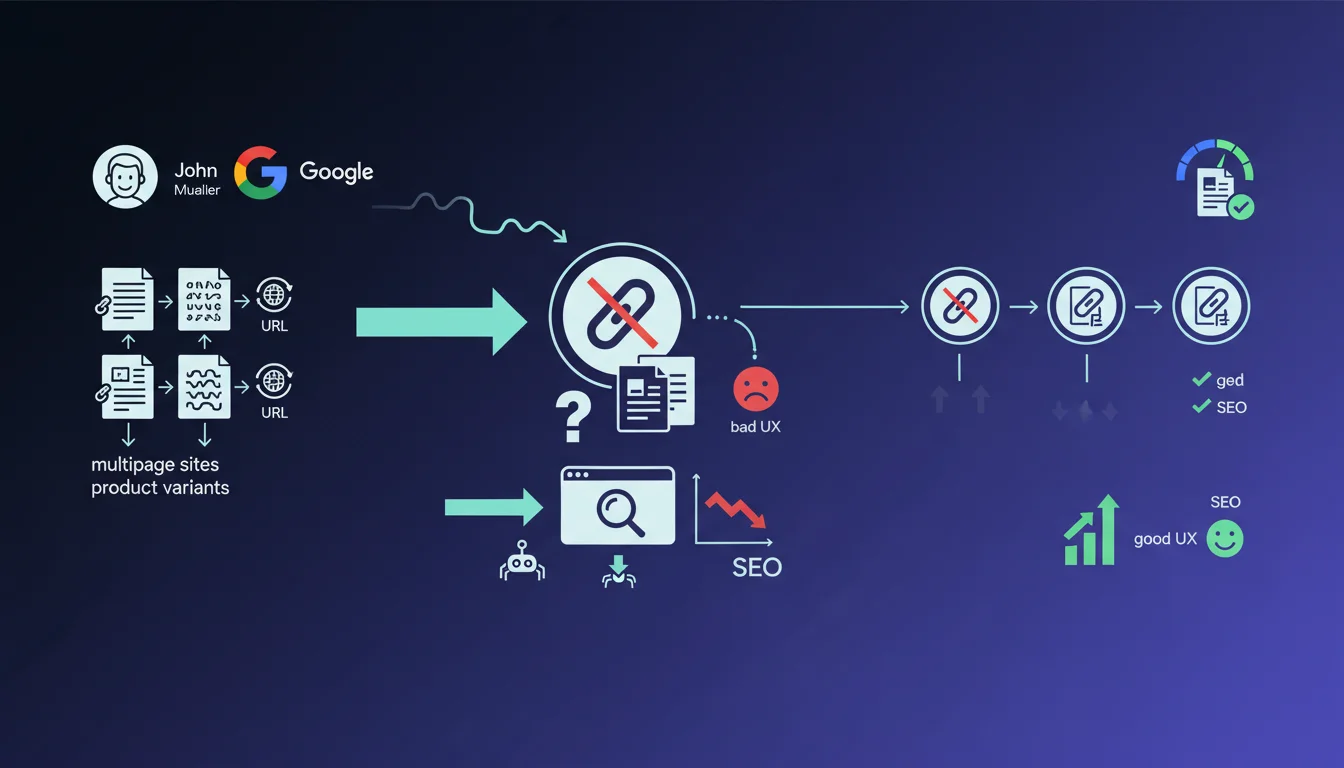
Official statement
In practice, Google's official documentation indicates that on multi-page sites, ProductGroup does not have a unique canonical URL, since variants are distributed across distinct and equivalent pages. It also clarifies that the url property is mainly useful for single-page sites, and should not be used the same way for multi-page sites.
The idea conveyed by John Mueller is that on a multi-page site, you don't choose a single variant as the "canonical version" of the group: each variant page keeps its own URL, and the markup should link these variants together via ProductGroup / hasVariant. This aligns with a logic where the URL of each Product or variant remains specific to its page, rather than forcing all variants toward a single page.
Google confirms that on a multi-page e-commerce site, each product variant should keep its own URL — not a single canonical pointing to a "parent" page. ProductGroup markup is used to link variants together, without designating a canonical version. This challenges some common URL consolidation practices.
What you need to understand
John Mueller's statement focuses on a specific case: multi-page e-commerce sites where each product variant (color, size, model) has its own URL.
In practice? Many sites redirect or canonicalize all variants toward a single "parent" page, thinking it will avoid duplication. Mueller indicates that this approach does not align with Google's logic for ProductGroup structured data.
Why does Google recommend a separate URL for each variant?
Google's official documentation specifies that ProductGroup has no unique canonical URL on multi-page sites. Each variant is considered a distinct and equivalent page, with no hierarchy between them.
The idea is to link these pages via the hasVariant markup, rather than forcing consolidation toward a single URL. This allows Google to understand the relationship between variants without diminishing their individual visibility.
What is the difference compared to single-page sites?
On a single-page site (one URL that dynamically loads variants), the url property of ProductGroup makes sense — it points to that unique page.
But on a multi-page site, each variant has its own URL, so using the url property to designate a "main page" creates confusion. Google recommends not using this property the same way in this context.
- On a multi-page site, each variant keeps its own URL
- ProductGroup markup links variants via hasVariant, without a unique canonical
- The
urlproperty is relevant mainly for single-page sites - No hierarchy between variants: they are equivalent in Google's eyes
SEO Expert opinion
Does this statement contradict observed field practices?
Let's be honest: a significant portion of e-commerce sites still consolidate variants toward a parent URL, often for crawl budget management or link equity concentration reasons.
The problem is that this practice — though widespread — can conflict with the logic of structured data recommended by Google. Mueller insists that ProductGroup does not designate a canonical page, which suggests that forcing a canonical toward a single variant risks muddying the signal sent to Google.
What nuances should be added to this recommendation?
Mueller is speaking here specifically about ProductGroup markup and structured data — not necessarily about the rel=canonical tag in the classic HTML sense. [To verify]: does Google actively penalize sites that canonicalize variants, or is it mainly a recommendation to optimize the interpretation of structured data?
Some high-volume sites — where each variant generates a distinct URL with very little content difference — may have good reasons to consolidate. In that case, the question becomes: should you prioritize classic SEO consolidation logic or the structured markup logic recommended by Google? The answer depends on context and objectives.
In what cases does this rule not apply?
If your site dynamically loads all variants on a single URL (via JavaScript, URL parameters, or selectors), this recommendation does not concern you: you are in single-page logic.
Practical impact and recommendations
What should you concretely do if you manage a multi-page site?
First step: check if your site currently uses canonical tags that redirect all variants toward a single parent page. If so, assess whether this consolidation is justified by crawl or link equity constraints, or if it can be loosened.
Next, ensure that each variant page has its own Product markup with complete structured data (price, availability, image). Link these variants via ProductGroup markup that uses hasVariant to point to each one.
What errors should be avoided in ProductGroup markup?
Do not designate a single variant as the canonical URL of the group. Avoid using the ProductGroup's url property to point toward a fictional "parent" page that doesn't actually exist.
If you have very similar variants (same product, same content, just a difference in size or color), you can consider leaving some pages on noindex while maintaining the internal markup. This allows you to preserve the structured markup logic without diluting Google's index.
How can you verify that your site complies with this recommendation?
- Audit the
rel=canonicaltags on your variant pages: do they point to themselves or to a parent page? - Verify that each variant has its own complete and unique Product markup
- Check that the ProductGroup uses
hasVariantto link variants, without a uniqueurlproperty - Test your pages with Google's Rich Results Test to detect any markup errors
- Evaluate the impact on crawl budget: if you have thousands of variants, consider a pagination or selective noindex strategy
💬 Comments (0)
Be the first to comment.