
Official statement
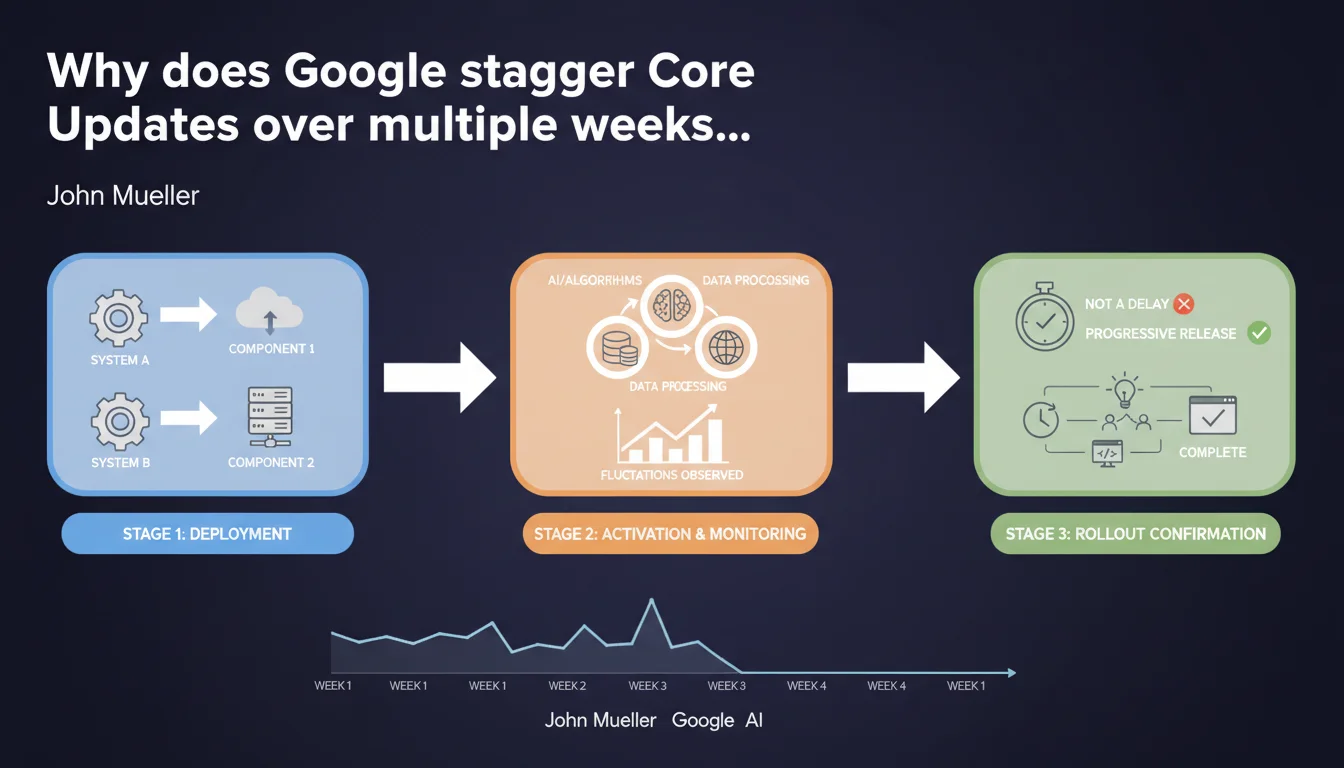
Deploying a Core Update over multiple weeks is therefore not a delay, but a consequence of how Google activates certain components before others.
Core Updates are not deployed in a single block but in successive stages because they affect multiple distinct systems and components that are activated progressively. There is no single machine for each update: the timeline depends on the teams involved and the changes being applied. The fluctuations observed over several weeks are therefore not a bug or a delay, but the normal consequence of Google's technical architecture.
What you need to understand
Why aren't Core Updates deployed instantly?
Google does not have a single button to activate a Core Update. Each major update actually affects multiple internal systems: relevance algorithms, quality filters, content processing components. These elements must be deployed sequentially to avoid overloading the infrastructure and minimize technical risks.
Mueller clarifies that there is no standardized "machine" for all Core Updates. Each rollout depends on the teams involved and the modifications being made. Some components are activated first, while others follow days or weeks later.
Are the fluctuations observed normal?
Yes. Position changes during Core Updates do not indicate a malfunction, but rather the fact that different algorithmic signals activate at staggered times. A site may rise then fall before stabilizing, because the components evaluating it are not all active simultaneously.
This mechanism explains why it is impossible to draw definitive conclusions before the official end of the rollout. What appears to be a gain or loss in the middle of the rollout may reverse once all systems are activated.
What should you take away from this statement?
- A Core Update is not a single event but a sequence of deployments spread over time
- Fluctuations over several weeks are a normal technical consequence, not a delay or a problem
- Each Core Update has its own deployment timeline depending on the systems affected
- There is no point in analyzing impacts before the official end of the rollout: intermediate data is misleading
- Google has no standardized process: each update can have a different deployment behavior
SEO Expert opinion
Does this statement change our understanding of Core Updates?
Not fundamentally — we already knew that Core Updates were spread over time. What is new is the explicit confirmation that there is no single machine for each update. This explains why some rollouts seem more chaotic than others: internal teams decide the order and pace at which components are activated.
In practice, we regularly observe sites that bounce multiple times during a Core Update. This statement validates that these movements are not statistical noise, but a reflection of different systems triggering at staggered times. A site may be evaluated by a quality filter before new relevance signals become active, creating temporary oscillations.
What nuances should be noted?
Google remains vague about the exact nature of the "systems" and "components" affected. Mueller speaks of staged deployment, but does not specify whether these stages involve specific algorithmic criteria, index segments, or query categories. [To be verified] — this opacity makes detailed analysis during rollout difficult.
Another point: saying there is no single machine for all Core Updates suggests that each update can have unpredictable behavior. This complicates comparative analysis between successive Core Updates. What looked like a pattern in the previous update may not repeat in the next one.
What should you do with data collected during deployment?
Let's be honest: most analyses published during a Core Update are premature. If components activate progressively, correlations observed mid-rollout can be completely reversed a week later. Studies identifying "winners" and "losers" on day 3 are methodologically weak.
That said, monitoring fluctuations remains useful for detecting weak signals. But you must wait for the official end of deployment before drawing conclusions or launching major adjustments. And even then, you should let several additional days pass for everything to stabilize.
Practical impact and recommendations
What should you do concretely during a Core Update?
The first rule is to avoid hasty actions. If your site loses 30% of organic traffic on day 5 of the rollout, wait for the official end before analyzing. Intermediate data is misleading: one component may be active while another that favors you is not yet.
Continue publishing quality content and improving user experience, but avoid major structural changes during deployment. You risk introducing variables that blur post-update analysis. If you must adjust something, document precisely the date and nature of the change so you can isolate it in your analysis.
What mistakes should you avoid?
Don't compare the impacts of one Core Update to another based solely on timeline. If the previous update showed massive effects by day 4, this doesn't mean the next one will have the same behavior. Each rollout has its own pace depending on the systems affected.
Another common mistake: relying on tools that announce "the Core Update is 80% complete." These estimates are based on external observations and do not necessarily reflect the true state of Google's internal deployment. Only the official announcement of rollout completion carries weight.
How should you adapt your monitoring strategy?
- Note the official start and end date of each Core Update
- Track your KPIs daily, but only analyze trends 7 days after the rollout ends
- Monitor your positions on strategic keywords, but wait for stabilization before diagnosing
- Document all modifications made to your site during and after the update
- If you experience a significant loss, identify the most affected pages to target your post-rollout analysis
- Cross-reference your data with that of competitors to distinguish industry-wide effects from domain-specific issues
Core Updates are complex events that unfold over several weeks by technical necessity, not malfunction. This timeline requires discipline: collect data during the rollout, but draw conclusions only after complete stabilization.
Given the complexity of these deployments and the opacity of activated systems, it becomes difficult to interpret observed fluctuations alone. If your site experiences significant variations or if you want to anticipate upcoming Core Updates, support from a specialized SEO agency can help you distinguish relevant signals from algorithmic noise and adjust your strategy based on the technical realities of these progressive deployments.
💬 Comments (1)