
Official statement
Other statements from this video 43 ▾
- □ Does the 15 MB Googlebot crawl limit really kill your indexation, and how can you fix it?
- □ Is Google Really Measuring Page Weight the Way You Think It Does?
- □ Has mobile page weight tripled in 10 years? Why should SEO professionals care about this trend?
- □ Is your structured data bloating your pages too much to be worth the SEO investment?
- □ Is your mobile site missing critical content that exists on desktop?
- □ Is your desktop content disappearing from Google rankings because it's missing on mobile?
- □ Does page speed really impact conversions according to Google?
- □ Is Google really processing 40 billion spam URLs every single day?
- □ Does network compression really improve your site's crawl budget?
- □ Is lazy loading really essential to optimize your initial page weight and boost Core Web Vitals?
- □ Does Googlebot really stop crawling after 15 MB per URL?
- □ Has mobile page weight really tripled in just one decade?
- □ Does page weight really affect user experience and SEO performance?
- □ Does structured data really bloat your HTML and hurt page performance?
- □ Is mobile-desktop parity really costing you search rankings more than you think?
- □ Should you still worry about page weight for SEO in 2024?
- □ Is resource size really the make-or-break factor for your website's speed?
- □ Is Google really enforcing a strict 1 MB limit on images—and what does that tell you about SEO priorities?
- □ Does optimizing page size actually benefit users more than it benefits your search rankings?
- □ Does Googlebot really cap crawling at 15 MB per URL?
- □ Is exploding web page weight hurting your SEO? Here's what you need to know
- □ Is page size really still hurting your SEO in 2024?
- □ Are structured data slowing down your pages enough to harm your SEO?
- □ Does page loading speed really impact your conversion rates?
- □ Does network compression really optimize user device storage space, or is it just a temporary fix?
- □ Is content disparity between mobile and desktop killing your rankings in mobile-first indexing?
- □ Is lazy loading really a must-have SEO performance lever you should activate systematically?
- □ Does Google really block 40 billion spam URLs daily—and how does your site avoid the filter?
- □ Can image optimization really cut your page weight by 90%?
- □ Does Googlebot really stop at 15 MB per URL?
- □ Why is mobile-desktop parity sabotaging your rankings in Mobile-First Indexing?
- □ Is your page weight really slowing down your SEO performance?
- □ Does structured data really slow down your crawl budget?
- □ Does Google really block 40 billion spam URLs every single day?
- □ Should you really cap your images at 1 MB to satisfy Google?
- □ Does Googlebot really stop crawling after 15 MB per URL?
- □ Does site speed really impact your conversion rates?
- □ Is mobile-desktop mismatch really destroying your SEO rankings right now?
- □ Do structured data markups really bloat your HTML pages?
- □ Is network compression really enough to optimize your site's crawlability?
- □ Can lazy loading really boost your performance without hurting crawlability?
- □ Does your website's overall size really hurt your SEO performance?
- □ Why does Google enforce a strict 1MB image size limit across its developer documentation?
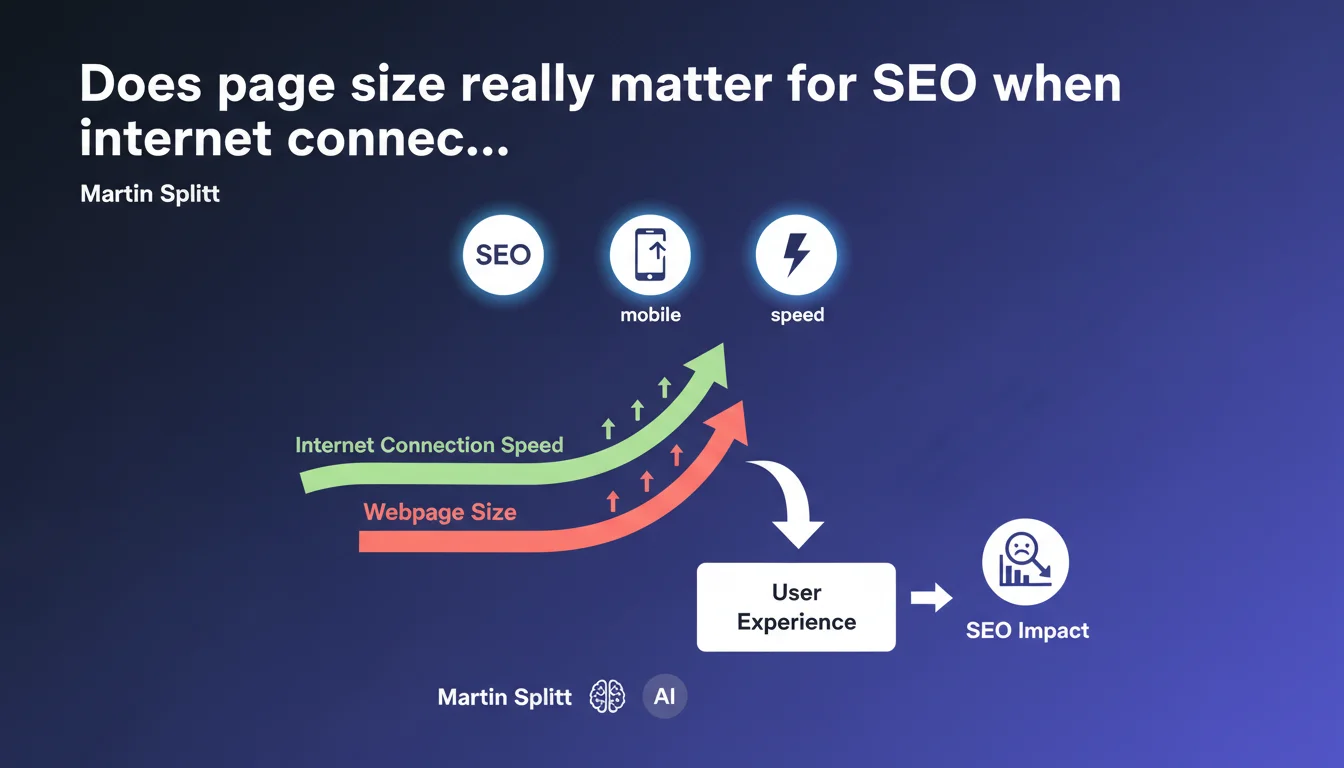
Google confirms that the increase in webpage size outpaces improvements in median mobile connection speeds. Loading velocity remains a major issue for user experience and SEO, making page weight optimization more relevant than ever.
What you need to understand
Don't faster connections automatically compensate for heavier pages?
That's the classic mistake Martin Splitt debunks here. Bandwidth increase is real, but it's not keeping pace with the exponential curve of modern webpage weight.
In concrete terms? The median webpage weighed around 500 KB in 2011. It now exceeds 2.5 MB on mobile according to HTTP Archive. Meanwhile, median mobile connection speeds haven't quintupled — nowhere near it.
What's the difference between theoretical connection speeds and real-world experience?
Operators love broadcasting their maximum speeds: 4G, 5G, fiber. But ground reality is entirely different. Latency, variable coverage areas, bandwidth sharing — all of this creates a massive gap between theoretical bandwidth and what users actually experience.
Martin Splitt talks about median speeds, not maximum speeds. That's what matters to Google: the average user's experience, not the lab tester's with a dedicated connection.
Why is Google pushing this point so hard right now?
Because the web industry has grown comfortable with a deceptive technical comfort zone. Developers often test on recent hardware with premium connections. The median user is elsewhere: mid-range smartphone, unstable 3G/4G connection, limited data allowance.
This statement reminds us that Core Web Vitals — notably LCP (Largest Contentful Paint) — are directly impacted by the total weight of resources to load.
- Median mobile page size exceeds 2.5 MB and continues to grow
- Median connection speeds progress much more slowly than page size
- The gap between theoretical bandwidth and real experience is underestimated by developers
- Core Web Vitals remain directly affected by resource weight
- Page size optimization remains an indirect ranking factor via UX
SEO Expert opinion
Does this statement really change established SEO practices?
No, and that's precisely the problem. Google has been repeating the same message for years, yet the median page weight keeps climbing. Martin Splitt's statement brings nothing new — it confirms a reality that SEO professionals already know.
What's missing here? Concrete thresholds. At how many MB do you actually lose rankings? What's the measured correlation between page weight and SERP positions? [To verify] because Google remains vague on quantifiable impacts.
Does the median connection speeds argument really hold up?
Yes and no. Splitt is right in principle: median connections progress slower than page weight. But it needs nuance by market. In Western Europe, 4G+ coverage is massive and data plans are generous. In other geographic zones, the argument is airtight.
If your audience is primarily urban French with recent hardware, the impact will be less than if you're targeting emerging markets or rural areas. Your traffic's geographic and demographic context completely changes the equation.
Isn't Google hiding other motivations behind this narrative?
Let's be honest: lighter pages also mean less bandwidth consumed by Googlebot. Fewer server resources to crawl, less data to process for indexing. What Google presents as UX advice also has a direct economic advantage for them.
That said, the argument remains valid. The fact that it also serves Google's interests doesn't make it false — just less altruistic than it appears.
Practical impact and recommendations
What are the priority actions to reduce your page weight?
Start with a real weight audit: use WebPageTest or PageSpeed Insights under real mobile conditions (3G throttling). Don't rely on your local tests with fiber. Identify the heaviest resources — usually unoptimized images and redundant JavaScript.
The quick wins are always the same but underutilized: modern image formats (WebP, AVIF), Brotli compression server-side, aggressive CSS/JS minification. These optimizations can cut your weight in half without touching visible content.
How do you verify real impact on your Core Web Vitals?
Don't settle for PageSpeed Insights — lab data doesn't reflect on-the-ground experience. Google Search Console > Page Experience shows you real user metrics via CrUX (Chrome User Experience Report).
Compare your heavy pages vs light pages: if your median LCP exceeds 2.5 seconds on mobile, weight is probably the culprit. Correlate this data with your SERP positions — some ultra-competitive sectors show clear correlations.
What mistakes should you avoid in weight optimization?
Never sacrifice useful content to save a few KB. A complete article with relevant visuals weighing 1.5 MB will always beat a skeletal page of 300 KB with no added value. Weight optimization serves UX, it doesn't replace it.
Also be wary of overly aggressive automatic optimization tools that break layout or degrade visual quality beyond reason. Always test visually after optimization.
- Audit real page weight under mobile conditions (3G throttling)
- Convert all images to modern formats (WebP minimum, AVIF if possible)
- Enable Brotli compression server-side for HTML/CSS/JS
- Implement lazy loading on images and iframes outside initial viewport
- Minify and bundle JavaScript to reduce request count
- Use a CDN to bring static resources closer to users
- Monitor real Core Web Vitals via Search Console, not just lab tests
- Eliminate unused web fonts and preload critical fonts
- Regularly audit and clean up accumulated third-party plugins/scripts
Page weight optimization remains a differentiating SEO lever, especially on mobile where the majority of searches now happen. But between in-depth technical audits, implementing modern formats, reworking loading architecture, and continuous Core Web Vitals monitoring, these optimizations require specialized technical expertise and significant time investment.
If your internal team lacks resources or specific technical skills in these areas, support from a specialized SEO agency can significantly accelerate performance gains. A professional audit quickly identifies critical bottlenecks and prioritizes projects based on actual impact to your organic traffic.
❓ Frequently Asked Questions
Le poids d'une page influence-t-il directement le classement dans Google ?
Quel est le poids maximum acceptable pour une page web en mobile ?
Les pages lourdes sont-elles moins bien crawlées par Googlebot ?
La compression d'images suffit-elle à résoudre les problèmes de poids ?
Faut-il privilégier les formats WebP ou AVIF pour les images ?
🎥 From the same video 43
Other SEO insights extracted from this same Google Search Central video · published on 30/03/2026
🎥 Watch the full video on YouTube →
💬 Comments (0)
Be the first to comment.