
Official statement
Other statements from this video 43 ▾
- □ Does the 15 MB Googlebot crawl limit really kill your indexation, and how can you fix it?
- □ Is Google Really Measuring Page Weight the Way You Think It Does?
- □ Has mobile page weight tripled in 10 years? Why should SEO professionals care about this trend?
- □ Is your structured data bloating your pages too much to be worth the SEO investment?
- □ Is your desktop content disappearing from Google rankings because it's missing on mobile?
- □ Does page speed really impact conversions according to Google?
- □ Is Google really processing 40 billion spam URLs every single day?
- □ Does network compression really improve your site's crawl budget?
- □ Is lazy loading really essential to optimize your initial page weight and boost Core Web Vitals?
- □ Does Googlebot really stop crawling after 15 MB per URL?
- □ Has mobile page weight really tripled in just one decade?
- □ Does page weight really affect user experience and SEO performance?
- □ Does structured data really bloat your HTML and hurt page performance?
- □ Is mobile-desktop parity really costing you search rankings more than you think?
- □ Should you still worry about page weight for SEO in 2024?
- □ Is resource size really the make-or-break factor for your website's speed?
- □ Is Google really enforcing a strict 1 MB limit on images—and what does that tell you about SEO priorities?
- □ Does optimizing page size actually benefit users more than it benefits your search rankings?
- □ Does Googlebot really cap crawling at 15 MB per URL?
- □ Is exploding web page weight hurting your SEO? Here's what you need to know
- □ Is page size really still hurting your SEO in 2024?
- □ Are structured data slowing down your pages enough to harm your SEO?
- □ Does page loading speed really impact your conversion rates?
- □ Does network compression really optimize user device storage space, or is it just a temporary fix?
- □ Is content disparity between mobile and desktop killing your rankings in mobile-first indexing?
- □ Is lazy loading really a must-have SEO performance lever you should activate systematically?
- □ Does Google really block 40 billion spam URLs daily—and how does your site avoid the filter?
- □ Can image optimization really cut your page weight by 90%?
- □ Does Googlebot really stop at 15 MB per URL?
- □ Why is mobile-desktop parity sabotaging your rankings in Mobile-First Indexing?
- □ Is your page weight really slowing down your SEO performance?
- □ Does structured data really slow down your crawl budget?
- □ Does Google really block 40 billion spam URLs every single day?
- □ Should you really cap your images at 1 MB to satisfy Google?
- □ Does Googlebot really stop crawling after 15 MB per URL?
- □ Does site speed really impact your conversion rates?
- □ Is mobile-desktop mismatch really destroying your SEO rankings right now?
- □ Do structured data markups really bloat your HTML pages?
- □ Does page size really matter for SEO when internet connections keep getting faster?
- □ Is network compression really enough to optimize your site's crawlability?
- □ Can lazy loading really boost your performance without hurting crawlability?
- □ Does your website's overall size really hurt your SEO performance?
- □ Why does Google enforce a strict 1MB image size limit across its developer documentation?
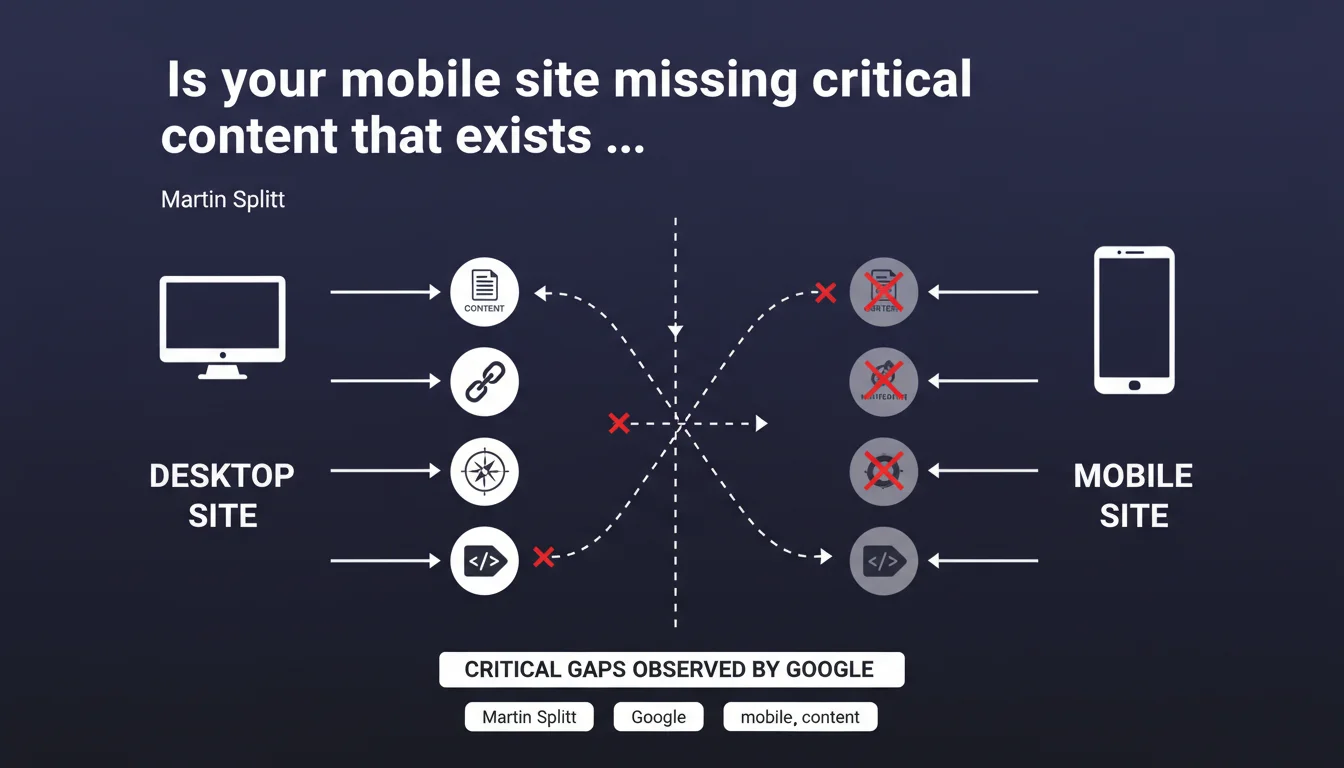
Google has found that many websites display major gaps between their mobile and desktop versions: truncated content, missing links, absent metadata. With mobile-first indexing, it's the mobile version that determines your rankings — and these disparities directly penalize your search positions.
What you need to understand
Why does Google place such emphasis on mobile-desktop parity?
Since the widespread shift to mobile-first indexing, Google crawls and prioritizes indexing the mobile version of your pages. If this version is diminished compared to desktop, it's that version — with all its shortcomings — that will serve as the reference for ranking.
Martin Splitt emphasizes that Google's teams have identified recurring patterns: text content shortened on mobile, navigation oversimplified, canonical or hreflang metadata missing, incomplete structured data. These gaps aren't trivial — they result in a loss of context for the algorithm.
What types of gaps are most frequently observed?
Missing content tops the list: deleted paragraphs, removed images, entire sections hidden under poorly implemented accordions. Next come missing links, particularly those pointing to deep pages or secondary categories, which weakens internal linking.
Metadata and <link> tags are also affected: incorrect canonical tags, missing hreflang, reduced structured data. Result: Google struggles to understand your site structure and properly associate language or regional versions.
Does this issue only affect sites with separate URLs?
No, but it's exacerbated in that case. Sites with distinct URLs (m.example.com vs www.example.com) often show more pronounced discrepancies because teams develop two versions in parallel.
Responsive sites aren't immune either: content can be hidden via CSS or JavaScript, structured data conditioned by screen size, menus truncated. Google sees what the mobile Googlebot sees — and if it's an impoverished version, the consequences are identical.
- Mobile-first indexing means the mobile version is authoritative for ranking
- Frequent gaps include: truncated content, missing links, absent metadata
- Sites with separate URLs are more exposed, but responsive sites aren't exempt
- Hiding content via CSS or JavaScript is equivalent to removing it in Google's eyes
- Structured data must be identical on mobile and desktop
SEO Expert opinion
Is this statement consistent with on-the-ground practices?
Absolutely. For years, traffic drops have been directly correlated with mobile-first migration on sites with disparities. Audits consistently reveal the same patterns: hidden content, navigation simplified to the point of cutting off access to entire sections of the site, incomplete metadata.
What's still surprising is how frequently these errors appear on major websites. The idea that "we simplify for mobile" remains entrenched, while simplifying doesn't mean impoverishing. Google has never asked to remove content — only to make it accessible and readable.
What nuances should be applied to this recommendation?
Google doesn't say that everything must be strictly identical. Some elements can legitimately vary: adapted layout, resized images, restructured menus for touch navigation. The substance should remain; the form can adapt.
Where it falls apart is when you delete paragraphs under the pretense that they'd be "too long on mobile," or hide internal links deemed "secondary." If an element matters for desktop ranking, it matters for mobile. [To be verified]: Google has never provided a precise threshold for what constitutes an "acceptable gap" — it's case by case.
In what cases does this rule reach its limits?
On some high-volume data sites — comparison tools, directories, marketplaces — displaying 100% of desktop content on mobile can pose performance problems. Degraded Core Web Vitals, exploding load times, catastrophic user experience.
The dilemma is real: preserve content parity or optimize speed? The solution often involves intelligent lazy loading, progressively loaded content, well-implemented accordions (content in the DOM, not loaded via AJAX). But be careful — if Google can't access the content without user interaction, you lose out.
Practical impact and recommendations
What should you prioritize checking on your site?
Start by comparing your strategic pages in mobile and desktop mode. Use the URL inspection tool in Search Console to see what the mobile Googlebot actually retrieves. Compare it with desktop rendering: HTML source, structured data, metadata, internal linking.
Then verify that canonical tags, hreflang, and alternate media are consistent. On a site with separate URLs, the mobile version should point to itself with canonical, and indicate the desktop version via <link rel="alternate" media="only screen and (min-width: 640px)">.
What concrete mistakes must you absolutely avoid?
Never remove text content on mobile under the pretense of lightening the load. If a paragraph provides SEO value, it should appear on both versions. Same logic for internal links: if a page is important, it should be accessible from mobile navigation.
Avoid poorly implemented accordions or tabs that load content via AJAX on click. Google may not trigger these interactions, so content remains invisible. If you must use these patterns, ensure content is present in the initial DOM, simply hidden by CSS.
Don't forget structured data: they must be identical on mobile and desktop. An FAQ present only on desktop won't be taken into account in mobile-first mode.
How do you bring a site with gaps into compliance?
- Audit strategic pages with the URL inspection tool (Search Console)
- Compare mobile vs desktop HTML source, identify missing content
- Verify presence and consistency of metadata (canonical, hreflang, alternate)
- Ensure structured data is identical across both versions
- Test internal linking: key links must be accessible on mobile
- Validate that hidden content (accordions, tabs) is present in initial DOM
- Monitor Core Web Vitals to ensure content parity doesn't degrade performance
- Re-test after fixes using the mobile optimization test tool
❓ Frequently Asked Questions
Un site responsive est-il automatiquement conforme à l'indexation mobile-first ?
Google pénalise-t-il les sites avec URLs mobiles et desktop séparées ?
Le contenu dans des accordéons fermés par défaut est-il indexé ?
Dois-je dupliquer les structured data sur mobile et desktop ?
Comment vérifier ce que Googlebot mobile voit réellement ?
🎥 From the same video 43
Other SEO insights extracted from this same Google Search Central video · published on 30/03/2026
🎥 Watch the full video on YouTube →
💬 Comments (0)
Be the first to comment.