
Official statement
Other statements from this video 43 ▾
- □ Does the 15 MB Googlebot crawl limit really kill your indexation, and how can you fix it?
- □ Is Google Really Measuring Page Weight the Way You Think It Does?
- □ Has mobile page weight tripled in 10 years? Why should SEO professionals care about this trend?
- □ Is your structured data bloating your pages too much to be worth the SEO investment?
- □ Is your mobile site missing critical content that exists on desktop?
- □ Is your desktop content disappearing from Google rankings because it's missing on mobile?
- □ Does page speed really impact conversions according to Google?
- □ Is Google really processing 40 billion spam URLs every single day?
- □ Does network compression really improve your site's crawl budget?
- □ Is lazy loading really essential to optimize your initial page weight and boost Core Web Vitals?
- □ Does Googlebot really stop crawling after 15 MB per URL?
- □ Does page weight really affect user experience and SEO performance?
- □ Does structured data really bloat your HTML and hurt page performance?
- □ Is mobile-desktop parity really costing you search rankings more than you think?
- □ Should you still worry about page weight for SEO in 2024?
- □ Is resource size really the make-or-break factor for your website's speed?
- □ Is Google really enforcing a strict 1 MB limit on images—and what does that tell you about SEO priorities?
- □ Does optimizing page size actually benefit users more than it benefits your search rankings?
- □ Does Googlebot really cap crawling at 15 MB per URL?
- □ Is exploding web page weight hurting your SEO? Here's what you need to know
- □ Is page size really still hurting your SEO in 2024?
- □ Are structured data slowing down your pages enough to harm your SEO?
- □ Does page loading speed really impact your conversion rates?
- □ Does network compression really optimize user device storage space, or is it just a temporary fix?
- □ Is content disparity between mobile and desktop killing your rankings in mobile-first indexing?
- □ Is lazy loading really a must-have SEO performance lever you should activate systematically?
- □ Does Google really block 40 billion spam URLs daily—and how does your site avoid the filter?
- □ Can image optimization really cut your page weight by 90%?
- □ Does Googlebot really stop at 15 MB per URL?
- □ Why is mobile-desktop parity sabotaging your rankings in Mobile-First Indexing?
- □ Is your page weight really slowing down your SEO performance?
- □ Does structured data really slow down your crawl budget?
- □ Does Google really block 40 billion spam URLs every single day?
- □ Should you really cap your images at 1 MB to satisfy Google?
- □ Does Googlebot really stop crawling after 15 MB per URL?
- □ Does site speed really impact your conversion rates?
- □ Is mobile-desktop mismatch really destroying your SEO rankings right now?
- □ Do structured data markups really bloat your HTML pages?
- □ Does page size really matter for SEO when internet connections keep getting faster?
- □ Is network compression really enough to optimize your site's crawlability?
- □ Can lazy loading really boost your performance without hurting crawlability?
- □ Does your website's overall size really hurt your SEO performance?
- □ Why does Google enforce a strict 1MB image size limit across its developer documentation?
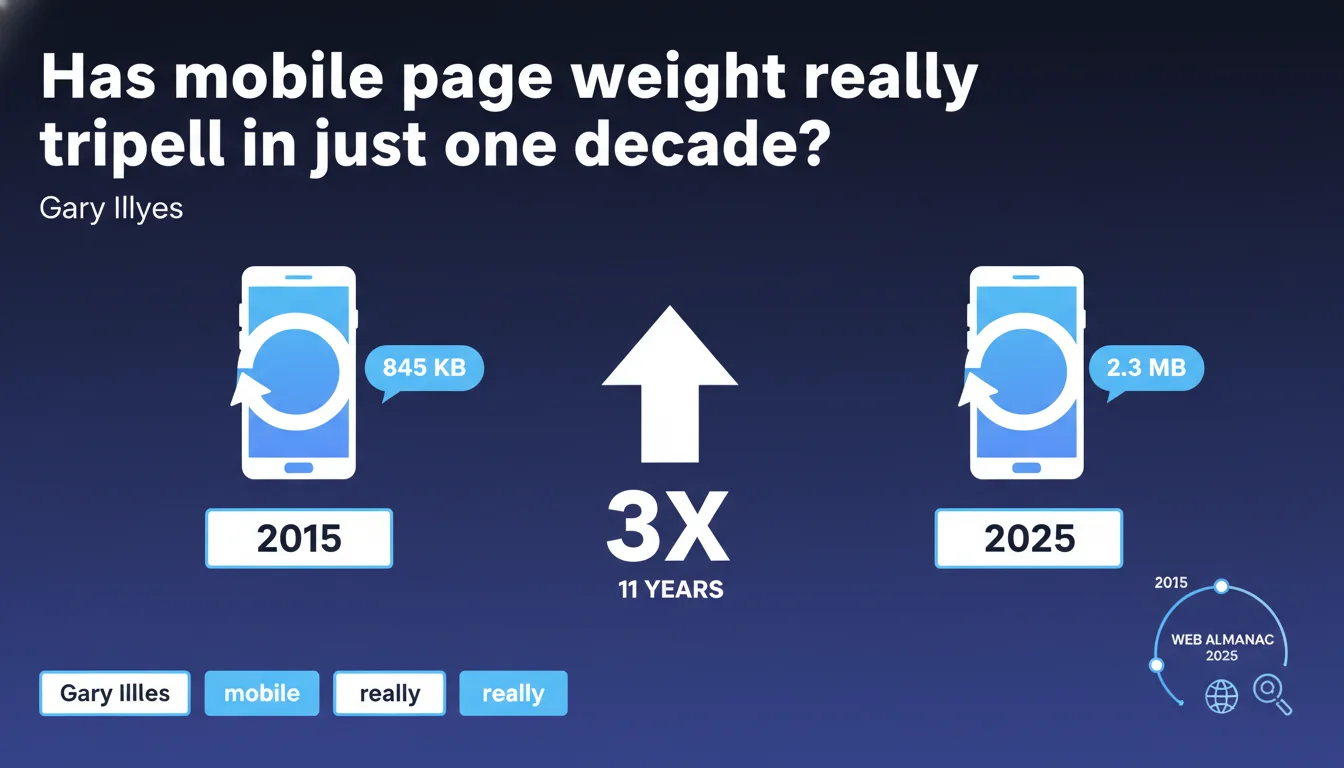
The median weight of mobile homepage pages has jumped from 845 KB to 2.3 MB in 11 years, a three-fold increase. This massive inflation directly impacts loading speed and Core Web Vitals. For SEO practitioners, it's a wake-up call: optimizing page weight is no longer optional—it's a survival requirement in the SERPs.
What you need to understand
Where does this explosion in page weight come from?
The Web Almanac reveals a heavy trend: the median weight of mobile pages has tripled over 11 years. Several factors explain this drift: proliferation of JavaScript frameworks, unoptimized high-resolution images, multiplication of third-party scripts (analytics, advertising, chatbots), and unminified CSS/JS.
This inflation is not harmless. It translates into degraded loading times, especially on slow networks (3G, unstable 4G). Yet, Google has clearly indexed speed as a ranking factor through Core Web Vitals since mid-2021.
What does a median weight of 2.3 MB concretely mean?
Concretely, 2.3 MB represents approximately 80 HTTP requests on average. On a 3G connection (around 1.6 Mbps), this gives a theoretical download time of ~11 seconds—not counting parsing and rendering. The median also masks extreme situations: some sites exceed 5-6 MB.
For an SEO practitioner, this poses a direct problem: the LCP (Largest Contentful Paint) explodes. If your hero image weighs 800 KB and arrives after 2 MB of JS, you're out of bounds. The "good" LCP threshold is 2.5 seconds—difficult to achieve with such ballast.
Why is Gary Illyes making this statement now?
Gary Illyes isn't throwing out this figure by accident. Google is observing a widespread degradation of performance in its index. By pointing out this inflation, he's sending a clear message: SEOs and developers must regain control of page weight.
This statement is part of Google's ongoing discourse on user experience. After introducing Core Web Vitals, the search engine is reminding us that technical optimization remains a prerequisite—not a cherry on top of the cake.
- The median weight has tripled: from 845 KB to 2.3 MB in 11 years
- JavaScript and images are the main culprits behind this inflation
- Direct impact on Core Web Vitals, particularly LCP and FID
- Mobile sites are hit hardest: slow networks + high weight = UX disaster
- Google reiterates that speed remains a ranking criterion
SEO Expert opinion
Is this statement consistent with what we observe in the field?
Yes, absolutely. The audits I conduct systematically show pages that easily exceed 3-4 MB, especially on e-commerce and media sites. The problem is that many clients don't even measure their page weight—they discover the figure during the initial audit.
What strikes me is that this inflation is often invisible on desktop. With fiber connections and powerful machines, internal teams don't feel the pain. But as soon as you test on a real mobile device, on throttled 4G, reality hits: 8-10 seconds to display the main content.
What nuances should we add to this finding?
Gary Illyes is talking about the median, not the average. This means that 50% of sites are above 2.3 MB. But be careful: some very well-optimized sites stay under 1 MB, even with rich content. The problem is therefore not a technical inevitability—it's a matter of discipline and priorities.
Another nuance: raw weight doesn't tell the whole story. A site weighing 2.3 MB with intelligent lazy loading, code-splitting, and HTTP/2 can load faster than a poorly structured 1.5 MB site. Weight is an indicator, not automatic condemnation. [To verify]: Gary Illyes doesn't specify whether Google weighs the raw weight or takes into account deferred loading strategies in its assessment of Core Web Vitals.
In what cases does this rule not apply strictly?
If you operate a site as a PWA (Progressive Web App) with a properly configured service worker, initial weight matters less: caching does the job for subsequent visits. Same for sites with high repeat traffic (SaaS, business tools) where the user only sees the weight once.
But let's be honest: for a typical content site (blog, e-commerce, media), the first visit counts enormously. Google crawls like a new user—without cache. If your LCP explodes on the first load, you lose in ranking. The rule therefore applies to 90% of cases.
Practical impact and recommendations
What should you concretely do to reduce page weight?
First priority: complete technical audit. Use WebPageTest, Lighthouse, and PageSpeed Insights to identify heavy resources. Next, scrutinize images, JavaScript, and CSS. Images often represent 50-70% of weight—compress them systematically.
For images, adopt modern formats (WebP, AVIF) with fallback. Implement native lazy loading (loading="lazy") for everything that isn't above-the-fold. On the JS/CSS side, minify, compress (Gzip/Brotli), and strip out everything that isn't critical.
What mistakes must you absolutely avoid?
Don't load 15 third-party scripts without auditing them. Every tracking pixel, every chatbot, every social widget adds 100-300 KB. Many of these scripts are unused or redundant. Triage: keep what truly serves your goals, defer or cut the rest.
Another pitfall: unoptimized web fonts. Loading 6 variants of a Google Font in WOFF2 can weigh 400 KB. Limit yourself to 2-3 weights maximum, use font-display: swap, and host locally if possible.
How do you verify that your site complies with best practices?
Test your site under multiple network conditions (3G slow, 4G, fiber) via Chrome DevTools. Total weight should ideally stay under 1.5 MB for mobile. If you exceed 2 MB, it's a red flag: dig into every resource over 100 KB.
Establish a performance budget in your CI/CD. Tools like Lighthouse CI or SpeedCurve can block a deployment if weight or LCP degrades. Automating monitoring prevents silent regressions.
- Audit page weight with WebPageTest and Lighthouse
- Compress all images (WebP/AVIF + lazy loading)
- Minify and compress JS/CSS (Gzip/Brotli)
- Triage third-party scripts: keep essentials, defer or remove extras
- Optimize web fonts: 2-3 variants max,
font-display: swap - Test on slow connections (3G slow) to detect regressions
- Implement automated performance budgeting in CI/CD
Reducing page weight is no longer a luxury—it's a sine qua non condition for maintaining good rankings. Core Web Vitals penalize heavy sites, especially on mobile. A rigorous audit followed by targeted optimizations (images, JS, CSS, third-party scripts) allows you to get back under 1.5 MB and gain several seconds on LCP.
These optimizations require sharp technical expertise and close coordination between SEO, developers, and marketing teams. If this complexity seems insurmountable or if you lack internal resources, partnering with a specialized SEO agency can significantly accelerate the process and guarantee measurable results without monopolizing your teams for months.
❓ Frequently Asked Questions
Le poids de la page impacte-t-il directement le classement Google ?
Un site de 2,3 Mo peut-il quand même bien ranker ?
Faut-il privilégier le poids ou la qualité du contenu ?
Les formats d'image modernes (WebP, AVIF) font-ils vraiment la différence ?
Comment convaincre la direction d'investir dans l'optimisation du poids ?
🎥 From the same video 43
Other SEO insights extracted from this same Google Search Central video · published on 30/03/2026
🎥 Watch the full video on YouTube →
💬 Comments (0)
Be the first to comment.