
Official statement
Other statements from this video 43 ▾
- □ Pourquoi Googlebot s'arrête-t-il à 15 Mo par URL et comment cela impacte-t-il votre crawl ?
- □ Google mesure-t-il vraiment le poids de page comme vous le pensez ?
- □ Le poids des pages mobiles a triplé en 10 ans : faut-il s'inquiéter pour le SEO ?
- □ Les données structurées alourdissent-elles trop vos pages pour être rentables en SEO ?
- □ Votre site mobile contient-il autant de contenu que votre version desktop ?
- □ Pourquoi votre contenu desktop disparaît-il des résultats Google s'il manque sur mobile ?
- □ La vitesse de page impacte-t-elle réellement les conversions selon Google ?
- □ Google traite-t-il vraiment 40 milliards d'URLs de spam par jour ?
- □ La compression réseau améliore-t-elle réellement le crawl budget de votre site ?
- □ Le lazy loading est-il vraiment indispensable pour optimiser le poids initial de vos pages ?
- □ Googlebot s'arrête-t-il vraiment après 15 Mo par URL ?
- □ Pourquoi le poids des pages mobiles a-t-il triplé en une décennie ?
- □ Le poids des pages impacte-t-il vraiment l'expérience utilisateur et le SEO ?
- □ Les données structurées alourdissent-elles vraiment vos pages HTML ?
- □ Pourquoi la parité mobile-desktop reste-t-elle un facteur de déclassement majeur ?
- □ Faut-il encore se préoccuper du poids des pages pour le SEO ?
- □ La taille des ressources est-elle le facteur déterminant de la vitesse de votre site ?
- □ Pourquoi Google impose-t-il une limite stricte de 1 Mo pour les images ?
- □ L'optimisation de la taille des pages profite-t-elle vraiment plus aux utilisateurs qu'au SEO ?
- □ Googlebot limite-t-il vraiment le crawl à 15 Mo par URL ?
- □ Le poids des pages web explose : faut-il s'inquiéter pour son SEO ?
- □ La taille des pages web nuit-elle encore vraiment à votre SEO ?
- □ Les structured data alourdissent-elles vos pages au point de nuire au SEO ?
- □ La vitesse de chargement influence-t-elle vraiment les conversions de vos pages ?
- □ La compression réseau suffit-elle à optimiser l'espace de stockage des utilisateurs ?
- □ Pourquoi la disparité mobile/desktop tue-t-elle votre référencement en indexation mobile-first ?
- □ Le lazy loading est-il vraiment un levier de performance SEO à activer systématiquement ?
- □ Google bloque 40 milliards d'URLs de spam par jour : comment votre site échappe-t-il au filtre ?
- □ Googlebot s'arrête-t-il vraiment à 15 Mo par URL ?
- □ Pourquoi la parité mobile-desktop impacte-t-elle autant votre classement en Mobile-First Indexing ?
- □ Le poids de vos pages freine-t-il vraiment votre référencement ?
- □ Les données structurées ralentissent-elles vraiment votre crawl ?
- □ Google intercepte vraiment 40 milliards d'URLs de spam par jour ?
- □ Faut-il limiter vos images à 1 Mo pour plaire à Google ?
- □ Googlebot s'arrête-t-il vraiment à 15 Mo par URL crawlée ?
- □ La vitesse d'un site impacte-t-elle vraiment la conversion ?
- □ Pourquoi la disparité mobile-desktop ruine-t-elle encore tant de classements SEO ?
- □ Les données structurées alourdissent-elles vraiment vos pages HTML ?
- □ Pourquoi la taille des pages reste-t-elle un facteur SEO critique malgré l'amélioration des connexions Internet ?
- □ La compression réseau suffit-elle à optimiser le crawl de votre site ?
- □ Le lazy loading peut-il vraiment booster vos performances sans impacter le crawl ?
- □ La taille d'un site web a-t-elle vraiment un impact sur son référencement ?
- □ Pourquoi Google limite-t-il la taille des images à 1Mo sur sa documentation développeur ?
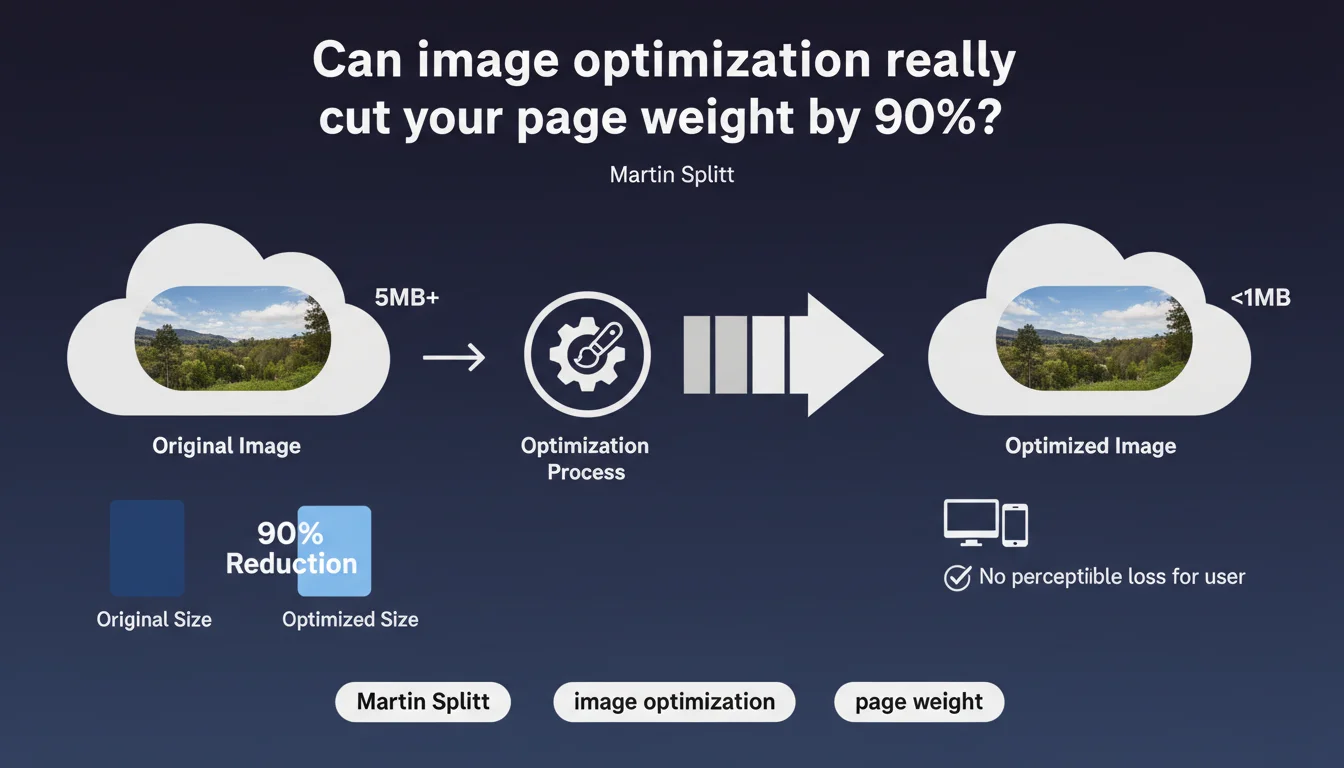
Google confirms that a properly compressed image maintains its visual quality while drastically reducing its weight — from several megabytes to under 1 MB. For SEO practitioners, this is a direct lever on Core Web Vitals and mobile experience. The message is clear: neglecting image optimization is sabotaging your performance for no valid reason.
What you need to understand
Why does Google insist so much on image optimization?
Because images represent the majority of web page weight. Martin Splitt reminds us: appropriate compression can reduce an image from several megabytes to less than one, with no perceptible degradation on screen. For Google, this is a major irritant — slow sites consume bandwidth, penalize mobile experience, and slow down crawling.
The search engine has long valued Core Web Vitals, and Largest Contentful Paint (LCP) is often degraded by unoptimized images. Reducing the weight of visual resources mechanically improves this score, thus organic visibility.
What does "appropriately compressed" mean?
Google doesn't give a magic number — and that's intentional. Compression depends on format, context, and visual content. A photo with subtle gradients tolerates less aggression than a vector illustration or flat design icon.
Concretely, "appropriate" means: no perceptible loss for the end user on a standard screen. No visible pixelation, no unsightly artifacts. The cursor sits between perceived quality and actual performance — and that's where errors multiply in the field.
What are the real gains for an SEO site?
Reducing image weight directly impacts three dimensions: loading speed, mobile experience, crawl budget. On mobile, a site that goes from 5 MB to 800 KB drastically reduces its Time to Interactive and LCP. On category pages in e-commerce with 50+ products, the effect is immediate.
On the crawl side, a lighter site = more pages crawled per Googlebot session. For large inventories, this is a non-negligible lever. Less obvious but equally strategic: the impact on bounce rate and engagement, indirect ranking factors.
- Improved LCP: heavy images are often the first visible element, thus the main brake on Largest Contentful Paint.
- Saved bandwidth: for mobile users on unstable 4G, but also for your server and CDN.
- Optimized crawl budget: Googlebot crawls more pages in less time if each resource is lightened.
- Indirect conversion rate: a page that loads quickly converts better — Google knows it, and factors it in.
SEO Expert opinion
Is this statement consistent with field observations?
Yes, without ambiguity. Audits show that 70 to 80% of sites don't compress their images correctly. JPEGs served at 100% quality, PNGs used for photos, desktop images served as-is on mobile — the errors are massive and systemic. Martin Splitt is hammering on an open door, but it's justified: the problem persists.
Where it gets tricky is that Google remains deliberately vague on thresholds. "Several megabytes to less than one" — okay, but for what resolution? What format? What JPEG quality? No precise figures. It's frustrating for a practitioner looking for an actionable reference. [To verify]: Google publishes no recommended format/compression/resolution matrix.
What nuances should be added?
First, "visually identical" is subjective. On a Retina screen in bright sunlight, JPEG Q75 compression may go unnoticed. On a 4K screen in a controlled environment, artifacts become visible. The perception threshold varies by device, context, and visual content itself.
Next, not all formats are equal. WebP and AVIF offer better compression/quality ratios than JPEG — but Google doesn't mention them here. That's a notable omission. The practitioner must find this info elsewhere. Splitt talks about "appropriate compression," but doesn't guide on which technologies to prioritize in 2025.
In what cases does this rule not apply?
Rarely. But certain contexts impose trade-offs. For an art or professional photography site, visual quality takes absolute priority — overly aggressive compression would destroy the value proposition. Same for graphic designer portfolio sites, where every pixel counts.
Another case: images serving as proof or technical documentation. Blueprints, annotated diagrams, screenshots with text — lossy compression can render critical details unreadable. There, you must intelligently balance weight and readability. But let's be honest: these exceptions concern 5% of sites. For 95% of the web, this rule applies without reservation.
Practical impact and recommendations
What should you do concretely?
First step: audit your existing setup. PageSpeed Insights, Lighthouse, WebPageTest — these tools identify unoptimized images and their optimization potential. Look for JPGs > 200 KB, PNGs used for photos, images served in desktop resolution on mobile. That's where quick wins are.
Next, define a compression strategy by content type. E-commerce product photos tolerate JPEG Q75-80 without issue. Flat design illustrations work better in WebP or optimized PNG. Simple icons and logos should be SVG — vector format, trivial weight. Don't settle for mass compression: segment.
- Identify images > 200 KB via Lighthouse audit or Screaming Frog.
- Test multiple compression levels (Q70, Q75, Q80 for JPEG) and compare visually.
- Adopt WebP with JPEG fallback to maximize compatibility.
- Implement native lazy loading on all images outside the initial viewport.
- Use
srcsetandsizesattributes to serve the resolution adapted to each device. - Automate compression via a CI/CD workflow or reliable CMS plugin.
What errors should you avoid?
Compressing blindly without visual validation. That's the most common mistake. An automated tool can butcher an image with subtle gradients or fine text. Always manually check a representative sample before global deployment.
Another trap: neglecting modern formats. Limiting yourself to JPEG in 2025 is leaving 30 to 40% of gain on the table. WebP is supported by 95% of browsers, AVIF is gaining ground. Ignoring these formats is a counterproductive choice. Yet hundreds of sites still serve only legacy JPEG/PNG.
How do you verify your site is compliant?
Run a full crawl with Screaming Frog or Sitebulb, filtering images > 150 KB. Cross-reference with PageSpeed Insights data to identify critical images — those impacting LCP. Prioritize optimizing these resources first.
Then test on WebPageTest in mobile 3G conditions. That's the most revealing scenario: if your page loads in under 3 seconds with optimized images, you're in the clear. Beyond that, dig deeper. Finally, validate visually across multiple devices — smartphone, tablet, desktop — to ensure no perceptible degradation.
Optimizing images is an SEO lever with strong ROI — but implementation demands rigor and method. Between format selection, compression thresholds, responsive implementation, and automation, variables multiply. If your team lacks time or technical expertise, it may be wise to entrust this project to a specialized SEO agency. External eyes and a proven methodology often accelerate performance gains — and avoid costly mistakes.
❓ Frequently Asked Questions
Quel niveau de compression JPEG Google recommande-t-il ?
WebP est-il obligatoire pour bien se classer ?
Les images non optimisées peuvent-elles pénaliser directement mon ranking ?
Faut-il optimiser toutes les images ou seulement celles above-the-fold ?
Un CDN suffit-il à compenser des images lourdes ?
🎥 From the same video 43
Other SEO insights extracted from this same Google Search Central video · published on 30/03/2026
🎥 Watch the full video on YouTube →
💬 Comments (0)
Be the first to comment.