
Official statement
Other statements from this video 43 ▾
- □ Pourquoi Googlebot s'arrête-t-il à 15 Mo par URL et comment cela impacte-t-il votre crawl ?
- □ Google mesure-t-il vraiment le poids de page comme vous le pensez ?
- □ Le poids des pages mobiles a triplé en 10 ans : faut-il s'inquiéter pour le SEO ?
- □ Les données structurées alourdissent-elles trop vos pages pour être rentables en SEO ?
- □ Votre site mobile contient-il autant de contenu que votre version desktop ?
- □ Pourquoi votre contenu desktop disparaît-il des résultats Google s'il manque sur mobile ?
- □ La vitesse de page impacte-t-elle réellement les conversions selon Google ?
- □ Google traite-t-il vraiment 40 milliards d'URLs de spam par jour ?
- □ La compression réseau améliore-t-elle réellement le crawl budget de votre site ?
- □ Googlebot s'arrête-t-il vraiment après 15 Mo par URL ?
- □ Pourquoi le poids des pages mobiles a-t-il triplé en une décennie ?
- □ Le poids des pages impacte-t-il vraiment l'expérience utilisateur et le SEO ?
- □ Les données structurées alourdissent-elles vraiment vos pages HTML ?
- □ Pourquoi la parité mobile-desktop reste-t-elle un facteur de déclassement majeur ?
- □ Faut-il encore se préoccuper du poids des pages pour le SEO ?
- □ La taille des ressources est-elle le facteur déterminant de la vitesse de votre site ?
- □ Pourquoi Google impose-t-il une limite stricte de 1 Mo pour les images ?
- □ L'optimisation de la taille des pages profite-t-elle vraiment plus aux utilisateurs qu'au SEO ?
- □ Googlebot limite-t-il vraiment le crawl à 15 Mo par URL ?
- □ Le poids des pages web explose : faut-il s'inquiéter pour son SEO ?
- □ La taille des pages web nuit-elle encore vraiment à votre SEO ?
- □ Les structured data alourdissent-elles vos pages au point de nuire au SEO ?
- □ La vitesse de chargement influence-t-elle vraiment les conversions de vos pages ?
- □ La compression réseau suffit-elle à optimiser l'espace de stockage des utilisateurs ?
- □ Pourquoi la disparité mobile/desktop tue-t-elle votre référencement en indexation mobile-first ?
- □ Le lazy loading est-il vraiment un levier de performance SEO à activer systématiquement ?
- □ Google bloque 40 milliards d'URLs de spam par jour : comment votre site échappe-t-il au filtre ?
- □ L'optimisation des images peut-elle vraiment diviser par 10 le poids de vos pages ?
- □ Googlebot s'arrête-t-il vraiment à 15 Mo par URL ?
- □ Pourquoi la parité mobile-desktop impacte-t-elle autant votre classement en Mobile-First Indexing ?
- □ Le poids de vos pages freine-t-il vraiment votre référencement ?
- □ Les données structurées ralentissent-elles vraiment votre crawl ?
- □ Google intercepte vraiment 40 milliards d'URLs de spam par jour ?
- □ Faut-il limiter vos images à 1 Mo pour plaire à Google ?
- □ Googlebot s'arrête-t-il vraiment à 15 Mo par URL crawlée ?
- □ La vitesse d'un site impacte-t-elle vraiment la conversion ?
- □ Pourquoi la disparité mobile-desktop ruine-t-elle encore tant de classements SEO ?
- □ Les données structurées alourdissent-elles vraiment vos pages HTML ?
- □ Pourquoi la taille des pages reste-t-elle un facteur SEO critique malgré l'amélioration des connexions Internet ?
- □ La compression réseau suffit-elle à optimiser le crawl de votre site ?
- □ Le lazy loading peut-il vraiment booster vos performances sans impacter le crawl ?
- □ La taille d'un site web a-t-elle vraiment un impact sur son référencement ?
- □ Pourquoi Google limite-t-il la taille des images à 1Mo sur sa documentation développeur ?
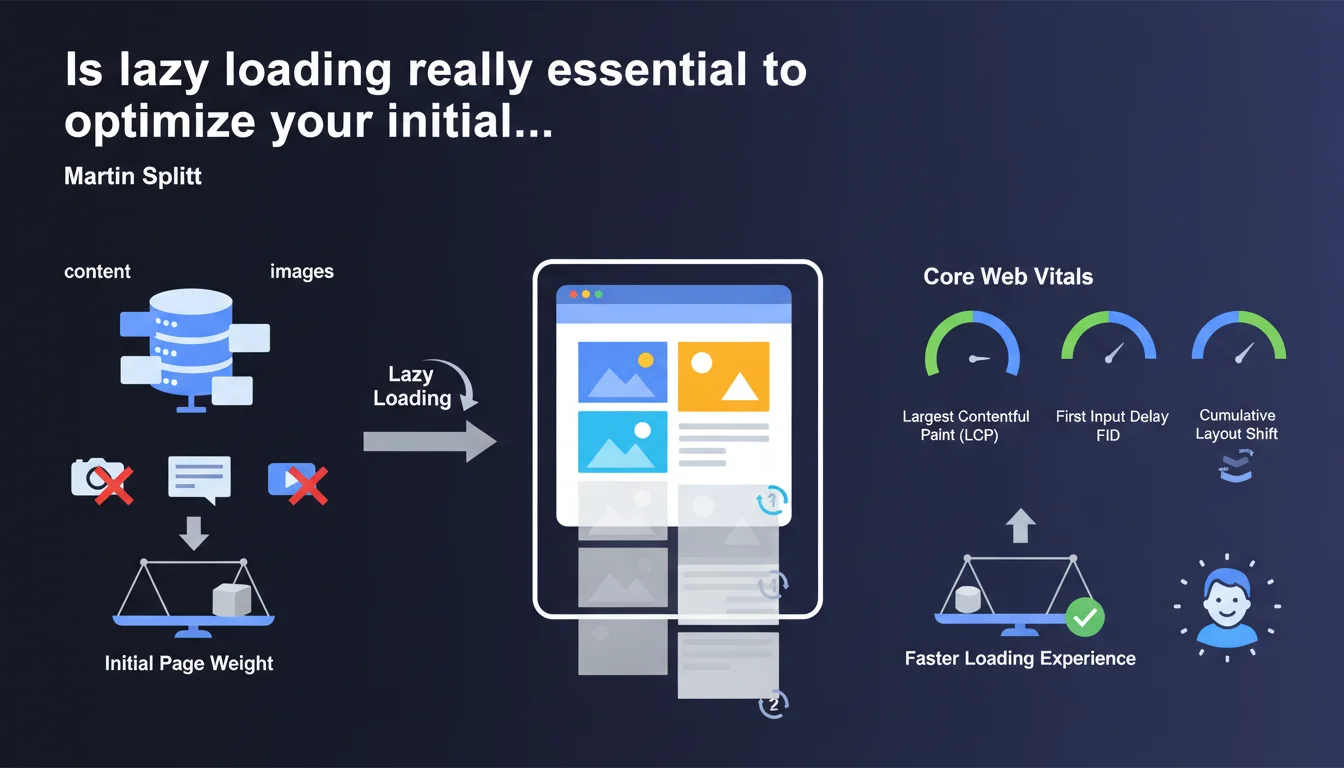
Google confirms that lazy loading reduces initial page weight by only loading images and heavy content that are visible or near the viewport. This technique directly improves performance metrics (LCP, FID) without sacrificing user experience. But beware: poorly implemented, lazy loading can harm image indexation and SEO.
What you need to understand
Why does Google insist so much on initial page weight?
A page's initial weight directly determines how quickly it becomes interactive for the user. The higher this weight, the longer the browser takes to download, parse, and display critical content. This is a determining factor for Core Web Vitals, particularly Largest Contentful Paint (LCP).
Lazy loading tackles this problem head-on: instead of loading 50 images when the page opens, you only load the ones visible on screen. The rest waits for the user to scroll. Result: fewer initial HTTP requests, less bandwidth consumed, faster Time to Interactive (TTI).
How does lazy loading actually work in practice?
The technique relies on the native HTML attribute loading="lazy" for images and iframes, or on JavaScript scripts that detect the viewport position. When an element approaches the visible area (typically with a safety margin), the browser triggers its loading.
Google explicitly recommends using the native attribute rather than complex JavaScript solutions. It's faster, better supported, and most importantly, Googlebot understands it perfectly. Custom scripts can block indexation if misconfigured.
Which content should you prioritize for lazy loading?
All heavy elements that are not above the fold: images at the bottom of the page, embedded videos, secondary carousels, third-party widgets. Conversely, never touch critical images (logo, hero image, first visual) — they must load immediately to avoid degrading LCP.
- Native lazy loading: use the loading="lazy" attribute on non-critical images and iframes
- Triggering threshold: the browser typically loads elements 1-2 screens before they become visible
- Positive SEO impact: reduction in initial weight, improvement of Core Web Vitals, better crawl budget
- Risk to avoid: never lazy-load images above the fold or those essential to main content
- Compatibility: the native attribute has been supported by all modern browsers since 2019
SEO Expert opinion
Is this recommendation consistent with what we observe in the field?
Absolutely. Audits I conduct consistently show that sites that properly lazy-load their images gain 20 to 40% on their LCP score. It's one of the most effective quick wins for improving Core Web Vitals without overhauling your entire architecture.
But — and this is a big but — I still see too many sites lazy-loading all their images, including header images. Catastrophic result: LCP explodes because the main image takes 2 seconds longer to appear. Google won't forgive this mistake.
What nuances doesn't Google mention here?
Martin Splitt talks about "heavy content" without specifying a threshold. Concretely, is a 30 KB image worth lazy-loading? Probably not. The gain will be negligible compared to the cost of the detection script. [To verify]: Google never gives precise figures on the minimum weight justifying lazy loading.
Another gray area: impact on image indexation. Googlebot is supposed to execute JavaScript and discover lazy-loaded images, but in practice, I've seen cases where certain images no longer appeared in Google Images after migrating to lazy loading. The cause? A misconfigured third-party script that blocked rendering on the bot side.
In what cases is lazy loading counterproductive?
On very short pages with few images (simple landing pages, minimalist product pages), lazy loading adds complexity for virtually no gain. Worse: if you lazy-load your product page's only image, you slow down its display for no reason.
Another problematic case: e-commerce sites with infinite scrolling product grids. If the lazy loading script is too aggressive (triggering threshold too close), users scrolling quickly see empty placeholders. This degrades UX and can increase bounce rate. You need to calibrate the preloading threshold carefully.
Practical impact and recommendations
How to implement lazy loading without SEO risk?
Prioritize the native HTML attribute loading="lazy" on all <img> and <iframe> tags located below the first screen. It's the simplest method and best supported by Googlebot.
For critical images (hero, logo, first product image), use loading="eager" or don't include anything — the browser will load them immediately. If you're unsure what's "above the fold", test on multiple screen resolutions (mobile 375px, tablet 768px, desktop 1920px).
What mistakes must you absolutely avoid?
Never lazy-load images that contribute to Largest Contentful Paint. Use Lighthouse or PageSpeed Insights to identify this element — if it's an image, it must load with priority, not lazily.
Also avoid automatic WordPress plugins that lazy-load everything indiscriminately. I've seen sites lose 30% of organic traffic after activating a poorly configured plugin that blocked image indexation. Always test after deployment.
- Add
loading="lazy"only to images and iframes below the fold line - Keep
loading="eager"(or no attribute) for critical above-the-fold visuals - Verify in Search Console that Googlebot sees all your images after implementation
- Test your Core Web Vitals with PageSpeed Insights before/after to measure real gains
- On mobile, be especially careful: what's "below the fold" on desktop may be visible on small screens
- Disable lazy loading on pages with little content (< 2 screens in height)
- Monitor your rankings in Google Images for 2-3 weeks post-deployment
❓ Frequently Asked Questions
Faut-il lazy-loader les images dans les balises <picture> et srcset ?
Le lazy loading natif fonctionne-t-il sur tous les navigateurs ?
Peut-on lazy-loader les images de fond CSS (background-image) ?
Le lazy loading impacte-t-il le référencement dans Google Images ?
Quel gain de performance peut-on espérer avec le lazy loading ?
🎥 From the same video 43
Other SEO insights extracted from this same Google Search Central video · published on 30/03/2026
🎥 Watch the full video on YouTube →
💬 Comments (0)
Be the first to comment.