
Official statement
Other statements from this video 43 ▾
- □ Pourquoi Googlebot s'arrête-t-il à 15 Mo par URL et comment cela impacte-t-il votre crawl ?
- □ Google mesure-t-il vraiment le poids de page comme vous le pensez ?
- □ Le poids des pages mobiles a triplé en 10 ans : faut-il s'inquiéter pour le SEO ?
- □ Les données structurées alourdissent-elles trop vos pages pour être rentables en SEO ?
- □ Votre site mobile contient-il autant de contenu que votre version desktop ?
- □ Pourquoi votre contenu desktop disparaît-il des résultats Google s'il manque sur mobile ?
- □ La vitesse de page impacte-t-elle réellement les conversions selon Google ?
- □ Google traite-t-il vraiment 40 milliards d'URLs de spam par jour ?
- □ La compression réseau améliore-t-elle réellement le crawl budget de votre site ?
- □ Le lazy loading est-il vraiment indispensable pour optimiser le poids initial de vos pages ?
- □ Googlebot s'arrête-t-il vraiment après 15 Mo par URL ?
- □ Pourquoi le poids des pages mobiles a-t-il triplé en une décennie ?
- □ Le poids des pages impacte-t-il vraiment l'expérience utilisateur et le SEO ?
- □ Les données structurées alourdissent-elles vraiment vos pages HTML ?
- □ Pourquoi la parité mobile-desktop reste-t-elle un facteur de déclassement majeur ?
- □ Faut-il encore se préoccuper du poids des pages pour le SEO ?
- □ La taille des ressources est-elle le facteur déterminant de la vitesse de votre site ?
- □ Pourquoi Google impose-t-il une limite stricte de 1 Mo pour les images ?
- □ L'optimisation de la taille des pages profite-t-elle vraiment plus aux utilisateurs qu'au SEO ?
- □ Googlebot limite-t-il vraiment le crawl à 15 Mo par URL ?
- □ Le poids des pages web explose : faut-il s'inquiéter pour son SEO ?
- □ La taille des pages web nuit-elle encore vraiment à votre SEO ?
- □ Les structured data alourdissent-elles vos pages au point de nuire au SEO ?
- □ La vitesse de chargement influence-t-elle vraiment les conversions de vos pages ?
- □ La compression réseau suffit-elle à optimiser l'espace de stockage des utilisateurs ?
- □ Pourquoi la disparité mobile/desktop tue-t-elle votre référencement en indexation mobile-first ?
- □ Le lazy loading est-il vraiment un levier de performance SEO à activer systématiquement ?
- □ Google bloque 40 milliards d'URLs de spam par jour : comment votre site échappe-t-il au filtre ?
- □ L'optimisation des images peut-elle vraiment diviser par 10 le poids de vos pages ?
- □ Googlebot s'arrête-t-il vraiment à 15 Mo par URL ?
- □ Pourquoi la parité mobile-desktop impacte-t-elle autant votre classement en Mobile-First Indexing ?
- □ Les données structurées ralentissent-elles vraiment votre crawl ?
- □ Google intercepte vraiment 40 milliards d'URLs de spam par jour ?
- □ Faut-il limiter vos images à 1 Mo pour plaire à Google ?
- □ Googlebot s'arrête-t-il vraiment à 15 Mo par URL crawlée ?
- □ La vitesse d'un site impacte-t-elle vraiment la conversion ?
- □ Pourquoi la disparité mobile-desktop ruine-t-elle encore tant de classements SEO ?
- □ Les données structurées alourdissent-elles vraiment vos pages HTML ?
- □ Pourquoi la taille des pages reste-t-elle un facteur SEO critique malgré l'amélioration des connexions Internet ?
- □ La compression réseau suffit-elle à optimiser le crawl de votre site ?
- □ Le lazy loading peut-il vraiment booster vos performances sans impacter le crawl ?
- □ La taille d'un site web a-t-elle vraiment un impact sur son référencement ?
- □ Pourquoi Google limite-t-il la taille des images à 1Mo sur sa documentation développeur ?
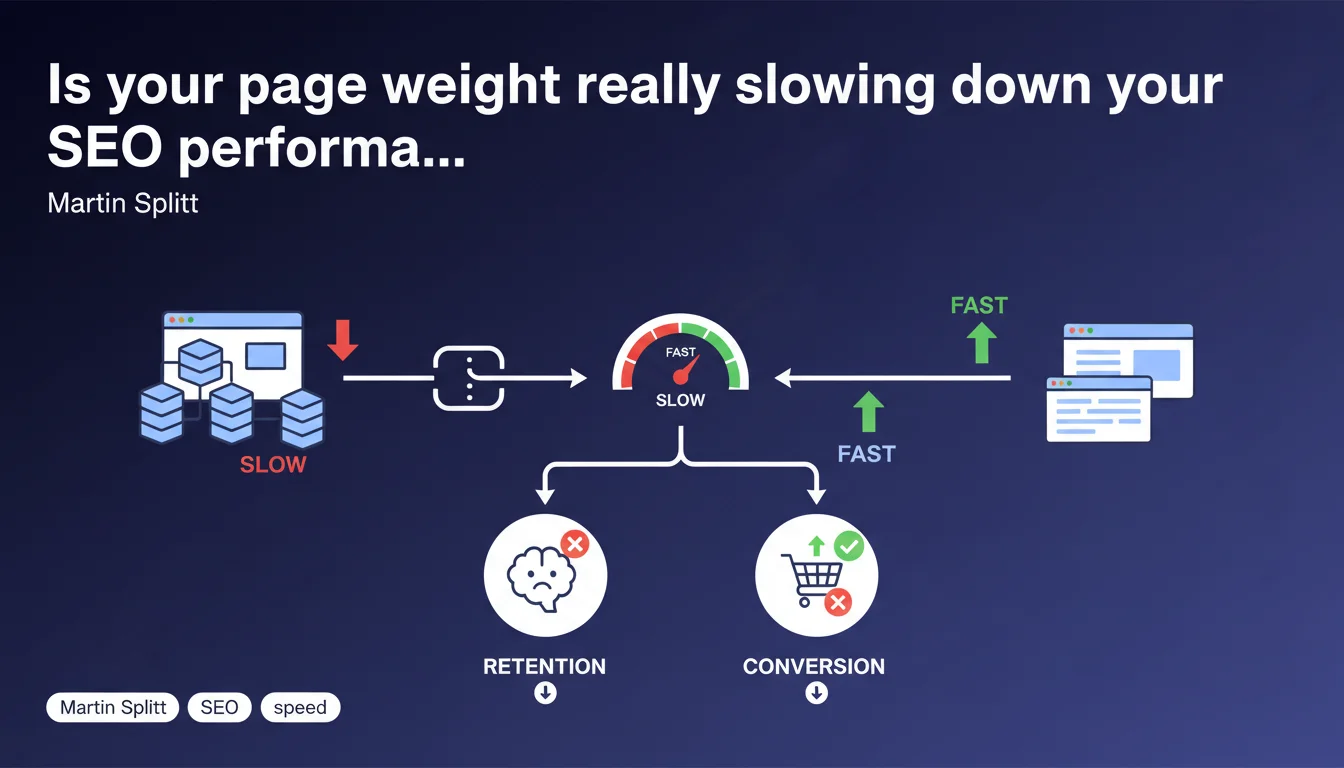
Google confirms that page size directly impacts loading speed, which in turn influences retention and conversions. The heavier a page, the longer data transfer and processing take. For SEO professionals, this is an unequivocal reminder: optimizing a page's technical weight is not a detail, it's a measurable performance variable.
What you need to understand
This statement reveals nothing revolutionary — we've known for years that speed matters. But it has the merit of establishing the factual foundation: size determines transfer time, and that time affects experience. No magic shortcuts.
What matters here is the chain of causality: weight → speed → user behavior → business results. Google doesn't explicitly say that weight influences ranking, but it links speed and engagement metrics — which can play an indirect role.
Why is Google emphasizing this point now?
Because websites are getting heavier and heavier. Between JavaScript frameworks, third-party libraries, marketing trackers, and uncompressed images, some pages weigh several megabytes just to display… three paragraphs of text.
Google wants to remind everyone of an obvious truth: every kilobyte has a cost. And that cost is paid in latency, mobile bandwidth, and user frustration. The studies cited (without detailed sources, note) show that fast sites convert better — which is consistent with everything we know about online behavior.
Is weight the only speed factor?
No. Raw weight is only part of the problem. You can have a 500 KB page that loads in 8 seconds because of poorly optimized blocking JavaScript, and a 2 MB page that renders in 2 seconds thanks to proper lazy loading and a performant CDN.
The composition of weight matters as much as total weight: images, CSS, JS, fonts, third-party resources. Each resource type has its own impact on rendering and interactivity. Weight is just a proxy — what really matters is Core Web Vitals and user perception.
- Weight = transfer time: more data to download = increased latency, especially on mobile or slow connections
- Speed ≠ pure lightness: a heavy well-optimized page can outperform a light poorly-structured one
- Retention and conversion: Google establishes a direct link between speed and business results, without detailing the studies
- Core Web Vitals: weight influences LCP (heavy resources = longer paint time), CLS (unset fonts and images), and FID/INP (heavy JS = blocked main thread)
SEO Expert opinion
Is this statement consistent with what we observe in the field?
Yes, completely. Audits consistently show a correlation between page weight and loading time — it's mechanical. Where it gets interesting is in optimization priorities.
I've seen 3 MB sites perform well because critical resources were prioritized, the rest lazy-loaded, and the server was fast. Conversely, 800 KB sites have stuttered because JavaScript blocked rendering or a cascade of requests was poorly sequenced. Raw weight is an indicator, not a sentence.
What's missing from this statement?
Concrete data. Google talks about "studies" without sourcing them. What types of sites? Which sectors? What weight thresholds trigger measurable drops in retention? [Needs verification] — we would have liked numbers, not just a general principle.
Next, the statement remains silent on business tradeoffs. Sometimes a heavy site is justified: a high-resolution photo gallery, an interactive product configurator, a complex web tool. The challenge isn't always to reduce at all costs, but to optimize what exists and measure real impact on conversions.
In which cases does this rule apply less?
When your audience is captive or has strong purchase intent. A B2B site with qualified traffic and high-value leads can tolerate a slightly heavier page if it delivers value (interactive demos, detailed comparators). Speed still matters, but it doesn't override functionality.
However, on a consumer e-commerce site or a media outlet with large mobile audiences, every millisecond counts. Users have immediate alternatives — they won't wait. That's where weight becomes critical for competitiveness.
Practical impact and recommendations
What should you do concretely to reduce weight without sacrificing quality?
Start by auditing the composition of your pages. Use a tool like WebPageTest or Lighthouse to identify the heaviest resources. Often, unoptimized images account for 60-80% of total weight — that's your number one lever.
Then compress: WebP or AVIF for images, minification for CSS and JS, Gzip or Brotli on the server side. Lazy-load everything that's not immediately visible. And challenge every third-party script: tracking, chat, ads — each adds weight and latency, often with unclear ROI.
What mistakes should you avoid?
Don't focus solely on raw weight. I've seen teams spend weeks scrounging a few KB off already-optimized images while a third-party JavaScript monopolized the main thread for 3 seconds. Prioritize impact, not vanity metrics.
Another pitfall: optimizing locally without testing in real conditions. Your pages load fast on your Mac with fiber? Test on a mid-range smartphone with fluctuating 4G — that's where you'll see the real problems.
How do you verify that your optimizations are working?
Measure before/after with tools like Lighthouse, PageSpeed Insights, or better yet, RUM data (Real User Monitoring) via Chrome UX Report or your own analytics. Core Web Vitals are your reference indicators: LCP, CLS, INP.
Also monitor business metrics: bounce rate, time on page, conversion rate. If your technical optimizations have no measurable impact on these KPIs, there's another problem — or you're optimizing the wrong place.
- Audit the composition of your pages (images, JS, CSS, fonts, third-party resources)
- Compress images (WebP, AVIF) and assets (minification, Gzip/Brotli)
- Implement lazy loading for all below-the-fold content
- Eliminate or defer non-critical third-party scripts
- Prioritize loading of critical resources (critical CSS, preload)
- Test in real conditions (mobile, slow connections) via WebPageTest or physical devices
- Measure impact on Core Web Vitals and business metrics (bounce rate, conversions)
Reducing your page weight is not an end in itself — it's a means to improve user experience, and therefore business performance. Focus on high-impact levers: images, JavaScript, third-party resources. Measure, iterate, and validate that your optimizations translate into concrete results.
These technical projects can quickly become complex, especially on high-volume sites or constrained tech stacks. If you lack internal resources or want to accelerate implementation, partnering with a web performance-specialized SEO agency can save you valuable time and secure your gains.
❓ Frequently Asked Questions
Le poids d'une page influence-t-il directement le classement dans Google ?
Quel est le poids idéal pour une page web en SEO ?
Les images sont-elles toujours le principal facteur de poids de page ?
Est-ce que lazy-loader les images suffit à régler les problèmes de poids ?
Comment mesurer l'impact réel du poids sur mes conversions ?
🎥 From the same video 43
Other SEO insights extracted from this same Google Search Central video · published on 30/03/2026
🎥 Watch the full video on YouTube →
💬 Comments (0)
Be the first to comment.