
Official statement
Other statements from this video 43 ▾
- □ Pourquoi Googlebot s'arrête-t-il à 15 Mo par URL et comment cela impacte-t-il votre crawl ?
- □ Google mesure-t-il vraiment le poids de page comme vous le pensez ?
- □ Le poids des pages mobiles a triplé en 10 ans : faut-il s'inquiéter pour le SEO ?
- □ Les données structurées alourdissent-elles trop vos pages pour être rentables en SEO ?
- □ Votre site mobile contient-il autant de contenu que votre version desktop ?
- □ Pourquoi votre contenu desktop disparaît-il des résultats Google s'il manque sur mobile ?
- □ La vitesse de page impacte-t-elle réellement les conversions selon Google ?
- □ Google traite-t-il vraiment 40 milliards d'URLs de spam par jour ?
- □ La compression réseau améliore-t-elle réellement le crawl budget de votre site ?
- □ Le lazy loading est-il vraiment indispensable pour optimiser le poids initial de vos pages ?
- □ Googlebot s'arrête-t-il vraiment après 15 Mo par URL ?
- □ Pourquoi le poids des pages mobiles a-t-il triplé en une décennie ?
- □ Le poids des pages impacte-t-il vraiment l'expérience utilisateur et le SEO ?
- □ Les données structurées alourdissent-elles vraiment vos pages HTML ?
- □ Faut-il encore se préoccuper du poids des pages pour le SEO ?
- □ La taille des ressources est-elle le facteur déterminant de la vitesse de votre site ?
- □ Pourquoi Google impose-t-il une limite stricte de 1 Mo pour les images ?
- □ L'optimisation de la taille des pages profite-t-elle vraiment plus aux utilisateurs qu'au SEO ?
- □ Googlebot limite-t-il vraiment le crawl à 15 Mo par URL ?
- □ Le poids des pages web explose : faut-il s'inquiéter pour son SEO ?
- □ La taille des pages web nuit-elle encore vraiment à votre SEO ?
- □ Les structured data alourdissent-elles vos pages au point de nuire au SEO ?
- □ La vitesse de chargement influence-t-elle vraiment les conversions de vos pages ?
- □ La compression réseau suffit-elle à optimiser l'espace de stockage des utilisateurs ?
- □ Pourquoi la disparité mobile/desktop tue-t-elle votre référencement en indexation mobile-first ?
- □ Le lazy loading est-il vraiment un levier de performance SEO à activer systématiquement ?
- □ Google bloque 40 milliards d'URLs de spam par jour : comment votre site échappe-t-il au filtre ?
- □ L'optimisation des images peut-elle vraiment diviser par 10 le poids de vos pages ?
- □ Googlebot s'arrête-t-il vraiment à 15 Mo par URL ?
- □ Pourquoi la parité mobile-desktop impacte-t-elle autant votre classement en Mobile-First Indexing ?
- □ Le poids de vos pages freine-t-il vraiment votre référencement ?
- □ Les données structurées ralentissent-elles vraiment votre crawl ?
- □ Google intercepte vraiment 40 milliards d'URLs de spam par jour ?
- □ Faut-il limiter vos images à 1 Mo pour plaire à Google ?
- □ Googlebot s'arrête-t-il vraiment à 15 Mo par URL crawlée ?
- □ La vitesse d'un site impacte-t-elle vraiment la conversion ?
- □ Pourquoi la disparité mobile-desktop ruine-t-elle encore tant de classements SEO ?
- □ Les données structurées alourdissent-elles vraiment vos pages HTML ?
- □ Pourquoi la taille des pages reste-t-elle un facteur SEO critique malgré l'amélioration des connexions Internet ?
- □ La compression réseau suffit-elle à optimiser le crawl de votre site ?
- □ Le lazy loading peut-il vraiment booster vos performances sans impacter le crawl ?
- □ La taille d'un site web a-t-elle vraiment un impact sur son référencement ?
- □ Pourquoi Google limite-t-il la taille des images à 1Mo sur sa documentation développeur ?
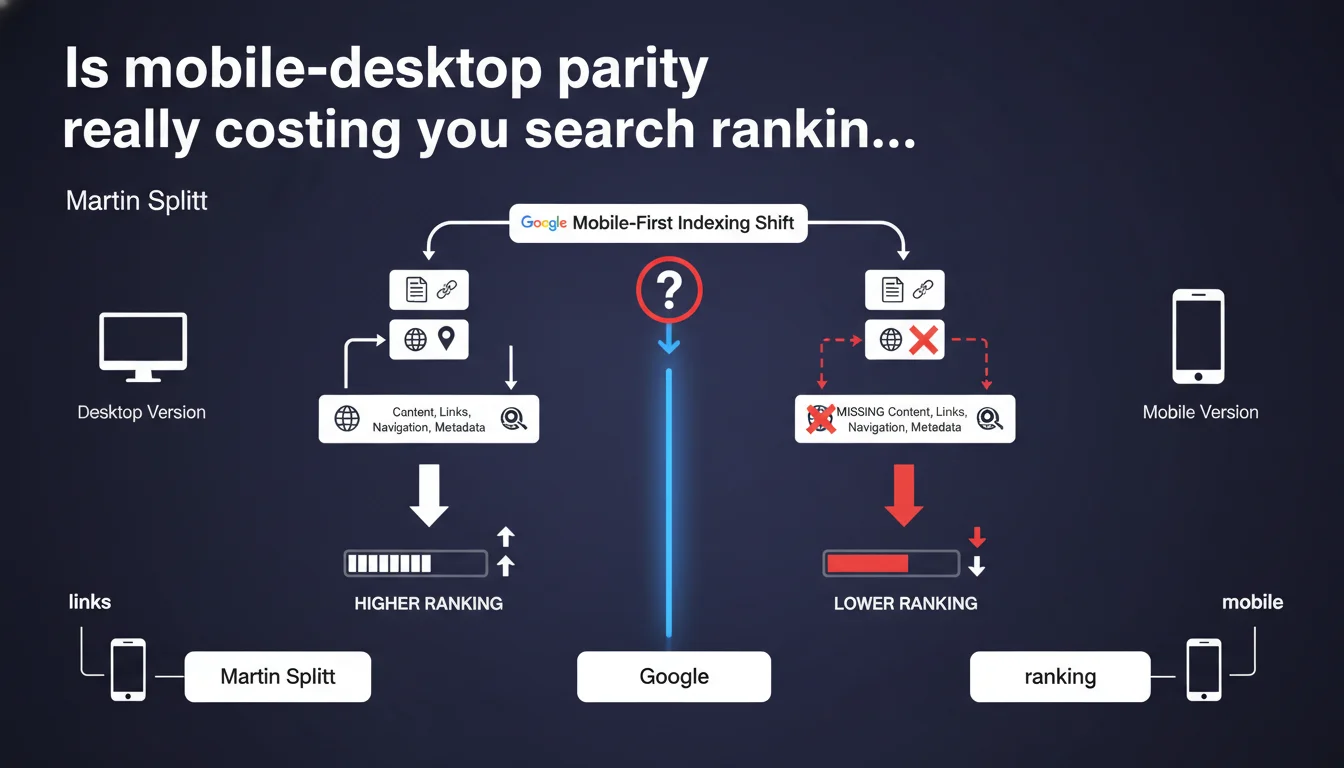
Google is finding that many websites lose content, links, navigation, or metadata on their mobile version compared to desktop. With mobile-first indexing, these gaps directly trigger ranking drops. The mobile version is now Google's source of truth — any reduction in content or structure comes with a real cost.
What you need to understand
What does mobile-first indexing actually change in practice?
Since the switch to mobile-first indexing, Google crawls and indexes your mobile version as a priority. If that version is stripped down — less content, fewer internal links, truncated metadata — this degraded version becomes Google's reference for ranking.
In concrete terms? A site with a stripped-down mobile version shoots itself in the foot. Google no longer sees the richness of your desktop version, and your rankings collapse.
What are the most common gaps between mobile and desktop?
Martin Splitt points to several recurring issues: content hidden or missing on mobile (shortened text, unloaded images), over-simplified navigation (reduced menus, removed breadcrumbs), missing internal links (weakened internal linking), and incomplete metadata (different or absent title tags/meta descriptions).
These gaps often stem from poorly calibrated UX decisions — you strip things down to "improve mobile experience," but you destroy SEO visibility in the process.
- Reduced or hidden content on mobile compared to desktop
- Simplified navigation that removes essential crawl paths
- Missing internal links, weakening internal linking structure
- Different or absent metadata (title, meta description, structured markup)
- Unloaded images or media on mobile, invisible to Googlebot
Why do these gaps trigger ranking problems?
Google has no reason to guess that your desktop version is richer. Mobile-first indexing means that your mobile version is the authoritative source. If it's incomplete, Google treats it as such — and adjusts rankings accordingly.
Content that doesn't exist on mobile doesn't exist for Google. A missing link breaks internal PageRank flow. Truncated metadata weakens relevance signals. The consequences are direct and measurable.
SEO Expert opinion
Does this statement align with real-world observations?
Absolutely. Since the full rollout of mobile-first, we regularly see sites dropping positions on queries where they ranked well on desktop. Audits consistently reveal content or structural gaps between the two versions.
The problem is that many sites adopted "mobile-light" approaches thinking they were doing the right thing — less text for speed, simplified navigation to avoid complex dropdowns. Result: Google sees a stripped-down site, and rankings follow suit.
What nuances should we add to this statement?
Martin Splitt mentions "many sites," but provides no hard numbers on how widespread the problem is or the actual impact measured. [Worth verifying]: What's Google's tolerance for minor gaps? Do all parity mismatches carry equal weight, or are some more critical than others?
Another point: Google doesn't specify how it handles content hidden behind accordions or tabs on mobile. Officially, this content gets indexed — but is it weighted as heavily as immediately visible content? Field observations suggest not, but Google remains vague on this.
When can this rule be legitimately relaxed?
For desktop-only sites (complex SaaS tools, admin interfaces), the question doesn't apply the same way. But these cases are rare. For any site targeting standard organic traffic, strict parity is non-negotiable.
There's also the case of Progressive Web Apps or client-side rendering sites: if Googlebot doesn't see the final rendered content, parity becomes irrelevant. The real issue sits upstream, at the crawl and rendering level.
Practical impact and recommendations
What's the concrete action plan to ensure mobile-desktop parity?
First step: audit both versions side-by-side. Use Google Search Console to confirm mobile-first indexing is active on your site, then systematically compare the mobile and desktop HTML for each strategically important page type.
Verify that all content visible on desktop is also visible on mobile — text, images, links, media. Content hidden behind accordions or tabs must be present in the initial HTML, not loaded dynamically after a click.
What mistakes must you avoid at all costs?
Never strip internal links on mobile under the guise of simplifying navigation. Internal linking is a pillar of SEO — thinning it on mobile is like shooting your link architecture in the foot from Google's perspective.
Avoid having different metadata between mobile and desktop. If you've got separate title tags or meta descriptions, unify them. Same goes for structured data: it must be strictly identical.
Watch out for lazy-loaded images that never render visibly for mobile Googlebot. If the image doesn't load at crawl time, it doesn't exist for Google.
How do you verify your site respects mobile-desktop parity?
- Compare the raw HTML source between mobile and desktop for your key pages (homepage, category pages, product sheets, articles)
- Verify that title tags, meta descriptions, hreflang, canonical tags are identical across both versions
- Make sure all internal links present on desktop also appear on mobile (navigation, footer, contextual linking)
- Check that structured data (Schema.org) is complete and identical on mobile
- Test mobile rendering with Google Search Console's URL inspection tool to see what Googlebot actually perceives
- Audit images and media: are they properly loading and visible to mobile Googlebot?
- If you use accordions or tabs on mobile, verify the content is in the initial HTML, not loaded via async JavaScript
❓ Frequently Asked Questions
Peut-on avoir un contenu légèrement différent entre mobile et desktop sans être pénalisé ?
Les métadonnées doivent-elles être strictement identiques entre mobile et desktop ?
Le contenu masqué dans des accordéons sur mobile est-il pris en compte par Google ?
Comment savoir si mon site est passé en indexation mobile-first ?
Les images lazy-loadées posent-elles problème pour Googlebot mobile ?
🎥 From the same video 43
Other SEO insights extracted from this same Google Search Central video · published on 30/03/2026
🎥 Watch the full video on YouTube →
💬 Comments (0)
Be the first to comment.