
Official statement
Other statements from this video 43 ▾
- □ Pourquoi Googlebot s'arrête-t-il à 15 Mo par URL et comment cela impacte-t-il votre crawl ?
- □ Google mesure-t-il vraiment le poids de page comme vous le pensez ?
- □ Le poids des pages mobiles a triplé en 10 ans : faut-il s'inquiéter pour le SEO ?
- □ Les données structurées alourdissent-elles trop vos pages pour être rentables en SEO ?
- □ Votre site mobile contient-il autant de contenu que votre version desktop ?
- □ Pourquoi votre contenu desktop disparaît-il des résultats Google s'il manque sur mobile ?
- □ La vitesse de page impacte-t-elle réellement les conversions selon Google ?
- □ Google traite-t-il vraiment 40 milliards d'URLs de spam par jour ?
- □ La compression réseau améliore-t-elle réellement le crawl budget de votre site ?
- □ Le lazy loading est-il vraiment indispensable pour optimiser le poids initial de vos pages ?
- □ Googlebot s'arrête-t-il vraiment après 15 Mo par URL ?
- □ Pourquoi le poids des pages mobiles a-t-il triplé en une décennie ?
- □ Le poids des pages impacte-t-il vraiment l'expérience utilisateur et le SEO ?
- □ Les données structurées alourdissent-elles vraiment vos pages HTML ?
- □ Pourquoi la parité mobile-desktop reste-t-elle un facteur de déclassement majeur ?
- □ Faut-il encore se préoccuper du poids des pages pour le SEO ?
- □ La taille des ressources est-elle le facteur déterminant de la vitesse de votre site ?
- □ Pourquoi Google impose-t-il une limite stricte de 1 Mo pour les images ?
- □ L'optimisation de la taille des pages profite-t-elle vraiment plus aux utilisateurs qu'au SEO ?
- □ Googlebot limite-t-il vraiment le crawl à 15 Mo par URL ?
- □ Le poids des pages web explose : faut-il s'inquiéter pour son SEO ?
- □ La taille des pages web nuit-elle encore vraiment à votre SEO ?
- □ Les structured data alourdissent-elles vos pages au point de nuire au SEO ?
- □ La vitesse de chargement influence-t-elle vraiment les conversions de vos pages ?
- □ La compression réseau suffit-elle à optimiser l'espace de stockage des utilisateurs ?
- □ Pourquoi la disparité mobile/desktop tue-t-elle votre référencement en indexation mobile-first ?
- □ Le lazy loading est-il vraiment un levier de performance SEO à activer systématiquement ?
- □ Google bloque 40 milliards d'URLs de spam par jour : comment votre site échappe-t-il au filtre ?
- □ L'optimisation des images peut-elle vraiment diviser par 10 le poids de vos pages ?
- □ Googlebot s'arrête-t-il vraiment à 15 Mo par URL ?
- □ Pourquoi la parité mobile-desktop impacte-t-elle autant votre classement en Mobile-First Indexing ?
- □ Le poids de vos pages freine-t-il vraiment votre référencement ?
- □ Les données structurées ralentissent-elles vraiment votre crawl ?
- □ Google intercepte vraiment 40 milliards d'URLs de spam par jour ?
- □ Faut-il limiter vos images à 1 Mo pour plaire à Google ?
- □ Googlebot s'arrête-t-il vraiment à 15 Mo par URL crawlée ?
- □ La vitesse d'un site impacte-t-elle vraiment la conversion ?
- □ Pourquoi la disparité mobile-desktop ruine-t-elle encore tant de classements SEO ?
- □ Les données structurées alourdissent-elles vraiment vos pages HTML ?
- □ Pourquoi la taille des pages reste-t-elle un facteur SEO critique malgré l'amélioration des connexions Internet ?
- □ La compression réseau suffit-elle à optimiser le crawl de votre site ?
- □ La taille d'un site web a-t-elle vraiment un impact sur son référencement ?
- □ Pourquoi Google limite-t-il la taille des images à 1Mo sur sa documentation développeur ?
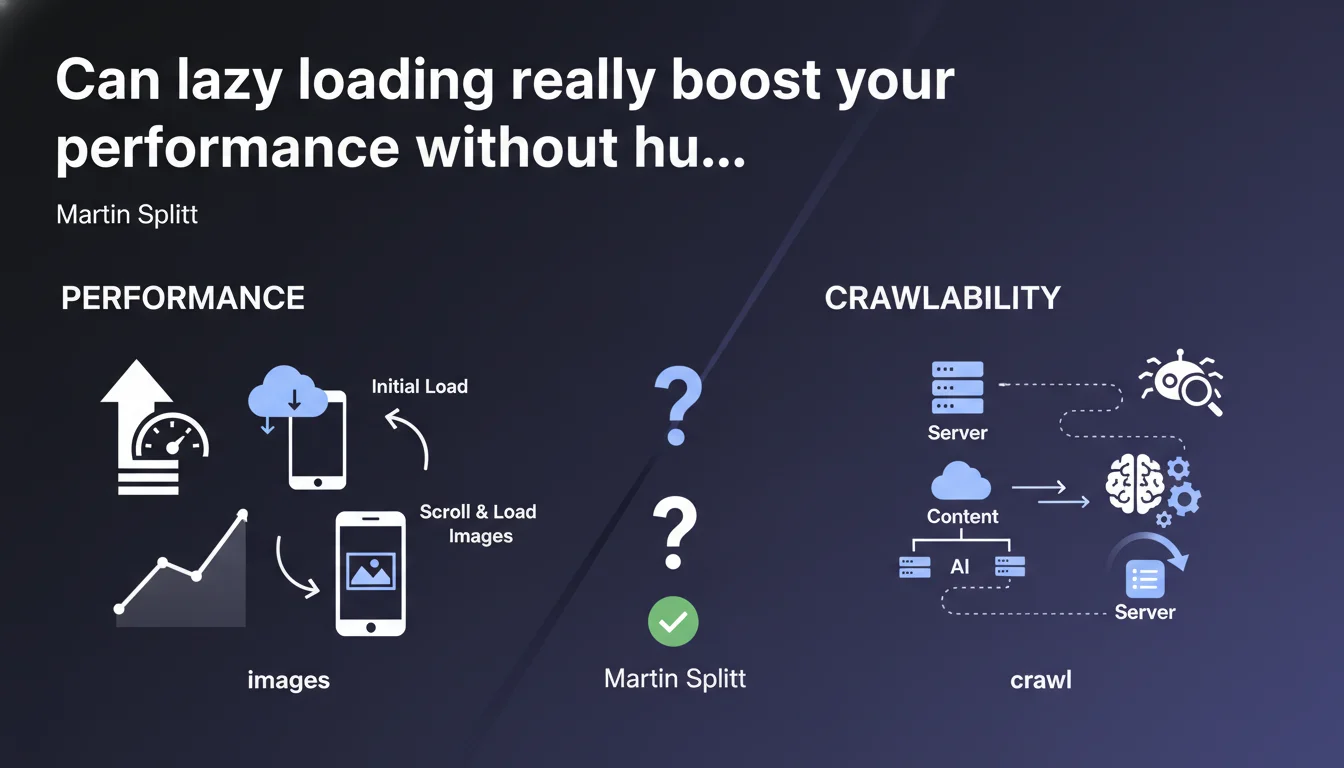
Martin Splitt confirms that lazy loading is a partial solution to lighten the initial page load for heavy pages by deferring resource loading such as images. The emphasis is on user experience, but the term "partial" suggests this technique isn't a magic bullet. For SEOs, the real question remains: how do you implement lazy loading without slowing down the indexing of your visual content?
What you need to understand
Why does Google describe lazy loading as a "partial solution"?
The term "partial" is not insignificant. Google acknowledges that lazy loading improves initial load times by loading only resources visible in the viewport, but it also introduces compromises. Deferred content isn't immediately accessible to crawlers, which can create indexing problems.
Concretely, if your lazy loading is poorly implemented — for example with heavy JavaScript without a fallback — Googlebot may never trigger the loading of certain images. Result: these resources appear neither in Google Images nor in your product rich snippets.
What resources are affected by this technique?
Splitt explicitly mentions images, but lazy loading also applies to iframes (embedded YouTube videos, widgets), non-critical third-party scripts, and even content blocks at the bottom of long pages. The idea is to identify what's heavy without being immediately necessary to the user.
In practice, images often represent 60 to 80% of a webpage's total weight. Deferring them can bring First Contentful Paint from 4 seconds down to less than 2 — but only if the rest of the page is already optimized.
What's the connection to Core Web Vitals?
Lazy loading directly impacts Largest Contentful Paint (LCP). If your LCP image is lazy loaded, you're sabotaging your performance: it won't load until after JavaScript, with a catastrophic additional delay. Google has already repeated this: never lazy load the LCP element.
On the other hand, deferring off-viewport images can improve your Total Blocking Time and reduce the initial page weight — two factors that affect overall metrics. But watch out: poorly calibrated lazy loading can increase Cumulative Layout Shift if you don't reserve space for upcoming images.
- Lazy loading reduces initial weight and improves perceived load times, but introduces indexing risks if poorly implemented.
- Images are the priority target, as they represent the majority of modern pages' weight.
- Never lazy load the LCP element — it's a critical error that degrades your Core Web Vitals.
- Reserve space for deferred images (width/height attributes) to prevent layout shift.
- Test rendering from Googlebot's perspective to verify that lazy-loaded resources are properly discovered and indexed.
SEO Expert opinion
Is this statement consistent with what we see in practice?
Yes, largely. Native lazy loading (the loading="lazy" HTML attribute) has worked well with Googlebot for several years. Tests show that lazy-loaded images are indexed if they follow best practices: width/height attributes, no blocking JavaScript, no dependence on complex scroll events.
Where problems arise is with custom JavaScript implementations. Some older (or poorly configured) libraries use techniques that Googlebot doesn't trigger — notably scroll listeners. Result: the image remains invisible to the bot. [To verify]: Google provides no details on the waiting period before deciding that a lazy-loaded resource will never be loaded.
What nuances should be added to this statement?
Splitt mentions a "partial solution," but doesn't specify the limitations. In reality, lazy loading doesn't fix anything if the rest of your tech stack is broken: slow server, blocking rendering, unoptimized CSS. It's one lever among many, not a miracle cure.
Another nuance: lazy loading can degrade user experience on mobile with slow connections if images take too long to appear after scrolling. You need to anticipate loading (preload 1-2 screens ahead) to avoid the "blank page" effect.
Finally, Google says nothing about the impact of lazy loading on CSS/JS files. Deferring non-critical JavaScript (analytics, chat widgets) is just as important as deferring images — sometimes even more so.
When does this technique not apply?
Never lazy load critical resources: logo, hero image above the fold, LCP elements. On short pages with few images, lazy loading adds complexity for marginal gain — better to optimize image weight directly (WebP, compression).
E-commerce sites must be especially careful: if your product pages have 20 gallery images and they're all lazy loaded without a fallback, Google Images risks never indexing them. Preload at least the first 3-4.
Practical impact and recommendations
What should you do concretely to implement lazy loading without SEO risk?
Favor the native loading="lazy" attribute for images and iframes — it's the most reliable method and best supported by Googlebot. Systematically add width and height attributes to prevent layout shift: the browser reserves space before the image even loads.
For critical images (above the fold, LCP image), use loading="eager" or fetchpriority="high". Test rendering in Google Search Console (URL inspection tool) to verify that Googlebot sees your lazy-loaded images.
If you must use a JavaScript solution (for example, for advanced fade effects), ensure it doesn't depend on scroll events — Googlebot doesn't always trigger them. Favor the Intersection Observer API, which is better supported.
What mistakes must be avoided at all costs?
Never lazy load the LCP element — it's the worst possible mistake. Don't hide your images behind JavaScript without HTML fallback: if the script fails or Googlebot doesn't execute it, your images disappear. Avoid "fully automatic" lazy loading plugins that make no distinction between critical and non-critical resources.
Be wary of solutions that lazy load CSS or fonts — this can create FOIT (Flash of Invisible Text) and degrade user experience. Google doesn't penalize directly, but Core Web Vitals take a hit.
How do you verify that your lazy loading works correctly?
Use the URL inspection tool in Google Search Console to see rendering from Googlebot's perspective. Check in the "Coverage" tab that your images appear properly in the Google Images index. Test your pages with Lighthouse (Chrome DevTools) to detect LCP images in lazy loading — Lighthouse will alert you.
Monitor your Core Web Vitals in PageSpeed Insights and Search Console: a sudden LCP degradation after enabling lazy loading signals a problem. Run an A/B test if possible: compare actual performance (CrUX) before/after to validate the impact.
- Use
loading="lazy"for images outside initial viewport - Add width/height to all images to prevent CLS
- Never lazy load the LCP image or critical resources
- Test Googlebot rendering in Search Console (URL inspection)
- Verify your images appear properly in Google Images
- Preload the first 2-3 images from product galleries (e-commerce)
- Monitor Core Web Vitals after deployment (LCP, CLS)
- Favor native solutions over heavy JavaScript
❓ Frequently Asked Questions
Le lazy loading natif (loading="lazy") est-il bien supporté par Googlebot ?
Peut-on lazy loader toutes les images d'une page sans risque SEO ?
Le lazy loading améliore-t-il vraiment les Core Web Vitals ?
Faut-il lazy loader les iframes (vidéos YouTube, widgets) ?
Comment vérifier que Googlebot voit mes images lazy loadées ?
🎥 From the same video 43
Other SEO insights extracted from this same Google Search Central video · published on 30/03/2026
🎥 Watch the full video on YouTube →
💬 Comments (0)
Be the first to comment.