
Official statement
Other statements from this video 43 ▾
- □ Pourquoi Googlebot s'arrête-t-il à 15 Mo par URL et comment cela impacte-t-il votre crawl ?
- □ Google mesure-t-il vraiment le poids de page comme vous le pensez ?
- □ Le poids des pages mobiles a triplé en 10 ans : faut-il s'inquiéter pour le SEO ?
- □ Les données structurées alourdissent-elles trop vos pages pour être rentables en SEO ?
- □ Pourquoi votre contenu desktop disparaît-il des résultats Google s'il manque sur mobile ?
- □ La vitesse de page impacte-t-elle réellement les conversions selon Google ?
- □ Google traite-t-il vraiment 40 milliards d'URLs de spam par jour ?
- □ La compression réseau améliore-t-elle réellement le crawl budget de votre site ?
- □ Le lazy loading est-il vraiment indispensable pour optimiser le poids initial de vos pages ?
- □ Googlebot s'arrête-t-il vraiment après 15 Mo par URL ?
- □ Pourquoi le poids des pages mobiles a-t-il triplé en une décennie ?
- □ Le poids des pages impacte-t-il vraiment l'expérience utilisateur et le SEO ?
- □ Les données structurées alourdissent-elles vraiment vos pages HTML ?
- □ Pourquoi la parité mobile-desktop reste-t-elle un facteur de déclassement majeur ?
- □ Faut-il encore se préoccuper du poids des pages pour le SEO ?
- □ La taille des ressources est-elle le facteur déterminant de la vitesse de votre site ?
- □ Pourquoi Google impose-t-il une limite stricte de 1 Mo pour les images ?
- □ L'optimisation de la taille des pages profite-t-elle vraiment plus aux utilisateurs qu'au SEO ?
- □ Googlebot limite-t-il vraiment le crawl à 15 Mo par URL ?
- □ Le poids des pages web explose : faut-il s'inquiéter pour son SEO ?
- □ La taille des pages web nuit-elle encore vraiment à votre SEO ?
- □ Les structured data alourdissent-elles vos pages au point de nuire au SEO ?
- □ La vitesse de chargement influence-t-elle vraiment les conversions de vos pages ?
- □ La compression réseau suffit-elle à optimiser l'espace de stockage des utilisateurs ?
- □ Pourquoi la disparité mobile/desktop tue-t-elle votre référencement en indexation mobile-first ?
- □ Le lazy loading est-il vraiment un levier de performance SEO à activer systématiquement ?
- □ Google bloque 40 milliards d'URLs de spam par jour : comment votre site échappe-t-il au filtre ?
- □ L'optimisation des images peut-elle vraiment diviser par 10 le poids de vos pages ?
- □ Googlebot s'arrête-t-il vraiment à 15 Mo par URL ?
- □ Pourquoi la parité mobile-desktop impacte-t-elle autant votre classement en Mobile-First Indexing ?
- □ Le poids de vos pages freine-t-il vraiment votre référencement ?
- □ Les données structurées ralentissent-elles vraiment votre crawl ?
- □ Google intercepte vraiment 40 milliards d'URLs de spam par jour ?
- □ Faut-il limiter vos images à 1 Mo pour plaire à Google ?
- □ Googlebot s'arrête-t-il vraiment à 15 Mo par URL crawlée ?
- □ La vitesse d'un site impacte-t-elle vraiment la conversion ?
- □ Pourquoi la disparité mobile-desktop ruine-t-elle encore tant de classements SEO ?
- □ Les données structurées alourdissent-elles vraiment vos pages HTML ?
- □ Pourquoi la taille des pages reste-t-elle un facteur SEO critique malgré l'amélioration des connexions Internet ?
- □ La compression réseau suffit-elle à optimiser le crawl de votre site ?
- □ Le lazy loading peut-il vraiment booster vos performances sans impacter le crawl ?
- □ La taille d'un site web a-t-elle vraiment un impact sur son référencement ?
- □ Pourquoi Google limite-t-il la taille des images à 1Mo sur sa documentation développeur ?
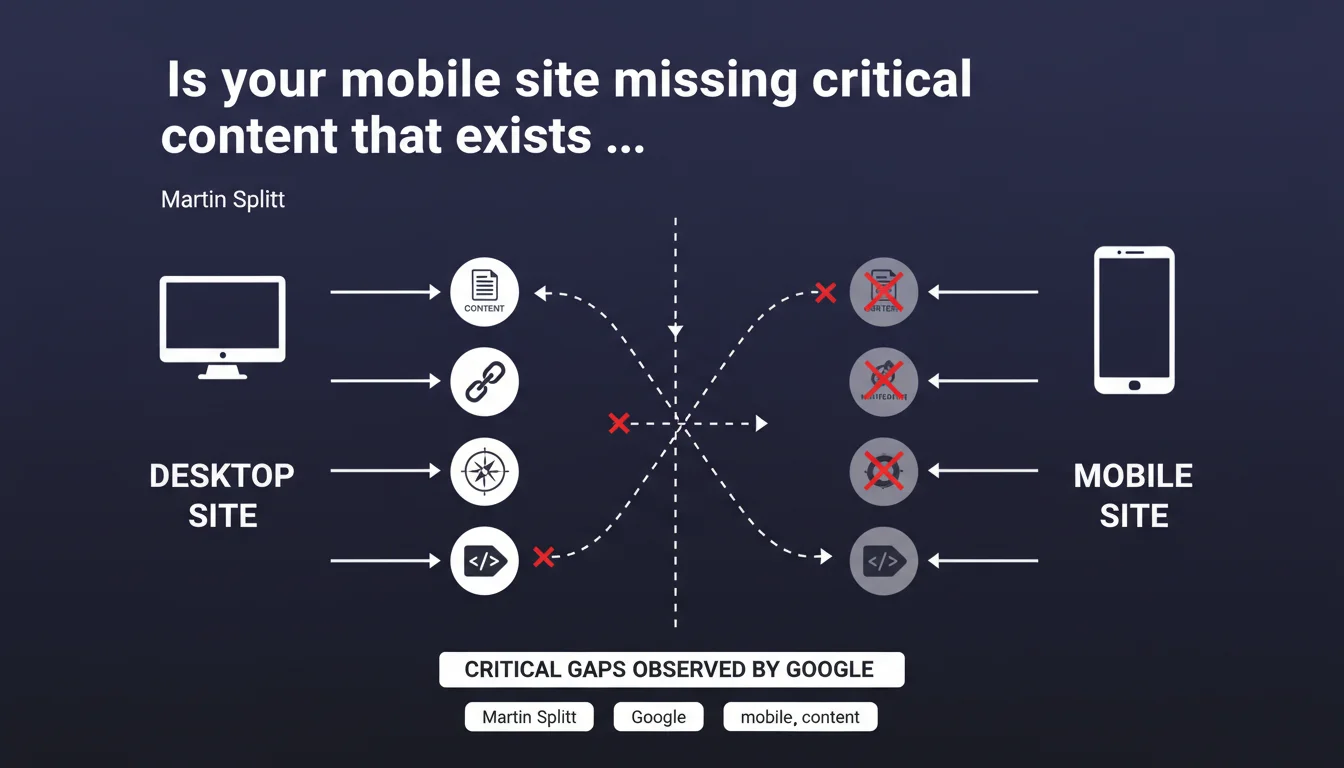
Google has found that many websites display major gaps between their mobile and desktop versions: truncated content, missing links, absent metadata. With mobile-first indexing, it's the mobile version that determines your rankings — and these disparities directly penalize your search positions.
What you need to understand
Why does Google place such emphasis on mobile-desktop parity?
Since the widespread shift to mobile-first indexing, Google crawls and prioritizes indexing the mobile version of your pages. If this version is diminished compared to desktop, it's that version — with all its shortcomings — that will serve as the reference for ranking.
Martin Splitt emphasizes that Google's teams have identified recurring patterns: text content shortened on mobile, navigation oversimplified, canonical or hreflang metadata missing, incomplete structured data. These gaps aren't trivial — they result in a loss of context for the algorithm.
What types of gaps are most frequently observed?
Missing content tops the list: deleted paragraphs, removed images, entire sections hidden under poorly implemented accordions. Next come missing links, particularly those pointing to deep pages or secondary categories, which weakens internal linking.
Metadata and <link> tags are also affected: incorrect canonical tags, missing hreflang, reduced structured data. Result: Google struggles to understand your site structure and properly associate language or regional versions.
Does this issue only affect sites with separate URLs?
No, but it's exacerbated in that case. Sites with distinct URLs (m.example.com vs www.example.com) often show more pronounced discrepancies because teams develop two versions in parallel.
Responsive sites aren't immune either: content can be hidden via CSS or JavaScript, structured data conditioned by screen size, menus truncated. Google sees what the mobile Googlebot sees — and if it's an impoverished version, the consequences are identical.
- Mobile-first indexing means the mobile version is authoritative for ranking
- Frequent gaps include: truncated content, missing links, absent metadata
- Sites with separate URLs are more exposed, but responsive sites aren't exempt
- Hiding content via CSS or JavaScript is equivalent to removing it in Google's eyes
- Structured data must be identical on mobile and desktop
SEO Expert opinion
Is this statement consistent with on-the-ground practices?
Absolutely. For years, traffic drops have been directly correlated with mobile-first migration on sites with disparities. Audits consistently reveal the same patterns: hidden content, navigation simplified to the point of cutting off access to entire sections of the site, incomplete metadata.
What's still surprising is how frequently these errors appear on major websites. The idea that "we simplify for mobile" remains entrenched, while simplifying doesn't mean impoverishing. Google has never asked to remove content — only to make it accessible and readable.
What nuances should be applied to this recommendation?
Google doesn't say that everything must be strictly identical. Some elements can legitimately vary: adapted layout, resized images, restructured menus for touch navigation. The substance should remain; the form can adapt.
Where it falls apart is when you delete paragraphs under the pretense that they'd be "too long on mobile," or hide internal links deemed "secondary." If an element matters for desktop ranking, it matters for mobile. [To be verified]: Google has never provided a precise threshold for what constitutes an "acceptable gap" — it's case by case.
In what cases does this rule reach its limits?
On some high-volume data sites — comparison tools, directories, marketplaces — displaying 100% of desktop content on mobile can pose performance problems. Degraded Core Web Vitals, exploding load times, catastrophic user experience.
The dilemma is real: preserve content parity or optimize speed? The solution often involves intelligent lazy loading, progressively loaded content, well-implemented accordions (content in the DOM, not loaded via AJAX). But be careful — if Google can't access the content without user interaction, you lose out.
Practical impact and recommendations
What should you prioritize checking on your site?
Start by comparing your strategic pages in mobile and desktop mode. Use the URL inspection tool in Search Console to see what the mobile Googlebot actually retrieves. Compare it with desktop rendering: HTML source, structured data, metadata, internal linking.
Then verify that canonical tags, hreflang, and alternate media are consistent. On a site with separate URLs, the mobile version should point to itself with canonical, and indicate the desktop version via <link rel="alternate" media="only screen and (min-width: 640px)">.
What concrete mistakes must you absolutely avoid?
Never remove text content on mobile under the pretense of lightening the load. If a paragraph provides SEO value, it should appear on both versions. Same logic for internal links: if a page is important, it should be accessible from mobile navigation.
Avoid poorly implemented accordions or tabs that load content via AJAX on click. Google may not trigger these interactions, so content remains invisible. If you must use these patterns, ensure content is present in the initial DOM, simply hidden by CSS.
Don't forget structured data: they must be identical on mobile and desktop. An FAQ present only on desktop won't be taken into account in mobile-first mode.
How do you bring a site with gaps into compliance?
- Audit strategic pages with the URL inspection tool (Search Console)
- Compare mobile vs desktop HTML source, identify missing content
- Verify presence and consistency of metadata (canonical, hreflang, alternate)
- Ensure structured data is identical across both versions
- Test internal linking: key links must be accessible on mobile
- Validate that hidden content (accordions, tabs) is present in initial DOM
- Monitor Core Web Vitals to ensure content parity doesn't degrade performance
- Re-test after fixes using the mobile optimization test tool
❓ Frequently Asked Questions
Un site responsive est-il automatiquement conforme à l'indexation mobile-first ?
Google pénalise-t-il les sites avec URLs mobiles et desktop séparées ?
Le contenu dans des accordéons fermés par défaut est-il indexé ?
Dois-je dupliquer les structured data sur mobile et desktop ?
Comment vérifier ce que Googlebot mobile voit réellement ?
🎥 From the same video 43
Other SEO insights extracted from this same Google Search Central video · published on 30/03/2026
🎥 Watch the full video on YouTube →
💬 Comments (0)
Be the first to comment.