
Official statement
Other statements from this video 43 ▾
- □ Does the 15 MB Googlebot crawl limit really kill your indexation, and how can you fix it?
- □ Is Google Really Measuring Page Weight the Way You Think It Does?
- □ Has mobile page weight tripled in 10 years? Why should SEO professionals care about this trend?
- □ Is your structured data bloating your pages too much to be worth the SEO investment?
- □ Is your mobile site missing critical content that exists on desktop?
- □ Is your desktop content disappearing from Google rankings because it's missing on mobile?
- □ Does page speed really impact conversions according to Google?
- □ Does network compression really improve your site's crawl budget?
- □ Is lazy loading really essential to optimize your initial page weight and boost Core Web Vitals?
- □ Does Googlebot really stop crawling after 15 MB per URL?
- □ Has mobile page weight really tripled in just one decade?
- □ Does page weight really affect user experience and SEO performance?
- □ Does structured data really bloat your HTML and hurt page performance?
- □ Is mobile-desktop parity really costing you search rankings more than you think?
- □ Should you still worry about page weight for SEO in 2024?
- □ Is resource size really the make-or-break factor for your website's speed?
- □ Is Google really enforcing a strict 1 MB limit on images—and what does that tell you about SEO priorities?
- □ Does optimizing page size actually benefit users more than it benefits your search rankings?
- □ Does Googlebot really cap crawling at 15 MB per URL?
- □ Is exploding web page weight hurting your SEO? Here's what you need to know
- □ Is page size really still hurting your SEO in 2024?
- □ Are structured data slowing down your pages enough to harm your SEO?
- □ Does page loading speed really impact your conversion rates?
- □ Does network compression really optimize user device storage space, or is it just a temporary fix?
- □ Is content disparity between mobile and desktop killing your rankings in mobile-first indexing?
- □ Is lazy loading really a must-have SEO performance lever you should activate systematically?
- □ Does Google really block 40 billion spam URLs daily—and how does your site avoid the filter?
- □ Can image optimization really cut your page weight by 90%?
- □ Does Googlebot really stop at 15 MB per URL?
- □ Why is mobile-desktop parity sabotaging your rankings in Mobile-First Indexing?
- □ Is your page weight really slowing down your SEO performance?
- □ Does structured data really slow down your crawl budget?
- □ Does Google really block 40 billion spam URLs every single day?
- □ Should you really cap your images at 1 MB to satisfy Google?
- □ Does Googlebot really stop crawling after 15 MB per URL?
- □ Does site speed really impact your conversion rates?
- □ Is mobile-desktop mismatch really destroying your SEO rankings right now?
- □ Do structured data markups really bloat your HTML pages?
- □ Does page size really matter for SEO when internet connections keep getting faster?
- □ Is network compression really enough to optimize your site's crawlability?
- □ Can lazy loading really boost your performance without hurting crawlability?
- □ Does your website's overall size really hurt your SEO performance?
- □ Why does Google enforce a strict 1MB image size limit across its developer documentation?
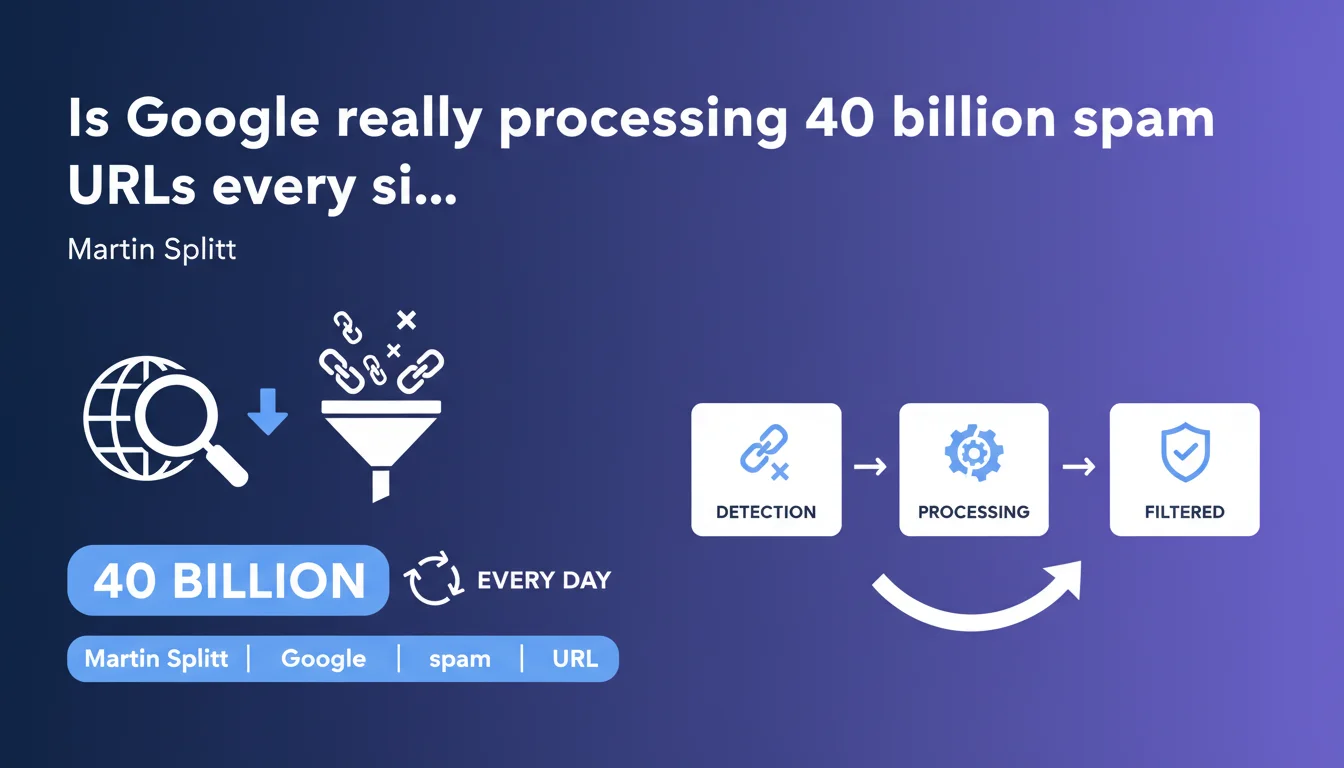
Google detects and processes 40 billion spam URLs daily, an official figure that reveals the catastrophic scale of web spam. This colossal volume explains why Google's anti-spam filters are increasingly aggressive and why some legitimate sites occasionally end up unfairly penalized.
What you need to understand
What does this 40 billion URL volume actually represent in concrete terms?
To put this figure into perspective: 40 billion URLs per day amounts to approximately 460,000 URLs processed every single second. We're talking about a continuous and massive stream that Google must analyze, classify, and neutralize in real time.
This volume demonstrates two critical things. First, that web spam is not a marginal problem but rather an industry operating at industrial scale. Second, that Google invests colossal resources — infrastructure, algorithms, machine learning — to maintain the quality of its index.
How does Google manage to process such a massive volume?
Google relies on multi-layered automated systems: detection on-the-fly during crawling, analysis of known spam patterns, machine learning trained on billions of examples, and behavioral signals from users.
Suspicious URLs aren't even all indexed. Many are blocked during the initial crawl or placed in quarantine. Only a tiny fraction passes the filters and requires manual intervention or algorithmic refinement.
Why had Google never communicated this figure so clearly before?
Google typically remains discreet about precise volumes to avoid giving spammers useful benchmarks. Mentioning 40 billion publicly is therefore a powerful signal: likely a response to the surge in AI-generated spam flooding the web since LLMs exploded in popularity.
By communicating this figure, Google also wants to reassure advertisers and users: "Yes, the web is polluted, but we've got it under control." It's both a technical statement and a communication operation.
- Google processes 40 billion spam URLs per day, or 460,000 per second
- This volume reflects the massive industrialization of web spam, amplified by generative AI
- Detection systems are multi-layered: crawling, indexation, post-indexation
- This official figure represents a first public communication this precise on volume
- Most spam URLs are neutralized before indexation even occurs
SEO Expert opinion
Is this figure credible based on real-world evidence?
Honestly? Yes. Field observations confirm the explosion of web spam in recent years. Between industrialized PBNs, AI content farms, automated scraping networks, and parasitic sites, 40 billion URLs daily seem coherent.
We regularly observe domains generating hundreds of thousands of pages within days. Multiply that by thousands of active networks operating simultaneously, add multilingual spam, and you easily reach these stratospheric volumes.
What are the consequences for legitimate sites?
The problem is that facing such a deluge, Google's algorithms must be extremely aggressive. And aggressive filters inevitably mean false positives.
We see it regularly: perfectly legitimate sites end up deindexed or penalized because they display patterns that resemble spam. A sudden spike in publications? Suspicious. Semi-automatically generated content? Suspicious. Backlinks arriving in volume? Suspicious.
Google's acceptable margin of error is probably around 0.001% — but on 40 billion URLs, that still means 400,000 potential false positives per day. [To verify] because Google doesn't communicate on this error rate.
Does this declaration hide something?
Let's be honest: Google doesn't specify exactly what it means by "processing." Does blocking at crawl stage = processing? Does detecting without acting = processing? The methodology for counting remains completely unclear.
Another blind spot: Google doesn't say how much spam actually passes through the filters anyway. 40 billion detected is impressive. But how many spam URLs are indexed despite it all? No figures. And that's precisely what would interest us most. [To verify]
Practical impact and recommendations
How do you avoid being categorized as spam by mistake?
First rule: avoid suspicious publishing patterns. Publishing 500 pages in 48 hours, even if it's legitimate content, triggers automated alerts. Space out your publications over time, maintain a rhythm consistent with your history.
Second rule: nurture editorial quality signals. Identified authors, clear publication dates, cited sources, documented updates. Everything showing that a human is editorial about the content reduces the risk of being confused with automatically generated spam.
What should you do if your site becomes a false positive victim?
If you notice a sudden deindexation or unexplained traffic drop, first check Google Search Console: manual penalty? Reported indexation issue? No message doesn't mean there's no algorithmic problem.
Next, conduct a complete technical audit to eliminate legitimate causes: massive duplicate content, involuntary cloaking, spam injection from hacking. If everything is clean on the technical side, document your case and use official reconsideration channels — but with no guarantee of quick response.
What practices should you adopt to stay off the radar?
Focus on diversifying legitimacy signals: measurable direct traffic, natural brand mentions, real user engagement, contextually relevant editorial backlinks.
Avoid tactics that closely resemble spam: networks of interconnected sites too obviously linked, automatically translated content without human post-editing, satellite pages each targeting a keyword variation.
- Maintain a consistent and progressive publication rhythm, never sudden spikes
- Clearly document the editorial origin of each piece of content (authors, dates, sources)
- Diversify legitimacy signals: direct traffic, mentions, real engagement
- Regularly audit to detect any spam injected through hacking
- Avoid suspicious patterns: site networks, mass auto-generated content, satellite pages
- If you experience unexplained drops, immediately check Search Console and indexation
Facing such a colossal spam volume, Google inevitably prioritizes aggressive detection at the risk of false positives. For a legitimate site, the best defense remains to multiply editorial quality signals and avoid any pattern that could be confused with automated spam.
These defensive optimizations require pointed expertise and constant monitoring of algorithmic changes. If you manage a high-volume content site or have already been impacted by an anti-spam filter, support from a specialized SEO agency can prove valuable in securing your organic visibility over the long term.
❓ Frequently Asked Questions
Les 40 milliards d'URLs incluent-elles uniquement le spam malveillant ou aussi le contenu de faible qualité ?
Un site peut-il être classé spam algorithmiquement sans pénalité manuelle visible ?
Ce volume de spam explique-t-il les lenteurs d'indexation constatées par de nombreux sites ?
Google communique-t-il le taux d'erreur de ses systèmes antispam ?
Faut-il craindre une détection spam si on publie du contenu assisté par IA ?
🎥 From the same video 43
Other SEO insights extracted from this same Google Search Central video · published on 30/03/2026
🎥 Watch the full video on YouTube →
💬 Comments (0)
Be the first to comment.