
Official statement
Other statements from this video 43 ▾
- □ Does the 15 MB Googlebot crawl limit really kill your indexation, and how can you fix it?
- □ Is Google Really Measuring Page Weight the Way You Think It Does?
- □ Has mobile page weight tripled in 10 years? Why should SEO professionals care about this trend?
- □ Is your structured data bloating your pages too much to be worth the SEO investment?
- □ Is your mobile site missing critical content that exists on desktop?
- □ Is your desktop content disappearing from Google rankings because it's missing on mobile?
- □ Does page speed really impact conversions according to Google?
- □ Is Google really processing 40 billion spam URLs every single day?
- □ Does network compression really improve your site's crawl budget?
- □ Is lazy loading really essential to optimize your initial page weight and boost Core Web Vitals?
- □ Does Googlebot really stop crawling after 15 MB per URL?
- □ Has mobile page weight really tripled in just one decade?
- □ Does page weight really affect user experience and SEO performance?
- □ Does structured data really bloat your HTML and hurt page performance?
- □ Is mobile-desktop parity really costing you search rankings more than you think?
- □ Should you still worry about page weight for SEO in 2024?
- □ Is resource size really the make-or-break factor for your website's speed?
- □ Is Google really enforcing a strict 1 MB limit on images—and what does that tell you about SEO priorities?
- □ Does optimizing page size actually benefit users more than it benefits your search rankings?
- □ Does Googlebot really cap crawling at 15 MB per URL?
- □ Is exploding web page weight hurting your SEO? Here's what you need to know
- □ Is page size really still hurting your SEO in 2024?
- □ Are structured data slowing down your pages enough to harm your SEO?
- □ Does page loading speed really impact your conversion rates?
- □ Does network compression really optimize user device storage space, or is it just a temporary fix?
- □ Is content disparity between mobile and desktop killing your rankings in mobile-first indexing?
- □ Is lazy loading really a must-have SEO performance lever you should activate systematically?
- □ Does Google really block 40 billion spam URLs daily—and how does your site avoid the filter?
- □ Can image optimization really cut your page weight by 90%?
- □ Does Googlebot really stop at 15 MB per URL?
- □ Why is mobile-desktop parity sabotaging your rankings in Mobile-First Indexing?
- □ Is your page weight really slowing down your SEO performance?
- □ Does structured data really slow down your crawl budget?
- □ Does Google really block 40 billion spam URLs every single day?
- □ Should you really cap your images at 1 MB to satisfy Google?
- □ Does Googlebot really stop crawling after 15 MB per URL?
- □ Is mobile-desktop mismatch really destroying your SEO rankings right now?
- □ Do structured data markups really bloat your HTML pages?
- □ Does page size really matter for SEO when internet connections keep getting faster?
- □ Is network compression really enough to optimize your site's crawlability?
- □ Can lazy loading really boost your performance without hurting crawlability?
- □ Does your website's overall size really hurt your SEO performance?
- □ Why does Google enforce a strict 1MB image size limit across its developer documentation?
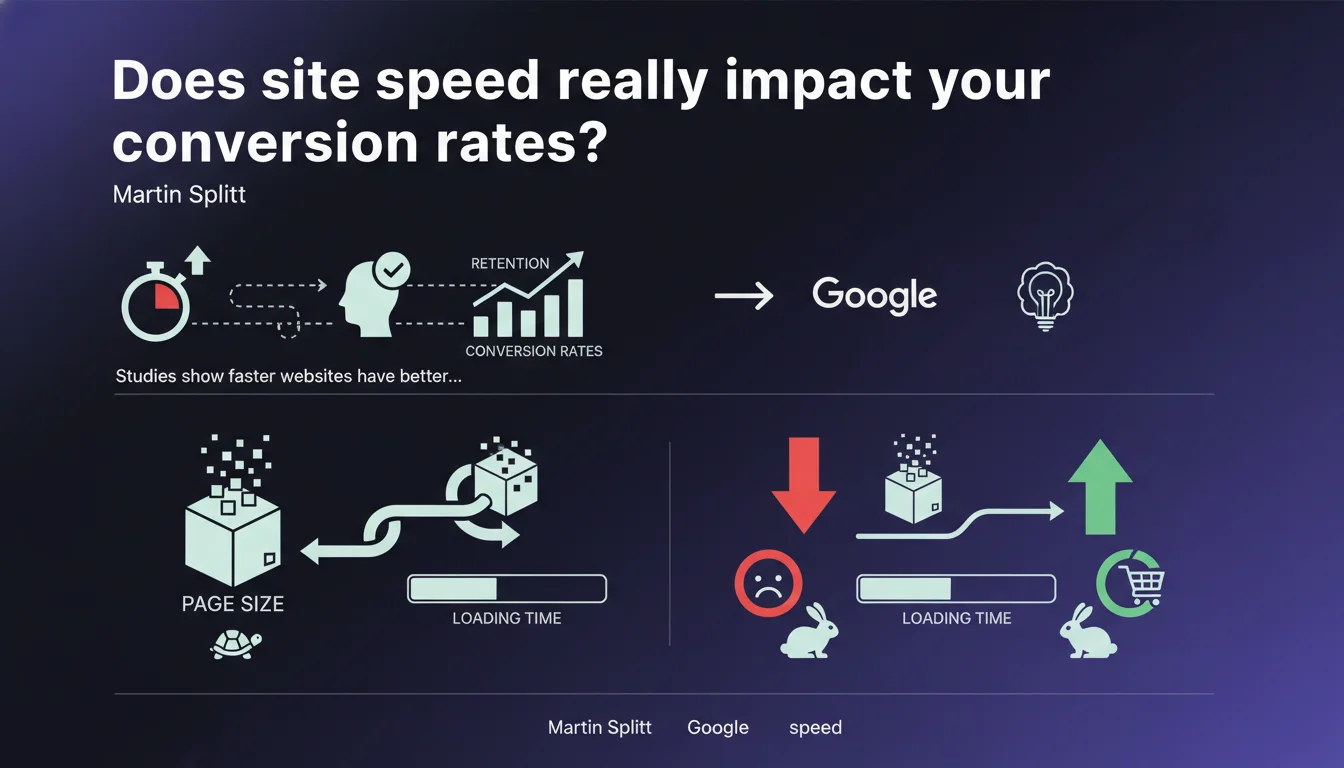
Google confirms that page load speed directly influences visitor retention and conversion. The more data a site transfers, the slower it loads — and the higher the bounce rate climbs. Page weight becomes a business lever, not just a technical metric.
What you need to understand
Why does Google explicitly acknowledge this link between speed and conversion?
This statement breaks away from the purely technical logic often associated with Core Web Vitals. Google doesn't just say "optimize your LCP" — it admits that speed directly affects business KPIs: retention, conversion, revenue.
Between the lines, it's a strong signal: the algorithm doesn't judge performance for the sake of the metric, but because it correlates with real user experience. A slow site loses customers before they even see the content.
What does "page size" concretely mean in this context?
Martin Splitt mentions the total data transferred: uncompressed images, unnecessary JavaScript, multiple web fonts, auto-play videos. Every additional kilobyte lengthens Time to Interactive (TTI) and degrades user perception.
On average mobile 4G, a 3 MB page can take 8 seconds to fully load. At that point, 53% of visitors have already left the site (source Google/SOASTA). The math is brutal.
What indicators does Google use to measure this impact?
- First Contentful Paint (FCP): first element visible on screen
- Largest Contentful Paint (LCP): main element loaded (< 2.5 s ideally)
- Cumulative Layout Shift (CLS): visual stability during loading
- Time to Interactive (TTI): moment when the page becomes truly usable
- Total Blocking Time (TBT): duration when the main thread is blocked
SEO Expert opinion
Is this statement consistent with real-world observations?
Yes — and that's rare. A/B tests conducted by Amazon, Walmart, and Shopify confirm that one additional second of delay = 7 to 10% conversion loss on average. Google isn't pulling this insight out of thin air.
Where it gets tricky: Google doesn't specify what speed threshold is sufficient. An LCP of 2.4 s is technically "good," but a competitor at 1.2 s can crush you on conversion rate — without the algorithm penalizing you at all.
What nuances should we add?
Speed is not the only conversion factor. A fast site with poor design, a broken checkout flow, or unclear pricing will always convert worse than an average site that's well thought out. Let's be honest: Google is oversimplifying.
Another point: the speed/conversion correlation varies by industry. In fashion e-commerce, where imagery matters, an ultra-fast site loading pixelated visuals can disappoint. Balancing visual quality / weight / speed is delicate. [To verify]: Google provides no sector-specific data to refine this finding.
In what cases does this rule not strictly apply?
In low-competition niches or high-intent searches (e.g., ultra-specialized B2B platform), a prospect will tolerate 3-4 seconds of loading if they have no credible alternatives. Speed remains a plus but doesn't become blocking.
Practical impact and recommendations
What concrete steps should you take to reduce page weight?
Top priority: compress images. WebP or AVIF reduce weight by 30 to 50% vs JPEG with no noticeable visual loss. Use native lazy loading for below-the-fold images.
Next, audit your JavaScript. A single misconfigured tracking pixel can load 200 KB of blocking third-party scripts. Switch to asynchronous or deferred loading (defer/async). Remove anything non-critical for above-the-fold content.
Finally, enable Brotli compression on your server (superior to Gzip) and aggressively cache static resources (Cache-Control max-age=31536000). A CDN becomes essential as soon as you target international traffic.
What mistakes should you absolutely avoid?
- Loading multiple web fonts (maximum 2, subset only the glyphs you need)
- Ignoring render-blocking CSS: inline critical CSS, defer the rest
- Using auto-play carousels with 10 unoptimized 4K slides
- Neglecting preload/prefetch for critical resources (LCP image, fonts)
- Leaving unused WordPress/Shopify plugins around that inject code
How do you verify your site respects these best practices?
Run a PageSpeed Insights or WebPageTest audit (preferably with 4G throttling). Target an LCP < 2 s, a CLS < 0.1, a TBT < 200 ms. If you're in the orange range, it's fixable — but the green competitor will steal your traffic.
Install Lighthouse CI in continuous integration to block any deployment that degrades metrics. Automate monitoring via CrUX (Chrome User Experience Report) to track real user speed, not just lab results.
❓ Frequently Asked Questions
La vitesse impacte-t-elle le SEO au-delà de la conversion ?
Quel est le seuil de poids de page acceptable aujourd'hui ?
Un CDN suffit-il à résoudre les problèmes de vitesse ?
Comment prioriser les optimisations de vitesse ?
La vitesse compte-t-elle autant en desktop qu'en mobile ?
🎥 From the same video 43
Other SEO insights extracted from this same Google Search Central video · published on 30/03/2026
🎥 Watch the full video on YouTube →
💬 Comments (0)
Be the first to comment.