
Official statement
Other statements from this video 43 ▾
- □ Does the 15 MB Googlebot crawl limit really kill your indexation, and how can you fix it?
- □ Is Google Really Measuring Page Weight the Way You Think It Does?
- □ Has mobile page weight tripled in 10 years? Why should SEO professionals care about this trend?
- □ Is your structured data bloating your pages too much to be worth the SEO investment?
- □ Is your mobile site missing critical content that exists on desktop?
- □ Is your desktop content disappearing from Google rankings because it's missing on mobile?
- □ Does page speed really impact conversions according to Google?
- □ Is Google really processing 40 billion spam URLs every single day?
- □ Does network compression really improve your site's crawl budget?
- □ Is lazy loading really essential to optimize your initial page weight and boost Core Web Vitals?
- □ Does Googlebot really stop crawling after 15 MB per URL?
- □ Has mobile page weight really tripled in just one decade?
- □ Does page weight really affect user experience and SEO performance?
- □ Does structured data really bloat your HTML and hurt page performance?
- □ Is mobile-desktop parity really costing you search rankings more than you think?
- □ Should you still worry about page weight for SEO in 2024?
- □ Is resource size really the make-or-break factor for your website's speed?
- □ Is Google really enforcing a strict 1 MB limit on images—and what does that tell you about SEO priorities?
- □ Does optimizing page size actually benefit users more than it benefits your search rankings?
- □ Does Googlebot really cap crawling at 15 MB per URL?
- □ Is exploding web page weight hurting your SEO? Here's what you need to know
- □ Is page size really still hurting your SEO in 2024?
- □ Are structured data slowing down your pages enough to harm your SEO?
- □ Does page loading speed really impact your conversion rates?
- □ Does network compression really optimize user device storage space, or is it just a temporary fix?
- □ Is content disparity between mobile and desktop killing your rankings in mobile-first indexing?
- □ Is lazy loading really a must-have SEO performance lever you should activate systematically?
- □ Does Google really block 40 billion spam URLs daily—and how does your site avoid the filter?
- □ Can image optimization really cut your page weight by 90%?
- □ Does Googlebot really stop at 15 MB per URL?
- □ Is your page weight really slowing down your SEO performance?
- □ Does structured data really slow down your crawl budget?
- □ Does Google really block 40 billion spam URLs every single day?
- □ Should you really cap your images at 1 MB to satisfy Google?
- □ Does Googlebot really stop crawling after 15 MB per URL?
- □ Does site speed really impact your conversion rates?
- □ Is mobile-desktop mismatch really destroying your SEO rankings right now?
- □ Do structured data markups really bloat your HTML pages?
- □ Does page size really matter for SEO when internet connections keep getting faster?
- □ Is network compression really enough to optimize your site's crawlability?
- □ Can lazy loading really boost your performance without hurting crawlability?
- □ Does your website's overall size really hurt your SEO performance?
- □ Why does Google enforce a strict 1MB image size limit across its developer documentation?
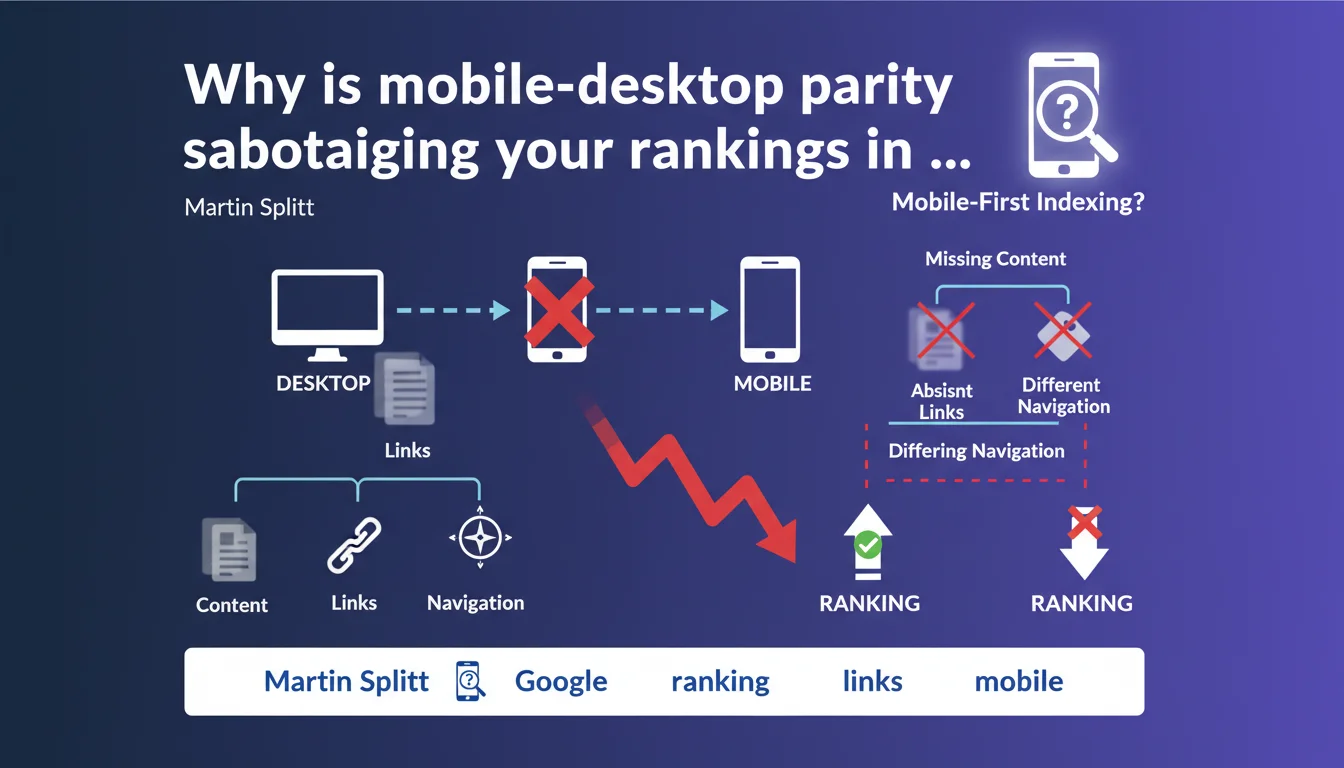
Google has discovered that many websites display critical differences between their mobile and desktop versions: truncated content, missing links, divergent metadata. These parity gaps directly degrade your rankings since the shift to Mobile-First Indexing. Indexing is now based on what Googlebot sees on mobile, and any shortfall on that version penalizes you.
What you need to understand
What does "mobile-desktop parity" actually mean in practical terms?
Mobile-desktop parity refers to strict alignment between what your mobile version displays and what your desktop version offers. Text content, images, internal links, navigation, metadata (title, meta description, heading tags), structured data — everything must be identical or virtually identical.
Since Mobile-First Indexing, Googlebot indexes your page's mobile version as a priority. If that version is diminished compared to desktop (sections hidden in accordions never expanded, poorly implemented lazy-loading, navigation oversimplified), Google only sees a watered-down version of your site. And it ranks what it sees.
What kinds of problems has Google actually identified?
Martin Splitt outlines several frequent gaps. Missing content: entire blocks absent on mobile, often from questionable UX choices. Missing links: reduced internal linking, simplified menus that deprive Googlebot of essential crawl paths. Divergent navigation: different structures that make your site architecture unclear for indexing.
Metadata also causes problems — different titles or meta descriptions between mobile and desktop create confusion. Some sites even serve incomplete structured data on mobile, depriving Google of rich signals that are present on desktop.
Why does this tank your rankings?
Because Google ranks what it indexes. If your mobile version lacks semantic depth, internal linking, structured signals, it appears less relevant than a competitor offering strict parity. Missing content isn't indexed — so it can't be ranked.
Fragmented navigation also dilutes crawl budget and internal PageRank flow. Missing links mean orphaned or under-crawled pages that lose visibility. Google doesn't perform gymnastics to reconstruct your site — it indexes what it finds, period.
- Mobile-First Indexing: Googlebot indexes your pages' mobile version first
- Strict parity required: content, links, navigation, metadata must be identical across mobile/desktop
- Missing content = unindexed content and degraded rankings
- Mobile internal linking: essential for crawl and PageRank distribution
- Consistent metadata: title, meta description, structured data must be aligned
SEO Expert opinion
Is this claim consistent with what we're seeing in the field?
Absolutely. Since the full rollout of Mobile-First Indexing, we've seen organic traffic drops on sites that "optimized" their mobile versions by removing content deemed secondary. Google doesn't guess what's missing — it indexes what it sees.
The most glaring cases involve e-commerce sites that hid lengthy product descriptions, customer reviews, or FAQs in accordions never expanded by default. Mobile Googlebot doesn't click your tabs. If content isn't visible on initial HTML load (or via well-implemented lazy-loading), it's potentially ignored. [Needs verification] on certain JS frameworks — Google claims to crawl rendered content, but timing and reliability vary depending on complexity.
What nuances should we apply to this rule?
Strict parity doesn't mean pixel-perfect identity. Google tolerates legitimate UX adaptations: larger buttons, hamburger navigation, resized images. What it won't tolerate is removal of text content or key structural links.
Some purely decorative or redundant content can differ without impact. But any element carrying meaning — headings, paragraphs, internal links, structured data — must be present on mobile. Image lazy-loading is acceptable if well-implemented (loading="lazy", fallback, no render-blocking JS). Accordions and tabs can work if content stays in the initial DOM and remains accessible to Googlebot.
In what cases does this rule not apply?
Be honest: rarely. Even desktop-only sites (yes, they exist in ultra-specialized B2B niches) have been indexed on Mobile-First since 2021. Google hasn't maintained a parallel desktop indexing track — everyone switched over.
The only theoretical exception: strict AMP pages, where Google may index the AMP version rather than the standard mobile version. But AMP is dying, so this case becomes marginal. For 99% of sites, mobile-desktop parity = non-negotiable.
Practical impact and recommendations
What concrete steps ensure parity?
First move: audit your mobile vs desktop templates. Compare the HTML source (not the visual render) of your page types: homepage, product pages, articles, category pages. Verify that <title>, <meta name="description">, <h1> through <h6>, and structured data (JSON-LD, microdata) are identical.
Next, examine text content closely. Any paragraph on desktop must also be on mobile, even if it's collapsed in an accordion — as long as the HTML contains the text on initial load. Test with Search Console's URL Inspection tool: check both raw HTML rendering and rendered DOM. If a block is missing, fix it.
For internal linking, compare the number of links in your menus, footers, breadcrumbs, related content blocks. A mobile menu reduced to 5 items when desktop shows 20 creates a crawl imbalance. Favor complete hamburger menus or progressive navigation strategies (accessible sub-menus) rather than cutting everything.
What mistakes must you absolutely avoid?
Don't hide essential content with display:none on mobile. Google may see it, but it interprets this choice as a signal of lower importance. Use native HTML accordions (<details>/<summary>) or accessible tabs that keep content in the DOM.
Also avoid overly aggressive JS lazy-loading that loads content only on scroll or click. Mobile Googlebot might miss it, especially if your JS is heavy or slow. Prefer native lazy-loading with loading="lazy" for images, and keep critical text in initial HTML.
Don't serve divergent metadata between mobile and desktop "to test." Google indexes mobile — so your mobile title/meta becomes the reference. If you A/B test, do it coherently or expect ranking fluctuations.
How do you verify your site is compliant?
Use the URL Inspection tool in Search Console. Test your key pages in mobile view. Compare HTML rendering and screenshots with desktop. Verify all critical elements are present: content, links, structured data.
Check the Coverage report to spot pages indexed with warnings or errors related to missing content. Analyze your server logs: if mobile Googlebot crawls fewer pages than desktop Googlebot did before the switch, that's a red flag — some pages may have become orphaned on mobile.
Also compare your ranking performance before/after Mobile-First. A drop in positions on keywords where you ranked well could indicate diminished mobile content. Cross-reference with Search Console data (impressions, clicks, CTR) to identify affected pages.
- Compare mobile vs desktop HTML source on your main templates
- Verify title, meta description, and heading tag consistency
- Ensure all desktop text content is present on mobile (even in accordions)
- Check internal linking: menus, breadcrumbs, contextual links
- Validate mobile structured data with Google's testing tool
- Audit lazy-loading: prefer native implementation, avoid blocking JS
- Test with URL Inspection tool in Search Console
- Review server logs for orphaned pages on mobile
- Monitor ranking performance post-Mobile-First
❓ Frequently Asked Questions
Le contenu en accordéon est-il indexé par Google en Mobile-First ?
Dois-je avoir exactement le même nombre de liens internes sur mobile et desktop ?
Google indexe-t-il le contenu chargé en lazy-loading JS ?
Peut-on avoir des métadonnées différentes entre mobile et desktop ?
Comment détecter si mon site a perdu du classement à cause d'un manque de parité ?
🎥 From the same video 43
Other SEO insights extracted from this same Google Search Central video · published on 30/03/2026
🎥 Watch the full video on YouTube →
💬 Comments (0)
Be the first to comment.