
Official statement
Other statements from this video 43 ▾
- □ Does the 15 MB Googlebot crawl limit really kill your indexation, and how can you fix it?
- □ Is Google Really Measuring Page Weight the Way You Think It Does?
- □ Is your structured data bloating your pages too much to be worth the SEO investment?
- □ Is your mobile site missing critical content that exists on desktop?
- □ Is your desktop content disappearing from Google rankings because it's missing on mobile?
- □ Does page speed really impact conversions according to Google?
- □ Is Google really processing 40 billion spam URLs every single day?
- □ Does network compression really improve your site's crawl budget?
- □ Is lazy loading really essential to optimize your initial page weight and boost Core Web Vitals?
- □ Does Googlebot really stop crawling after 15 MB per URL?
- □ Has mobile page weight really tripled in just one decade?
- □ Does page weight really affect user experience and SEO performance?
- □ Does structured data really bloat your HTML and hurt page performance?
- □ Is mobile-desktop parity really costing you search rankings more than you think?
- □ Should you still worry about page weight for SEO in 2024?
- □ Is resource size really the make-or-break factor for your website's speed?
- □ Is Google really enforcing a strict 1 MB limit on images—and what does that tell you about SEO priorities?
- □ Does optimizing page size actually benefit users more than it benefits your search rankings?
- □ Does Googlebot really cap crawling at 15 MB per URL?
- □ Is exploding web page weight hurting your SEO? Here's what you need to know
- □ Is page size really still hurting your SEO in 2024?
- □ Are structured data slowing down your pages enough to harm your SEO?
- □ Does page loading speed really impact your conversion rates?
- □ Does network compression really optimize user device storage space, or is it just a temporary fix?
- □ Is content disparity between mobile and desktop killing your rankings in mobile-first indexing?
- □ Is lazy loading really a must-have SEO performance lever you should activate systematically?
- □ Does Google really block 40 billion spam URLs daily—and how does your site avoid the filter?
- □ Can image optimization really cut your page weight by 90%?
- □ Does Googlebot really stop at 15 MB per URL?
- □ Why is mobile-desktop parity sabotaging your rankings in Mobile-First Indexing?
- □ Is your page weight really slowing down your SEO performance?
- □ Does structured data really slow down your crawl budget?
- □ Does Google really block 40 billion spam URLs every single day?
- □ Should you really cap your images at 1 MB to satisfy Google?
- □ Does Googlebot really stop crawling after 15 MB per URL?
- □ Does site speed really impact your conversion rates?
- □ Is mobile-desktop mismatch really destroying your SEO rankings right now?
- □ Do structured data markups really bloat your HTML pages?
- □ Does page size really matter for SEO when internet connections keep getting faster?
- □ Is network compression really enough to optimize your site's crawlability?
- □ Can lazy loading really boost your performance without hurting crawlability?
- □ Does your website's overall size really hurt your SEO performance?
- □ Why does Google enforce a strict 1MB image size limit across its developer documentation?
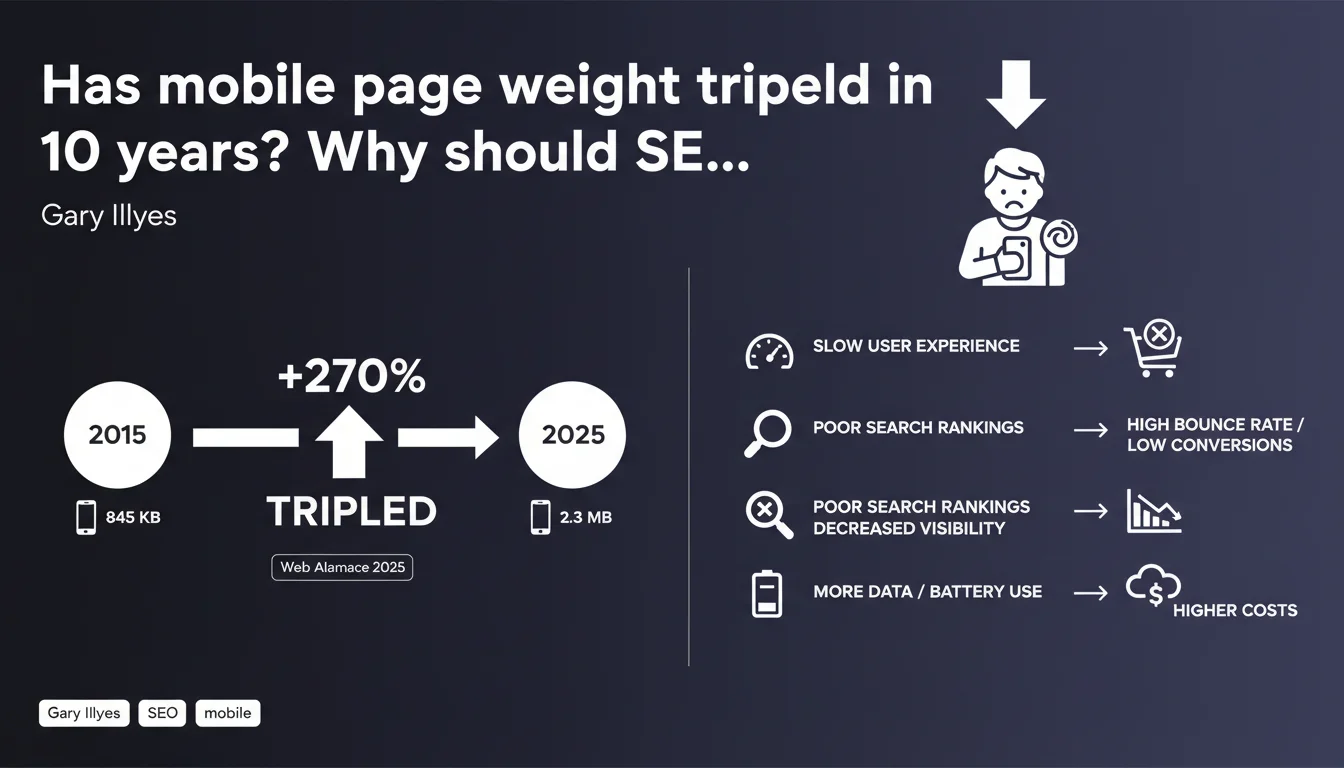
The median weight of a mobile homepage has grown from 845 KB to 2.3 MB in ten years. This explosion raises serious questions about Core Web Vitals and user experience. Google is observing this trend without clarifying its direct impact on rankings.
What you need to understand
Why is this growth in page weight becoming a real problem?
The figures from the Web Almanac are crystal clear: a threefold multiplication of median weight over a decade. This inflation is driven by high-definition visuals, increasingly heavy JavaScript frameworks, and an accumulation of third-party scripts — analytics, chatbots, advertisements.
The real issue? On mobile, this overload directly impacts loading time, LCP (Largest Contentful Paint), and data consumption. Users on slow networks pay the price.
Does Google actually penalize heavy pages?
Not directly. Google has never stated that a page weight in MB triggers automatic punishment. What matters: user experience metrics — CWV, perceived speed, bounce rate.
But let's be honest: a 3 MB page will mechanically take longer to load than a 500 KB page. The impact on LCP and FID is almost inevitable. Google evaluates the experience, not the weight — but the two are correlated.
What are the main culprits behind this bloat?
Unoptimized images top the list. Poorly compressed PNG or JPEG formats, absence of WebP or AVIF, desktop visuals served on mobile without adaptation.
Then there are scripts. Dozens of HTTP requests for libraries you use just 10% of. Custom fonts loaded from distant CDNs. Autoplay videos that tank your First Input Delay.
- Unoptimized images: lack of modern formats, insufficient compression
- Bloated JavaScript: oversized frameworks, unnecessary dependencies
- Third-party scripts: tracking, ads, social widgets beyond your control
- Web fonts: synchronous loading, multiple variants rarely used
- Videos and rich media: autoplay, absent lazy loading
SEO Expert opinion
Is this observation consistent with what we're seeing in the field?
Yes, unsurprisingly. Technical SEO audits confirm it: the vast majority of analyzed sites far exceed 2 MB on mobile. Popular CMS platforms — WordPress, Shopify — ship by default with themes loaded with rarely optimized resources.
What puzzles me: Gary Illyes presents these figures as a neutral observation, without explicit recommendation. Is this just a simple observation or a disguised warning signal? Hard to say. [To verify]: Google rarely communicates direct correlations between page weight and ranking.
In what cases is this trend not problematic?
If your site displays excellent Core Web Vitals despite heavy weight, you're technically in the clear. Some luxury e-commerce sites serve 4 MB pages with LCP under 2.5s thanks to aggressive lazy loading and premium CDN infrastructure.
But that's the exception. For 95% of sites, high weight equals degraded experience. The infrastructure budgets that enable these technical miracles aren't within reach of everyone.
What nuance should we add to these figures?
The median weight says nothing about distribution. A 2.3 MB median can hide highly performant 500 KB sites and unmanageable 8 MB ones. Aggregated data masks sector disparities.
Practical impact and recommendations
What concrete steps should you take to reverse this trend?
Start with a weight audit. Identify the heaviest resources: images, scripts, fonts. Prioritize quick wins — image compression, WebP migration, removal of unnecessary scripts.
Lazy loading is your best ally. Load images and iframes only when they enter the viewport. Defer non-critical script execution with defer or async.
How do you measure the real impact on your performance?
Use PageSpeed Insights and the CrUX Report to see how real users perceive your site. Lab data (Lighthouse) is useful, but field metrics matter more to Google.
Monitor your LCP, your CLS, and your FID or INP. If you exceed recommended thresholds, your page weight is directly impacting user experience.
What mistakes should you avoid in this optimization?
Don't sacrifice visual quality to the point of making your site ugly. An over-compressed JPEG that pixelates is worse than a slightly heavy file. Find the balance between weight and rendering quality.
Another trap: removing all third-party scripts at once without testing. Some are essential — analytics, consent management. Prioritize those that deliver business value.
- Audit total weight for each key template (homepage, product page, article)
- Convert all images to WebP or AVIF format
- Implement native lazy loading on images and iframes
- Load fonts with font-display: swap to avoid FOIT
- Minify and concatenate CSS and JavaScript
- Remove non-essential third-party scripts or load them asynchronously
- Use a CDN to serve static resources
- Monitor Core Web Vitals with CrUX and Search Console
❓ Frequently Asked Questions
Le poids de ma page impacte-t-il directement mon ranking Google ?
À partir de quel poids une page mobile est-elle considérée comme trop lourde ?
Les images sont-elles le principal facteur d'alourdissement ?
Faut-il privilégier WebP ou AVIF pour les images ?
Comment gérer les scripts tiers qui plombent mon temps de chargement ?
🎥 From the same video 43
Other SEO insights extracted from this same Google Search Central video · published on 30/03/2026
🎥 Watch the full video on YouTube →
💬 Comments (0)
Be the first to comment.