
Official statement
Other statements from this video 43 ▾
- □ Does the 15 MB Googlebot crawl limit really kill your indexation, and how can you fix it?
- □ Is Google Really Measuring Page Weight the Way You Think It Does?
- □ Has mobile page weight tripled in 10 years? Why should SEO professionals care about this trend?
- □ Is your structured data bloating your pages too much to be worth the SEO investment?
- □ Is your mobile site missing critical content that exists on desktop?
- □ Does page speed really impact conversions according to Google?
- □ Is Google really processing 40 billion spam URLs every single day?
- □ Does network compression really improve your site's crawl budget?
- □ Is lazy loading really essential to optimize your initial page weight and boost Core Web Vitals?
- □ Does Googlebot really stop crawling after 15 MB per URL?
- □ Has mobile page weight really tripled in just one decade?
- □ Does page weight really affect user experience and SEO performance?
- □ Does structured data really bloat your HTML and hurt page performance?
- □ Is mobile-desktop parity really costing you search rankings more than you think?
- □ Should you still worry about page weight for SEO in 2024?
- □ Is resource size really the make-or-break factor for your website's speed?
- □ Is Google really enforcing a strict 1 MB limit on images—and what does that tell you about SEO priorities?
- □ Does optimizing page size actually benefit users more than it benefits your search rankings?
- □ Does Googlebot really cap crawling at 15 MB per URL?
- □ Is exploding web page weight hurting your SEO? Here's what you need to know
- □ Is page size really still hurting your SEO in 2024?
- □ Are structured data slowing down your pages enough to harm your SEO?
- □ Does page loading speed really impact your conversion rates?
- □ Does network compression really optimize user device storage space, or is it just a temporary fix?
- □ Is content disparity between mobile and desktop killing your rankings in mobile-first indexing?
- □ Is lazy loading really a must-have SEO performance lever you should activate systematically?
- □ Does Google really block 40 billion spam URLs daily—and how does your site avoid the filter?
- □ Can image optimization really cut your page weight by 90%?
- □ Does Googlebot really stop at 15 MB per URL?
- □ Why is mobile-desktop parity sabotaging your rankings in Mobile-First Indexing?
- □ Is your page weight really slowing down your SEO performance?
- □ Does structured data really slow down your crawl budget?
- □ Does Google really block 40 billion spam URLs every single day?
- □ Should you really cap your images at 1 MB to satisfy Google?
- □ Does Googlebot really stop crawling after 15 MB per URL?
- □ Does site speed really impact your conversion rates?
- □ Is mobile-desktop mismatch really destroying your SEO rankings right now?
- □ Do structured data markups really bloat your HTML pages?
- □ Does page size really matter for SEO when internet connections keep getting faster?
- □ Is network compression really enough to optimize your site's crawlability?
- □ Can lazy loading really boost your performance without hurting crawlability?
- □ Does your website's overall size really hurt your SEO performance?
- □ Why does Google enforce a strict 1MB image size limit across its developer documentation?
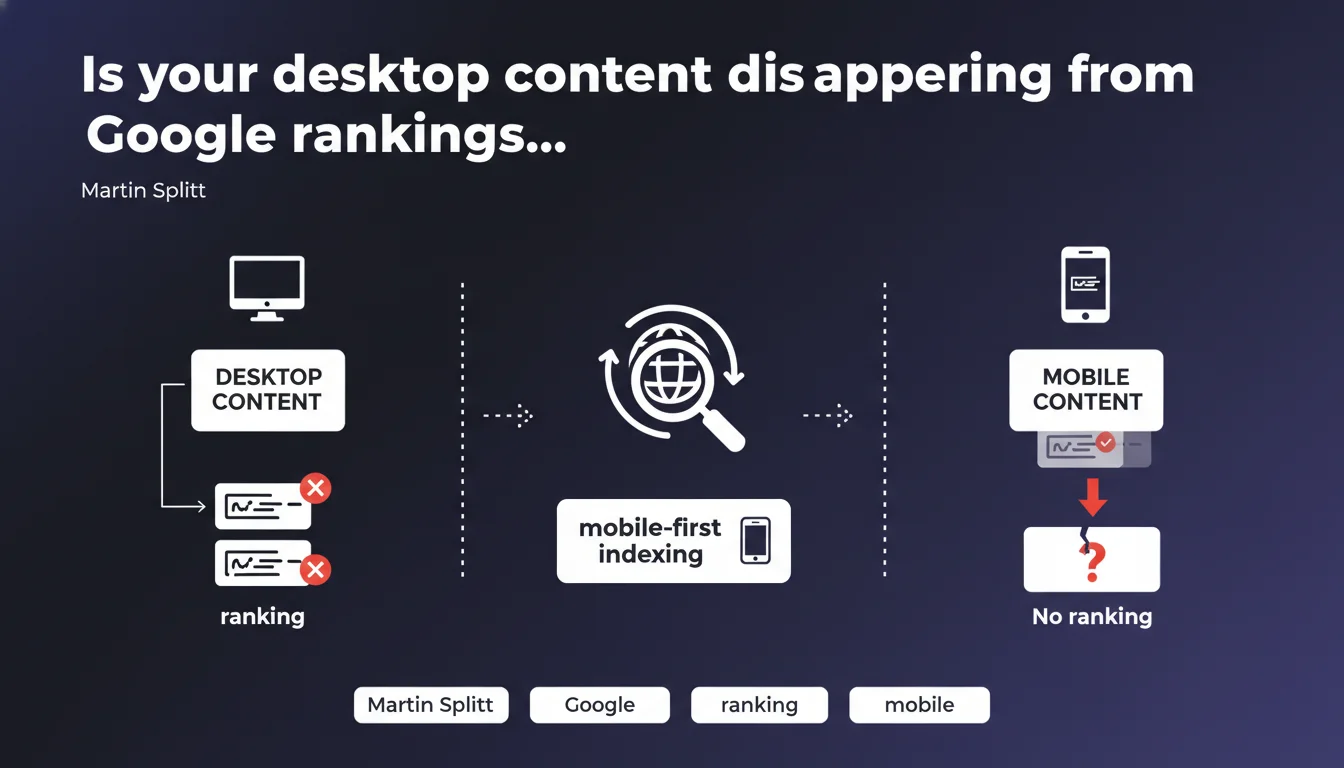
Google won't rank pages for queries related to content that's absent from the mobile version, even if that content exists on desktop. Mobile-first indexing uses exclusively the mobile version to assess a page's relevance. If a text block, section, or structural elements aren't rendered on smartphone, they simply don't exist in the algorithm's eyes.
What you need to understand
What exactly does Google mean by "missing content"?
We're talking about any textual, visual, or structural element present on the desktop version but absent or hidden on mobile. This includes paragraphs hidden behind accordions that aren't expanded by default, images that fail to lazy-load properly, or HTML blocks that are completely removed in responsive design.
Mobile-first indexing makes no compromises: if Googlebot mobile doesn't see content, it considers it nonexistent. No matter how comprehensive your desktop version is — it's the mobile version that dictates what can be ranked.
Since when has this rule actually been enforced?
Mobile-first indexing was rolled out gradually, site by site, before becoming the standard for the entire web. All new sites are indexed mobile-first from launch. Legacy domains that hadn't yet switched were converted automatically.
What changed is that Google no longer maintains two parallel indexes. There's no safety net anymore: if your mobile version is incomplete, your rankings collapse on the affected queries. It's mechanical.
Which types of sites are most exposed to this problem?
E-commerce sites with truncated product descriptions on mobile to save space. News outlets that hide entire paragraphs behind non-crawlable "Read more" buttons. SaaS platforms that display technical specifications only on desktop.
Sites using client-side JavaScript to conditionally display content based on screen width are also at risk — if server-side rendering doesn't keep up, Googlebot mobile misses it.
- Content parity: any text visible on desktop must be visible on mobile, even if the formatting differs
- Accordions and tabs: Google can index their content, but only if it's technically present in the mobile DOM
- Images and media: alt attributes, captions, and alternative text must be identical across both versions
- Structured data: Schema.org tags must be present on mobile, not just on desktop
- Internal linking: incomplete navigation on mobile breaks the site structure and PageRank distribution
SEO Expert opinion
Is this statement consistent with what we observe in the field?
Absolutely. We've seen sites lose 40 to 60% of their organic traffic after a mobile redesign that had "simplified" the experience by removing entire sections. Google wasn't bluffing: if content is missing, rankings disappear for the associated queries.
What's less visible is the granularity of this penalty. Google doesn't necessarily demote the entire page — it may simply stop offering it for specific terms related to the missing content. Result: a gradual erosion of long-tail traffic that goes unnoticed until log analysis.
What nuances should we apply to this rule?
Martin Splitt doesn't clarify whether Google differentiates between content that's visually hidden but present in the DOM and content completely absent from HTML. [To verify] based on field feedback: closed accordions by default seem to be indexed, but their weighting might be lower than immediately visible text.
Another gray area: what about content loaded dynamically after user interaction (infinite scroll, "See more" clicks)? If JavaScript doesn't execute for Googlebot or rendering takes too long, these elements can be ignored. We lack clear public data on tolerance thresholds.
Finally, some corporate sites intentionally show fewer technical details on mobile, betting that decision-makers will seek this information from a desktop. That's a losing bet — B2B queries are now predominantly mobile, and Google won't make an exception.
Practical impact and recommendations
How do you verify your site isn't losing content on mobile?
Start with a comparative crawl: use Screaming Frog or Oncrawl in desktop mode, then in mobile mode (Googlebot smartphone user-agent). Export the word count per URL and compare. Any significant discrepancy is a red flag.
Next, manually inspect strategic pages using the Search Console URL inspection tool. Look at the rendered HTML: if entire blocks are missing, or if display:none hides essential content without valid UX reasoning, you have a problem.
What mistakes should you absolutely avoid during a responsive redesign?
Never remove text content on the grounds that "it's too long on small screens." Instead prefer UX solutions like accordions, tabs, or scrolling — as long as the content remains in the DOM and is technically accessible to Googlebot.
Beware of CSS frameworks that automatically hide certain elements on mobile. A simple .hidden-xs can make a key paragraph disappear. Verify that your structured data is properly present on mobile — some CMS platforms generate it only on desktop.
Also avoid conditioning the display of entire content blocks on complex JavaScript interactions. If Googlebot must click, scroll, or wait for an event to see the text, it risks missing it.
What should you do if you've already lost traffic because of this problem?
Restore content parity between desktop and mobile as quickly as possible. Redeploy missing sections, even if it requires reworking the UX. Then force reindexing via Search Console (URL inspection > Request indexing) for priority pages.
Monitor server logs to confirm that Googlebot mobile actually recrawls these pages and that rendering is complete. Position recovery can take several weeks — be patient, but track progress through performance reports.
- Crawl your site in both desktop AND mobile mode with respective Googlebot user-agents
- Compare word count per URL and identify discrepancies > 10%
- Verify that accordions/tabs load their content in the initial DOM, not after interaction
- Audit Schema.org tags and ensure they're present on mobile
- Test JavaScript rendering using the Search Console URL inspection tool
- Confirm that images have the same alt attributes and captions across both versions
- Review mobile internal linking so it's as complete as desktop
- Document UX decisions that justify differentiated display (never pure deletion)
❓ Frequently Asked Questions
Les accordéons fermés par défaut sur mobile sont-ils indexés par Google ?
Faut-il avoir exactement le même nombre de mots sur mobile et desktop ?
Comment Google gère-t-il les images lazy-loadées sur mobile ?
Si mon site est en m-dot (version mobile séparée), cette règle s'applique-t-elle aussi ?
Peut-on récupérer rapidement du trafic après avoir restauré le contenu manquant ?
🎥 From the same video 43
Other SEO insights extracted from this same Google Search Central video · published on 30/03/2026
🎥 Watch the full video on YouTube →
💬 Comments (0)
Be the first to comment.