
Official statement
Other statements from this video 43 ▾
- □ Does the 15 MB Googlebot crawl limit really kill your indexation, and how can you fix it?
- □ Is Google Really Measuring Page Weight the Way You Think It Does?
- □ Has mobile page weight tripled in 10 years? Why should SEO professionals care about this trend?
- □ Is your structured data bloating your pages too much to be worth the SEO investment?
- □ Is your mobile site missing critical content that exists on desktop?
- □ Is your desktop content disappearing from Google rankings because it's missing on mobile?
- □ Does page speed really impact conversions according to Google?
- □ Is Google really processing 40 billion spam URLs every single day?
- □ Does network compression really improve your site's crawl budget?
- □ Is lazy loading really essential to optimize your initial page weight and boost Core Web Vitals?
- □ Does Googlebot really stop crawling after 15 MB per URL?
- □ Has mobile page weight really tripled in just one decade?
- □ Does page weight really affect user experience and SEO performance?
- □ Does structured data really bloat your HTML and hurt page performance?
- □ Is mobile-desktop parity really costing you search rankings more than you think?
- □ Should you still worry about page weight for SEO in 2024?
- □ Is resource size really the make-or-break factor for your website's speed?
- □ Is Google really enforcing a strict 1 MB limit on images—and what does that tell you about SEO priorities?
- □ Does optimizing page size actually benefit users more than it benefits your search rankings?
- □ Does Googlebot really cap crawling at 15 MB per URL?
- □ Is exploding web page weight hurting your SEO? Here's what you need to know
- □ Is page size really still hurting your SEO in 2024?
- □ Are structured data slowing down your pages enough to harm your SEO?
- □ Does page loading speed really impact your conversion rates?
- □ Does network compression really optimize user device storage space, or is it just a temporary fix?
- □ Is content disparity between mobile and desktop killing your rankings in mobile-first indexing?
- □ Is lazy loading really a must-have SEO performance lever you should activate systematically?
- □ Does Google really block 40 billion spam URLs daily—and how does your site avoid the filter?
- □ Can image optimization really cut your page weight by 90%?
- □ Does Googlebot really stop at 15 MB per URL?
- □ Why is mobile-desktop parity sabotaging your rankings in Mobile-First Indexing?
- □ Is your page weight really slowing down your SEO performance?
- □ Does structured data really slow down your crawl budget?
- □ Should you really cap your images at 1 MB to satisfy Google?
- □ Does Googlebot really stop crawling after 15 MB per URL?
- □ Does site speed really impact your conversion rates?
- □ Is mobile-desktop mismatch really destroying your SEO rankings right now?
- □ Do structured data markups really bloat your HTML pages?
- □ Does page size really matter for SEO when internet connections keep getting faster?
- □ Is network compression really enough to optimize your site's crawlability?
- □ Can lazy loading really boost your performance without hurting crawlability?
- □ Does your website's overall size really hurt your SEO performance?
- □ Why does Google enforce a strict 1MB image size limit across its developer documentation?
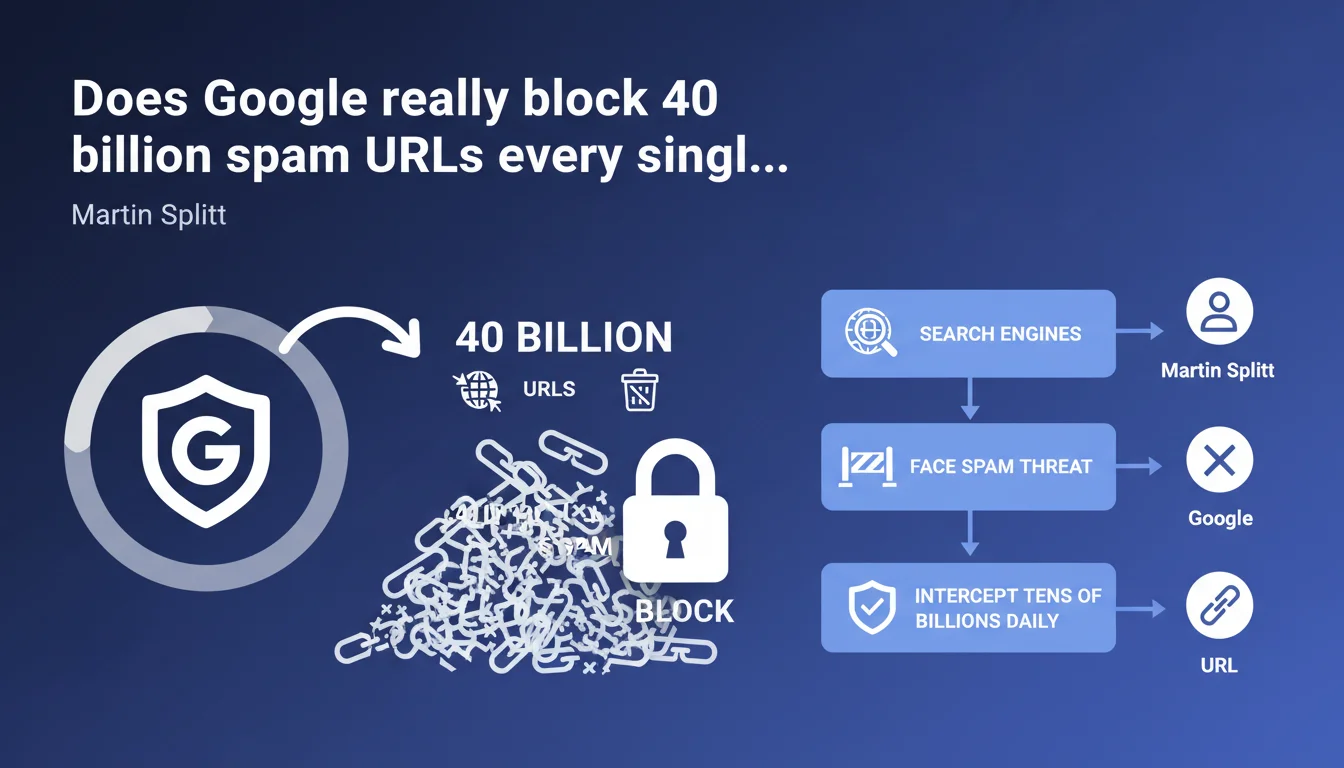
Google blocks 40 billion spam URLs daily, a figure that illustrates the industrial scale of web spam. This statement from Martin Splitt confirms that spam detection is now largely automated and Google's filters operate upstream of indexation. For legitimate sites, this means that poor configuration or ambiguous signals can push you across the wrong side of this barrier.
What you need to understand
What does this 40 billion figure really mean in practice?
This colossal volume represents URLs detected and blocked before they even reach the index. We're talking about real-time detection, likely at the crawl level or just before indexation.
Google doesn't clarify whether these 40 billion include duplicates from the same spam campaign or if these are unique URLs. The distinction matters — a scraped site network can generate millions of variants of the same page.
How does Google filter spam at this scale?
It's impossible to handle this volume manually. Google relies on machine learning models trained to recognize spam patterns: disposable domains, massively duplicated content, artificial link schemes, suspicious crawl behavior.
Detection likely happens at multiple levels: during URL discovery (via links, sitemaps), during crawling (analysis of server responses), and at indexation time (content analysis and signal evaluation).
Why this announcement now?
Martin Splitt is trying to show that Google is handling the problem — a way to reassure amid rising AI-generated spam at scale. But it's also an indirect message to SEOs: if your practices look too much like spam, you risk being caught in the net.
- 40 billion URLs blocked per day = nearly total automated detection
- Filtering happens before indexation, not after
- Spam signals are detected by machine learning, not by humans
- A legitimate misconfigured site can trigger these filters
- The boundary between aggressive optimization and spam becomes increasingly blurred for algorithms
SEO Expert opinion
Is this figure credible given the total web volume?
Let's be honest — 40 billion per day sounds massive. But when you know the industrial spam ecosystem (auto-generated content farms, PBN networks, massive scraping, doorway pages), it's not far-fetched. [To verify]: Google doesn't clarify the methodology — are we talking about URLs discovered or URLs crawled?
What concerns me more is the silence on false positives. At this scale, even a 0.1% error rate means 40 million legitimate URLs blocked per day. Google says nothing about that.
Are legitimate sites safe from these filters?
Absolutely not. I've seen e-commerce sites with thousands of pages filtered due to poorly managed URL parameters, WordPress blogs generating noise through misconfigured archives, multilingual sites inadvertently creating duplicates.
The problem — and Google won't say it plainly — is that these filters don't always distinguish between a poorly built site and a malicious one. If your technical signals (speed, structure, robots.txt) resemble those of a scraper, you risk the same treatment.
Should I worry if I'm doing aggressive but legitimate SEO?
It depends on what you mean by "aggressive." If you're publishing 100 AI articles per day with over-optimized internal linking and purchased backlinks, you're getting dangerously close to detectable spam patterns. Machine learning doesn't judge intent — it detects patterns.
Practical impact and recommendations
How do I verify my site isn't caught in these filters?
First step: compare the number of URLs crawled (Search Console, server logs) against the number of URLs indexed. A significant gap may signal a problem. Use the site: command to check actual indexation, not just what Search Console says.
Next, analyze your server logs. If Googlebot discovers thousands of URLs but only indexes a fraction, and those URLs aren't blocked by robots.txt or noindex, you're probably being filtered.
What technical errors can trigger spam flagging?
Poorly managed URL parameters are a classic: ?sort=, ?page=, ?sessionid= generate infinite variants. Google might interpret this as doorway spam. Same thing with massive duplicate content: misconfigured pagination, non-canonicalized AMP/mobile/desktop versions, syndicated content without rel=canonical tags.
Sites generating automated content — even legitimate ones (product sheets, aggregators) — must absolutely differentiate their output from a scraper. This requires quality signals: fast load times, user engagement, coherent internal linking.
What should I do if my site suffers a sudden indexation drop?
Dig into your crawl logs to identify which URLs no longer get through. Check Googlebot's behavior: is it still crawling these pages, or completely ignoring them? If they're crawled but not indexed, it's probably a quality or spam filter.
Then audit your technical signals: server response time, 4xx/5xx error rates, chained redirects, duplicate content. Fix the most obvious issues first. If nothing changes after 4-6 weeks, it might be a manual filter — Search Console should notify you at that point.
- Monitor the gap between crawled and indexed URLs weekly
- Analyze server logs to detect URLs ignored by Googlebot
- Clean up unnecessary URL parameters via robots.txt or URL Parameters Tool
- Systematically canonicalize duplicated or similar content
- Verify that auto-generated content delivers real added value
- Monitor Core Web Vitals and user engagement signals
- Test page differentiation to avoid thin content flagged as spam
❓ Frequently Asked Questions
Ces 40 milliards d'URLs bloquées incluent-elles les pages en noindex ou robots.txt ?
Un site légitime peut-il être bloqué par erreur dans ces filtres ?
Comment savoir si mon site est touché par un filtre spam ?
Google communique-t-il quand il détecte un site comme spam ?
Le spam IA généré en masse est-il comptabilisé dans ces 40 milliards ?
🎥 From the same video 43
Other SEO insights extracted from this same Google Search Central video · published on 30/03/2026
🎥 Watch the full video on YouTube →
💬 Comments (0)
Be the first to comment.