
Official statement
Other statements from this video 29 ▾
- □ Does a bloated robots.txt file really hurt your SEO rankings?
- □ Does it really matter whether you submit your sitemap in robots.txt or Search Console?
- □ Do H1-H6 heading tags really still impact Google rankings?
- □ Is a strict heading tag hierarchy really necessary for SEO rankings?
- □ How long does Google actually take to fully process a domain migration?
- □ Can a site migration really boost your SEO rankings or destroy them completely?
- □ Does Googlebot really crawl from just one place when indexing your geo-targeted content?
- □ Can a noindex tag on geolocalized pages wipe your entire website from Google search results?
- □ Should you really ditch geo-redirects for a simple dynamic banner?
- □ How many location pages can you create before Google penalizes you for spam?
- □ Should you redirect mobile users to your app—and what are the hidden SEO risks?
- □ Does the domain directive in your Disavow file really help you bypass Google's 2MB limit?
- □ Should you really use the Disavow tool only for purchased links?
- □ Should you noindex your internal search results pages to prevent spammers from creating backlinks?
- □ Does semantic HTML really boost your search rankings?
- □ Is AMP still a ranking factor in Google Search?
- □ Is AMP really a ranking factor for Google?
- □ Does removing AMP actually boost crawl on your regular pages?
- □ Should you test removing your Disavow file incrementally, or can you delete it all at once?
- □ Why do knowledge panels display differently across devices and search contexts?
- □ Does Google's synonym system really work without any human intervention?
- □ Should you really create a separate page for each location to implement Local Business schema correctly?
- □ Do you really need to mark up ALL your content with structured data?
- □ Do you really need to display all FAQ schema questions visibly on your page?
- □ Can hidden accordion content really show up in featured snippets?
- □ Why does Google deliberately choose not to index your entire website?
- □ Should you delete pages to boost your site's indexation?
- □ Does search volume of anchor text really impact the value of your internal links?
- □ Should you really add unique content to your e-commerce product pages?
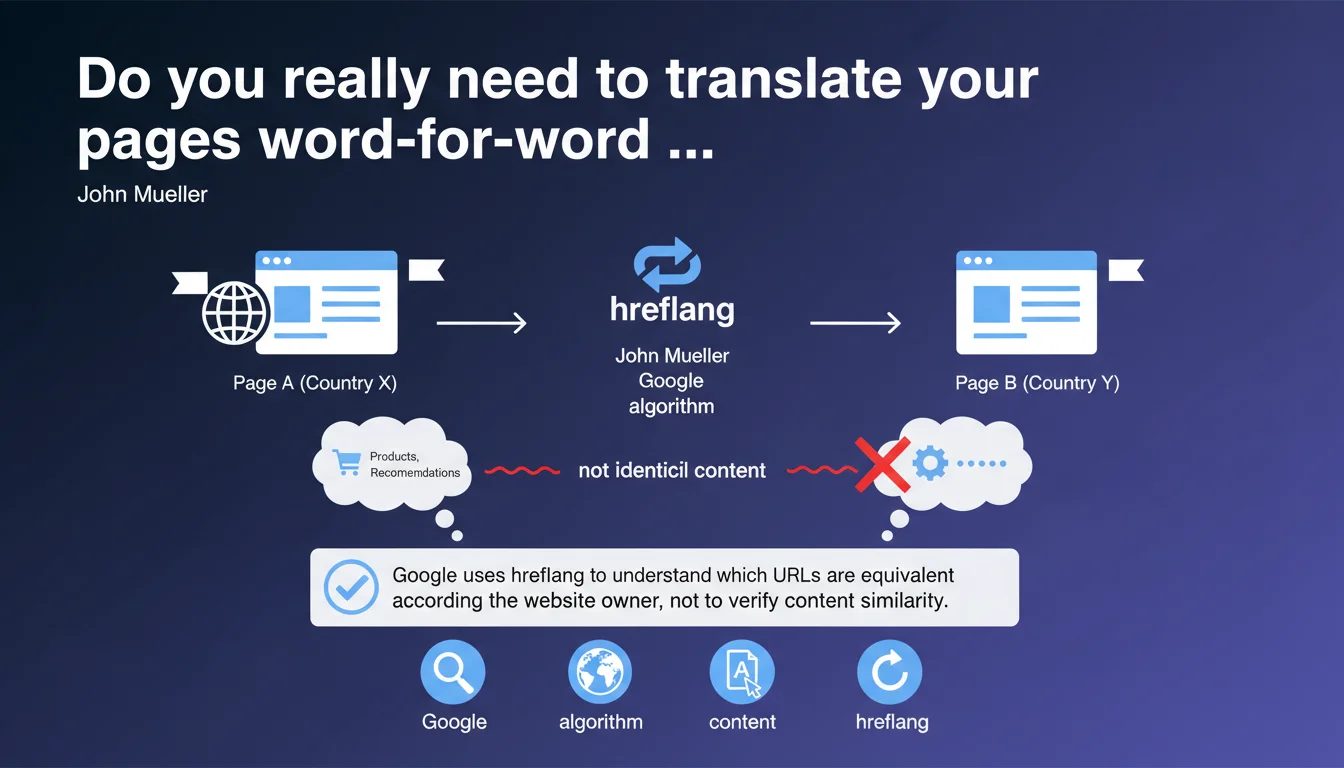
Google does not verify whether your hreflang pages have identical content. Hreflang simply indicates which URLs you consider equivalent across countries — it's up to you to determine that equivalence. Different products, localized recommendations, adapted algorithms: all of this remains compatible with a valid hreflang implementation.
What you need to understand
Why does this Google clarification change everything?
For years, the widespread belief was that hreflang requires nearly identical content to be effective. Many SEO professionals thought Google compared pages against each other to validate the hreflang relationship.
Mueller sets the record straight: Google performs no similarity verification. Hreflang is a declaration of intent by the website owner — "these pages are equivalent for me" — and Google uses it to route users based on their language and location.
What does this concretely mean for multilingual websites?
You can legitimately link pages via hreflang where the content varies significantly: different product catalog by country, localized algorithmic recommendations, editorial formats adapted to local usage patterns.
Google will simply interpret these URLs as functional variants of the same semantic entity. As long as you — the website owner — consider them equivalent, the hreflang signal is valid.
What are the limits of this flexibility?
Caution: this doesn't turn hreflang into a magic bullet. If your pages have no thematic connection, you create confusion for your users and potentially for Google.
The algorithm won't penalize the technical implementation, but user signals risk being degraded if the visitor lands on content that doesn't match their original intent.
- Hreflang does not impose identical content — it's a declaration of equivalence made by the website owner
- Google does not compare content between linked pages to validate the hreflang relationship
- Product variants, local algorithms, differentiated recommendations: everything is compatible with hreflang
- Semantic consistency remains important for user experience, even if it's not a technical validation criterion
SEO Expert opinion
Does this statement reflect what we observe in the field?
Honestly? Yes, and it's consistent with behaviors observed for years. E-commerce sites with radically different catalogs between countries — some products absent, others exclusive — work perfectly with hreflang.
The theoretical textbook cases ("you need 80% identical content") never had any real foundation. Google couldn't care less — what matters is that you stand behind the equivalence relationship you declare.
What nuances should we add to this flexibility?
Let's be clear: no technical verification doesn't mean "anything goes". If you link pages that are semantically incompatible (a French product page to an unrelated English blog post), you create a user experience problem.
Google won't penalize you for the hreflang implementation itself, but behavioral metrics (bounce rate, session duration) risk degrading. And the algorithm picks up on that very well.
In what cases does this rule not apply?
There's really no technical exception — hreflang works independently of content. But there are situations where this flexibility becomes a pitfall.
Example: linking a French page targeting "chaussures de sport" to an English page targeting "running shoes for kids". Technically valid, but strategically absurd. You fragment your relevance signals across different intentions. [To verify]: no Google data quantifies the ranking impact of these inconsistencies — but common sense is enough.
Practical impact and recommendations
What should you concretely do to optimize your hreflang?
First rule: stop obsessing over textual similarity. Your French catalog can have 500 products, UK 350, Germany 600 — as long as you manage equivalences consistently, no problem.
Focus on semantic consistency: a French page about "running shoes" should point to an equivalent page in terms of intent, even if the content, products, or structure differ.
What errors should you absolutely avoid?
Common mistake: linking pages that have no functional connection just because they exist in multiple languages. For example, linking a French category page to an English product page because "they're close".
Another trap: over-declaring equivalences by default (all French pages to all corresponding English pages) without verifying relevance. This dilutes the signal value and creates noise.
How do you verify your implementation is optimal?
- Audit your hreflang declarations: each linked page pair must have a logical semantic relationship (same intent, same hierarchical level)
- Accept content variations between countries — different products, local recommendations, adapted formats are all compatible
- Monitor user metrics by geography: a high bounce rate after hreflang redirect signals perceived inconsistency
- Avoid linking pages of different types (French product page to English category page) unless it's truly relevant
- Test the stability of your declarations: frequently changing equivalences creates confusion for Google
- Document your equivalence logic internally — this facilitates future audits and prevents drift
❓ Frequently Asked Questions
Peut-on utiliser hreflang entre une page produit FR et une page catégorie EN si elles ciblent la même intention ?
Si mes catalogues diffèrent fortement entre pays, dois-je quand même déclarer des équivalences hreflang ?
Google pénalise-t-il les sites qui changent fréquemment leurs déclarations hreflang ?
Peut-on lier via hreflang des pages avec des algorithmes de recommandation différents ?
Si deux pages hreflang n'ont que 30 % de contenu commun, est-ce un problème ?
🎥 From the same video 29
Other SEO insights extracted from this same Google Search Central video · published on 14/01/2022
🎥 Watch the full video on YouTube →
💬 Comments (0)
Be the first to comment.