
Official statement
Other statements from this video 29 ▾
- □ Does a bloated robots.txt file really hurt your SEO rankings?
- □ Does it really matter whether you submit your sitemap in robots.txt or Search Console?
- □ Do H1-H6 heading tags really still impact Google rankings?
- □ How long does Google actually take to fully process a domain migration?
- □ Can a site migration really boost your SEO rankings or destroy them completely?
- □ Does Googlebot really crawl from just one place when indexing your geo-targeted content?
- □ Can a noindex tag on geolocalized pages wipe your entire website from Google search results?
- □ Should you really ditch geo-redirects for a simple dynamic banner?
- □ How many location pages can you create before Google penalizes you for spam?
- □ Should you redirect mobile users to your app—and what are the hidden SEO risks?
- □ Do you really need to translate your pages word-for-word for hreflang to work effectively?
- □ Does the domain directive in your Disavow file really help you bypass Google's 2MB limit?
- □ Should you really use the Disavow tool only for purchased links?
- □ Should you noindex your internal search results pages to prevent spammers from creating backlinks?
- □ Does semantic HTML really boost your search rankings?
- □ Is AMP still a ranking factor in Google Search?
- □ Is AMP really a ranking factor for Google?
- □ Does removing AMP actually boost crawl on your regular pages?
- □ Should you test removing your Disavow file incrementally, or can you delete it all at once?
- □ Why do knowledge panels display differently across devices and search contexts?
- □ Does Google's synonym system really work without any human intervention?
- □ Should you really create a separate page for each location to implement Local Business schema correctly?
- □ Do you really need to mark up ALL your content with structured data?
- □ Do you really need to display all FAQ schema questions visibly on your page?
- □ Can hidden accordion content really show up in featured snippets?
- □ Why does Google deliberately choose not to index your entire website?
- □ Should you delete pages to boost your site's indexation?
- □ Does search volume of anchor text really impact the value of your internal links?
- □ Should you really add unique content to your e-commerce product pages?
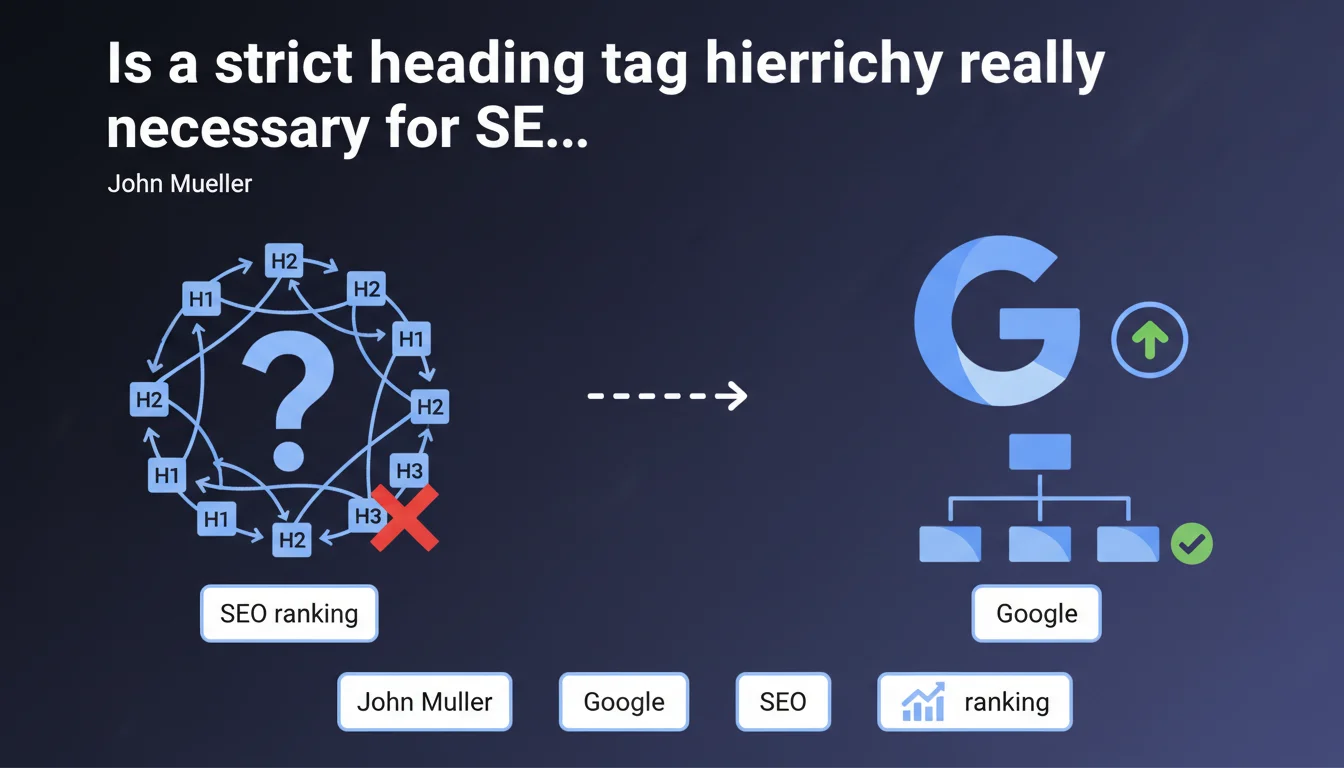
Google confirms that a strict hierarchical structure of heading tags is not an absolute requirement for ranking. This doesn't mean the structure has no importance — simply that minor deviations won't penalize a site. The focus should be on semantic consistency and user experience rather than perfect W3C compliance.
What you need to understand
This statement from John Mueller addresses a recurring question in the SEO community: must you absolutely follow an H1 > H2 > H3 hierarchy without ever skipping a level? The answer is no — at least not in the strict sense some understand it.
Google uses heading tags to understand a page's structure, but its algorithm is tolerant enough to handle variations. What really matters is that the hierarchy helps users navigate and understand the content.
Why does Google show this tolerance regarding heading hierarchy?
The search engine has evolved toward a semantic understanding of content. It no longer simply reads HTML structure mechanically — it analyzes context, entities, and relationships between concepts.
If you skip a level (H1 directly to H3), Google won't penalize you harshly. Its goal is to determine whether your content answers the search intent well, not to verify that your code is textbook-perfect.
What does "structuring well" mean according to Google?
The recommendation remains to structure your content logically. A single unique H1 announcing the main topic, H2s for major sections, H3s for subsections — that's good editorial sense.
The important nuance: you can have deviations without compromising your ranking. But a page with 15 H1s or headings completely disconnected from the content sends confused signals — and Google detects that.
- A strict hierarchy is not an absolute technical requirement for ranking
- Google prioritizes semantic understanding of content over W3C compliance
- A logical structure remains recommended for UX and accessibility
- Minor deviations (occasionally skipping a level) don't cause penalties
- Avoid flagrant abuse: multiple H1s without coherence, misleading headings
SEO Expert opinion
Does this statement truly reflect real-world observations?
Yes, broadly speaking. We regularly observe well-ranked sites with imperfect heading structures. Occasional level skips don't seem to negatively impact ranking, especially if the rest of the content is solid.
However, what can be problematic — and Mueller doesn't emphasize this enough — is the intent behind the structure. If you multiply H1s to stuff keywords, Google will detect it through other signals (abnormal density, lack of semantic coherence). It's not the heading structure itself penalizing you, but the manipulation signal it sends.
What nuances should be added to this statement?
Google's statement remains deliberately vague about what constitutes a "good structure." Concretely, if you have a page with H1 > H3 > H2 > H4, is that acceptable? Probably, if it remains coherent for users. [Needs verification] — no public data precisely defines Google's tolerance threshold.
Let's be honest: accessibility and UX benefit from clean hierarchy. Screen readers, navigation tools, users scanning the page — all benefit from logical structure. So even if Google is tolerant, it remains a best practice.
When doesn't this loose rule apply?
On highly competitive content, every optimization counts. If you're facing sites with flawless structure, rich content, and strong authority, your poorly organized heading hierarchy can become a relative disadvantage — not because of a penalty, but because your competition does better.
Similarly, for news sites or AMP pages, structure must be impeccable to fully benefit from rich snippets and Google News features. Tolerance exists, but it doesn't exempt you from aiming for excellence when stakes are high.
Practical impact and recommendations
What should you concretely do with this information?
First, don't panic if you discover level skips in your existing pages. If your site performs well and structure remains globally coherent, it's not an urgent priority to fix.
Next, adopt a pragmatic approach: prioritize clear hierarchy to facilitate content understanding — by Google, but especially by your users. A descriptive H1, H2s that break down major sections, H3s for details — it's simple and effective.
What errors should you avoid despite this tolerance?
Avoid multiple H1s without valid editorial reason. Yes, HTML5 allows multiple H1s in different sections, but in practice, a single H1 per page remains the safest norm — especially since Google itself recommends this approach in its Search Central documentation.
Don't stuff your headings with forced keywords. If your titles sound robotic or repetitive, it's a signal you're optimizing for an algorithm rather than a human. Google increasingly detects this.
- Verify that each page has a unique, descriptive H1
- Ensure H2s structure major sections logically
- Use H3-H6 to hierarchize subsections without overusing
- Avoid systematic level skips (H1 > H4) without editorial reason
- Check that headings reflect actual content — not just keyword lists
- Audit strategic pages with tools like Screaming Frog or Sitebulb
How can you verify that your site follows best practices?
Run a technical audit to identify pages with atypical structures: multiple H1s, repeated level skips, empty or duplicate headings. Prioritize fixes on high-traffic or high-commercial-potential pages.
Use tools like Google Search Console to monitor ranking changes after any structure modifications. If you fix major errors, expect temporary fluctuations before stabilization.
Heading hierarchy remains a good SEO practice, even if it's not an absolute ranking criterion. Aim for consistency and clarity, fix flagrant abuse, but don't obsess over W3C perfection if your content is solid.
These structural optimizations, while non-critical individually, fit into an overall quality strategy. For complex sites or competitive environments, it may be wise to engage a specialized SEO agency that can thoroughly audit your architecture, prioritize high-impact actions, and guide your teams in implementing these best practices — without falling into over-optimization.
❓ Frequently Asked Questions
Peut-on utiliser plusieurs H1 sur une même page sans risque SEO ?
Est-ce grave de sauter un niveau de heading, par exemple passer de H2 à H4 ?
Les balises heading influencent-elles encore le classement en SEO ?
Faut-il corriger en priorité les erreurs de structure Hn sur un site existant ?
Google pénalise-t-il les pages avec trop de H1 bourré de mots-clés ?
🎥 From the same video 29
Other SEO insights extracted from this same Google Search Central video · published on 14/01/2022
🎥 Watch the full video on YouTube →
💬 Comments (0)
Be the first to comment.