
Official statement
Other statements from this video 29 ▾
- □ Does a bloated robots.txt file really hurt your SEO rankings?
- □ Does it really matter whether you submit your sitemap in robots.txt or Search Console?
- □ Do H1-H6 heading tags really still impact Google rankings?
- □ Is a strict heading tag hierarchy really necessary for SEO rankings?
- □ How long does Google actually take to fully process a domain migration?
- □ Can a site migration really boost your SEO rankings or destroy them completely?
- □ Does Googlebot really crawl from just one place when indexing your geo-targeted content?
- □ Can a noindex tag on geolocalized pages wipe your entire website from Google search results?
- □ How many location pages can you create before Google penalizes you for spam?
- □ Should you redirect mobile users to your app—and what are the hidden SEO risks?
- □ Do you really need to translate your pages word-for-word for hreflang to work effectively?
- □ Does the domain directive in your Disavow file really help you bypass Google's 2MB limit?
- □ Should you really use the Disavow tool only for purchased links?
- □ Should you noindex your internal search results pages to prevent spammers from creating backlinks?
- □ Does semantic HTML really boost your search rankings?
- □ Is AMP still a ranking factor in Google Search?
- □ Is AMP really a ranking factor for Google?
- □ Does removing AMP actually boost crawl on your regular pages?
- □ Should you test removing your Disavow file incrementally, or can you delete it all at once?
- □ Why do knowledge panels display differently across devices and search contexts?
- □ Does Google's synonym system really work without any human intervention?
- □ Should you really create a separate page for each location to implement Local Business schema correctly?
- □ Do you really need to mark up ALL your content with structured data?
- □ Do you really need to display all FAQ schema questions visibly on your page?
- □ Can hidden accordion content really show up in featured snippets?
- □ Why does Google deliberately choose not to index your entire website?
- □ Should you delete pages to boost your site's indexation?
- □ Does search volume of anchor text really impact the value of your internal links?
- □ Should you really add unique content to your e-commerce product pages?
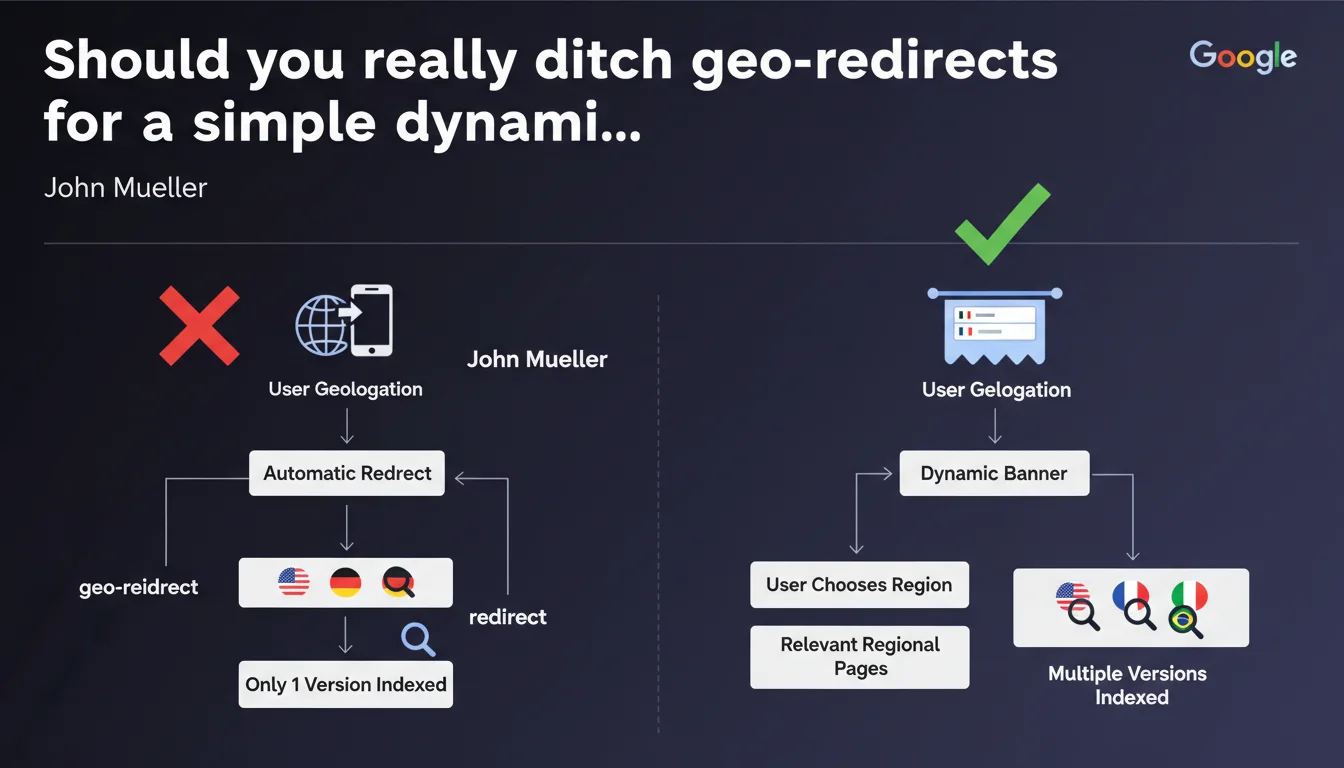
Google advises against automatic redirects based on geolocation and instead recommends using a dynamic banner that lets users choose their region. The goal: prevent a single geographic version from being indexed at the expense of others, and allow both bots and users to access all regional versions.
What you need to understand
Why does Google oppose automatic geo-redirects?
The fundamental problem with automatic redirects is that they create an indexation bias. Googlebot typically crawls from US-based IPs — if your site automatically redirects to a local version based on IP, the bot will only see a single geographic variant.
As a result: your other regional versions risk never being discovered or indexed. Users searching for information specific to a given region won't find the right pages.
What exactly is a dynamic banner?
A dynamic banner detects the user's probable location (via IP, browser language, or other signals) and suggests a regional version without forcing a redirect. The user stays in control: they can accept, decline, or manually choose a different region.
This approach allows Google to access all geo-targeted URLs, index them correctly, and serve them to users based on their search context.
How does this work with hreflang?
The dynamic banner doesn't replace hreflang, it complements it. Hreflang tells Google which language or regional versions exist and in what contexts to serve them.
But if Googlebot can't even crawl these versions because of forced redirects, hreflang becomes pointless. The banner ensures that all URLs declared in hreflang are accessible and indexable.
- Automatic redirects create an indexation tunnel limiting Googlebot to a single geographic version
- A dynamic banner preserves access to all regional URLs while improving user experience
- Hreflang remains essential for signaling relationships between versions, but only works if Google can discover them
- This approach also avoids duplicate content issues poorly managed between regional versions
SEO Expert opinion
Is this recommendation really new?
No. Google has been hammering this message for years, but many e-commerce and multinational sites keep using automatic redirects. Why? Because it's simpler to implement server-side and some marketing managers prioritize immediate conversion over SEO.
The real issue is that Mueller provides no concrete data on the actual impact of these redirects on rankings. We know they cause indexation problems — but what's the scale of the visibility penalty? [To verify]
In which cases can this rule be bypassed?
Let's be honest: some sites can't afford automatic redirects for legal or commercial reasons. A gambling site, for example, must block access from certain jurisdictions.
In these cases, the trick is to whitelist Google's bots so they access all versions without redirect, while redirecting real users. It's technical cloaking, but justified if it's the only solution. Document this approach in your robots.txt file or via Search Console to avoid any ambiguity.
What's the limit of this approach in terms of UX?
A dynamic banner sounds good in theory. In practice, many users ignore it or close it reflexively (banner blindness). If your site has 10 regional versions, how do you guarantee the user finds the right one without friction?
You need to combine the banner with a visible and persistent region selector (footer, header) and store the user's choice in a cookie or localStorage. The challenge: don't sacrifice conversion for pure SEO — and vice versa.
Practical impact and recommendations
What exactly should you do to migrate to a dynamic banner?
First step: audit your current redirects. Identify all redirection rules based on IP or browser language (.htaccess files, Nginx, CDNs like Cloudflare, or application logic). Document which version is served to which region.
Next, develop a JavaScript or server-side banner that detects the suggested region but doesn't force any automatic redirect. Users must be able to ignore the suggestion and stay on the initial page — or manually choose another region via a dropdown menu.
Verify that Googlebot can access all your regional URLs without being redirected. Use the URL Inspection tool in Search Console to test each geo-targeted version and confirm that Google sees the expected content.
What mistakes must you absolutely avoid?
Don't replace an automatic redirect with a blocking interstitial that forces users to choose before accessing content. Google considers these popups intrusive, especially on mobile, and may penalize your site.
Also avoid managing region selection solely through client-side JavaScript if your content changes based on region. Google may struggle to index multiple versions of the same URL correctly if they're generated dynamically without distinct URLs.
Finally, don't neglect hreflang. If you abandon redirects but forget to declare relationships between regional versions, Google risks serving the wrong version to users or treating your pages as duplicate content.
How do you verify your site is compliant after migration?
- Test each regional URL with the URL Inspection tool in Search Console to confirm Googlebot accesses it without redirect
- Verify that your hreflang tags are present and correct on all versions (use a validator like hreflang.org)
- Check that the dynamic banner displays correctly based on context (IP, browser language) but never blocks content access
- Analyze your server logs to confirm Googlebot crawls all your geo-targeted versions, not just one
- Monitor indexation progress in Search Console: all your regional URLs should appear in the index after a few weeks
- Measure UX impact: does bounce rate or conversion degrade after removing redirects? If so, adjust banner visibility or messaging
❓ Frequently Asked Questions
Puis-je garder une redirection automatique si je whitelist Googlebot ?
La bannière dynamique doit-elle être en JavaScript ou côté serveur ?
Hreflang suffit-il sans bannière dynamique ?
Que faire si mon CDN force des redirections géolocalisées ?
Comment gérer les utilisateurs qui ignorent systématiquement la bannière ?
🎥 From the same video 29
Other SEO insights extracted from this same Google Search Central video · published on 14/01/2022
🎥 Watch the full video on YouTube →
💬 Comments (0)
Be the first to comment.