
Official statement
Other statements from this video 29 ▾
- □ Un fichier robots.txt volumineux pénalise-t-il vraiment votre SEO ?
- □ Soumettre son sitemap dans robots.txt ou Search Console : y a-t-il vraiment une différence ?
- □ Les balises H1-H6 ont-elles encore un impact réel sur le classement Google ?
- □ Faut-il vraiment respecter une hiérarchie stricte des balises Hn pour le SEO ?
- □ Combien de temps faut-il réellement pour qu'une migration de domaine soit prise en compte par Google ?
- □ Une migration de site peut-elle vraiment booster votre SEO ou tout faire planter ?
- □ Googlebot crawle-t-il vraiment depuis un seul endroit pour indexer vos contenus géolocalisés ?
- □ Le noindex sur pages géolocalisées peut-il faire disparaître tout votre site des résultats Google ?
- □ Faut-il vraiment abandonner les redirections géolocalisées pour une simple bannière ?
- □ Faut-il créer des pages de destination pour chaque ville ou se limiter aux régions ?
- □ Faut-il rediriger les utilisateurs mobiles vers votre application mobile ?
- □ Faut-il vraiment traduire mot pour mot ses pages pour que le hreflang fonctionne ?
- □ Fichier Disavow : pourquoi la directive domaine permet-elle de contourner la limite de 2MB ?
- □ Faut-il vraiment utiliser le fichier Disavow uniquement pour les liens achetés ?
- □ Faut-il mettre en noindex ses pages de résultats de recherche interne pour bloquer les backlinks spam ?
- □ Le HTML sémantique booste-t-il vraiment votre référencement naturel ?
- □ AMP est-il encore un critère de ranking dans Google Search ?
- □ AMP est-il vraiment un facteur de classement pour Google ?
- □ Faut-il tester la suppression de son fichier Disavow de manière incrémentale ?
- □ Pourquoi les panels de connaissance s'affichent-ils différemment selon les appareils ?
- □ Le système de synonymes de Google fonctionne-t-il vraiment sans intervention humaine ?
- □ Faut-il vraiment créer une page distincte par localisation pour le schema Local Business ?
- □ Faut-il vraiment marquer TOUT son contenu en données structurées ?
- □ Faut-il vraiment afficher toutes les questions du schema FAQ sur la page ?
- □ Le contenu masqué dans les accordéons peut-il vraiment apparaître dans les featured snippets ?
- □ Pourquoi Google ne veut-il pas indexer l'intégralité de votre site web ?
- □ Faut-il supprimer des pages pour améliorer l'indexation de son site ?
- □ Le volume de recherche des ancres influence-t-il vraiment la valeur d'un lien interne ?
- □ Faut-il vraiment ajouter du contenu unique sur vos pages produit en e-commerce ?
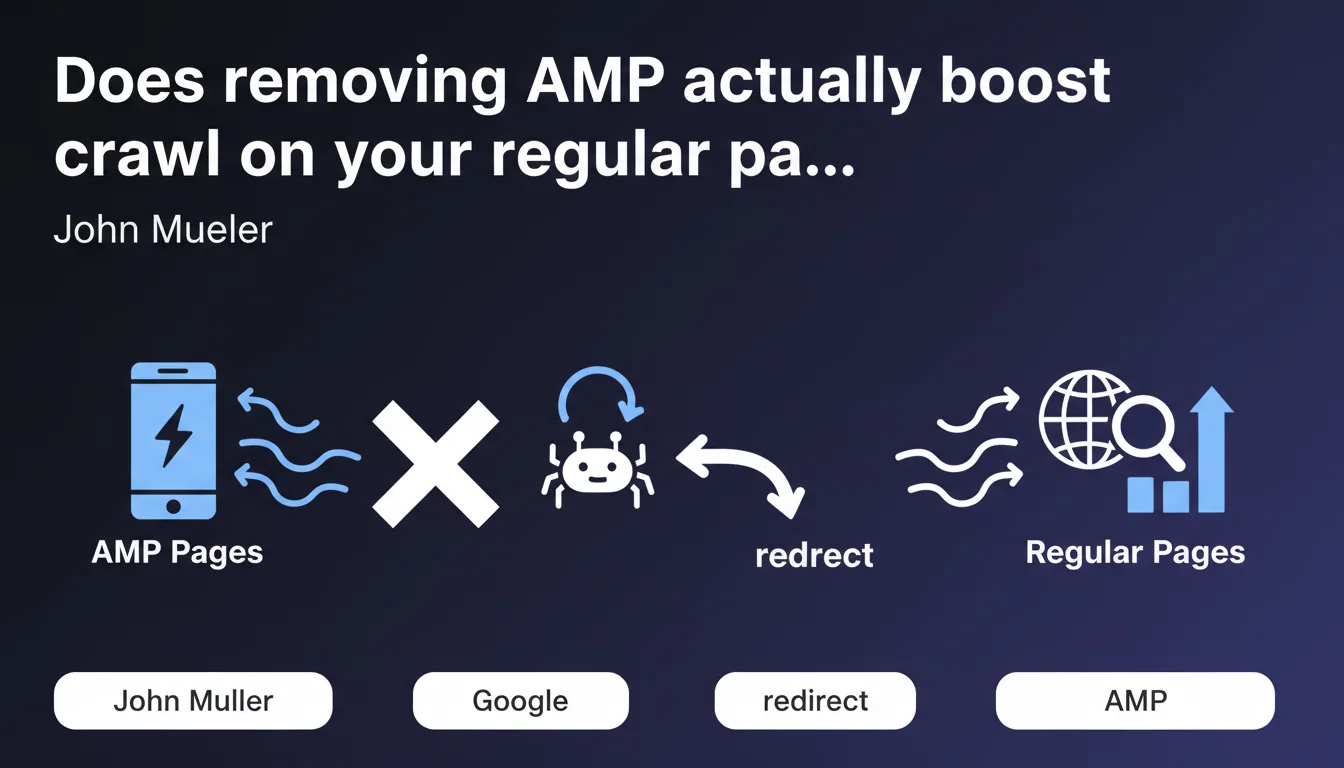
Googlebot automatically redistributes the crawl budget previously allocated to AMP pages toward traditional HTML pages after AMP removal. This reallocation happens naturally, without requiring any manual intervention. For sites that have discontinued AMP, this means potentially more crawl activity on standard pages.
What you need to understand
Why was Google crawling AMP pages so frequently?
AMP pages required frequent refreshes of their cache on Google's side to ensure consistency of displayed content. This AMP cache was an intermediate layer between your server and the end user.
Googlebot therefore regularly passed through to check for updates, consuming a portion of the crawl budget total allocated to your domain. This frequency was generally higher than that of classic HTML pages, due to reasons inherent to AMP's infrastructure.
What actually happens after you remove AMP?
Once AMP pages are removed, Google obviously can no longer crawl them. However, the overall crawl volume assigned to your site doesn't decrease—it automatically redistributes toward traditional pages.
In other words, Googlebot will dedicate this freed-up crawl time to exploring your standard HTML pages more frequently or more deeply. It's a transparent reallocation, with no special configuration needed on your end.
What are the impacts on indexation?
This redistribution means your standard pages can be refreshed more often in Google's index. For sites with content that evolves rapidly, this is a net advantage.
On the other hand, if your technical architecture has weaknesses (slow pages, 500 errors, chained redirects), this surplus of crawl risks exposing these issues more quickly. Let's be honest: intensified crawl is only beneficial if the infrastructure can handle it.
- Automatic reallocation of crawl budget to HTML pages after AMP removal
- No manual intervention required on your part
- Potential for increased refreshing of content in the index
- Requires solid technical infrastructure to absorb this additional crawl
- Particularly advantageous for sites with evolving content
SEO Expert opinion
Is this statement consistent with real-world observations?
In principle, yes. We do indeed observe increased crawl on standard pages after AMP abandonment across several audited sites. However, the extent of this increase varies greatly depending on site size and the proportion of initial AMP pages.
What's missing here—and it's frustrating—is the exact timing. How long does this reallocation take to become effective? A week? A month? Mueller doesn't specify. [To verify] in your own logs after migration.
Should you expect an immediate indexation boost?
No, and this is where many risk making a mistake. Crawl redistribution doesn't guarantee better indexation if your standard pages have quality or relevance issues.
Google will crawl more, certainly. But if the content is poor, duplicated, or technically deficient, you won't see any positive effect. Crawl is a necessary condition, not a sufficient one.
Which sites truly benefit from this effect?
Editorial sites with high publication frequency get the most out of this reallocation. If you publish daily and your content evolves quickly, this additional crawl accelerates their rise in the index.
Conversely, a brochure website with ten quasi-static pages will probably see no notable difference. Business context matters enormously here—and Mueller, as often, remains quite generalist in his response.
Practical impact and recommendations
What should you check in your crawl logs after AMP removal?
First step: analyze your log files over a 30 to 60-day period after AMP removal. Compare the crawl frequency of HTML pages before and after. Use tools like Screaming Frog Log File Analyser or OnCrawl to visualize this evolution.
Pay particular attention to HTTP response codes. If you notice an abnormal rise in 500 or 503 errors, your server is struggling to absorb the crawl surplus. You'll then need to adjust your infrastructure capacity or moderate crawl via Google Search Console.
How can you optimize your site to absorb this redistributed crawl?
Ensure your server response time stays under 200 ms for priority pages. Googlebot doesn't like to wait—and excessive crawl on slow pages creates frustration on the bot side and wastes crawl budget.
Also review your internal linking. If certain important pages were primarily accessible through AMP, verify they remain well-linked from your standard HTML pages. Without this, the redistributed crawl risks missing them.
- Analyze crawl logs over 30-60 days post-AMP removal
- Compare crawl frequency before/after to identify redistribution
- Verify your server absorbs the load without 500/503 errors
- Optimize server response times (target: <200 ms)
- Audit internal linking to ensure accessibility of priority pages
- Use Google Search Console to adjust crawl if needed
- Monitor indexation evolution via coverage reports
❓ Frequently Asked Questions
Le crawl redistribué se fait-il instantanément après suppression d'AMP ?
Faut-il faire une action particulière dans Search Console après avoir supprimé AMP ?
Un site sans AMP peut-il perdre du crawl si un concurrent en garde ?
Est-ce que cette redistribution améliore automatiquement le classement SEO ?
Les pages AMP redirigées en 301 vers les pages classiques consomment-elles encore du crawl ?
🎥 From the same video 29
Other SEO insights extracted from this same Google Search Central video · published on 14/01/2022
🎥 Watch the full video on YouTube →
💬 Comments (0)
Be the first to comment.