
Official statement
Other statements from this video 29 ▾
- □ Un fichier robots.txt volumineux pénalise-t-il vraiment votre SEO ?
- □ Les balises H1-H6 ont-elles encore un impact réel sur le classement Google ?
- □ Faut-il vraiment respecter une hiérarchie stricte des balises Hn pour le SEO ?
- □ Combien de temps faut-il réellement pour qu'une migration de domaine soit prise en compte par Google ?
- □ Une migration de site peut-elle vraiment booster votre SEO ou tout faire planter ?
- □ Googlebot crawle-t-il vraiment depuis un seul endroit pour indexer vos contenus géolocalisés ?
- □ Le noindex sur pages géolocalisées peut-il faire disparaître tout votre site des résultats Google ?
- □ Faut-il vraiment abandonner les redirections géolocalisées pour une simple bannière ?
- □ Faut-il créer des pages de destination pour chaque ville ou se limiter aux régions ?
- □ Faut-il rediriger les utilisateurs mobiles vers votre application mobile ?
- □ Faut-il vraiment traduire mot pour mot ses pages pour que le hreflang fonctionne ?
- □ Fichier Disavow : pourquoi la directive domaine permet-elle de contourner la limite de 2MB ?
- □ Faut-il vraiment utiliser le fichier Disavow uniquement pour les liens achetés ?
- □ Faut-il mettre en noindex ses pages de résultats de recherche interne pour bloquer les backlinks spam ?
- □ Le HTML sémantique booste-t-il vraiment votre référencement naturel ?
- □ AMP est-il encore un critère de ranking dans Google Search ?
- □ AMP est-il vraiment un facteur de classement pour Google ?
- □ Supprimer AMP boost-t-il le crawl de vos pages classiques ?
- □ Faut-il tester la suppression de son fichier Disavow de manière incrémentale ?
- □ Pourquoi les panels de connaissance s'affichent-ils différemment selon les appareils ?
- □ Le système de synonymes de Google fonctionne-t-il vraiment sans intervention humaine ?
- □ Faut-il vraiment créer une page distincte par localisation pour le schema Local Business ?
- □ Faut-il vraiment marquer TOUT son contenu en données structurées ?
- □ Faut-il vraiment afficher toutes les questions du schema FAQ sur la page ?
- □ Le contenu masqué dans les accordéons peut-il vraiment apparaître dans les featured snippets ?
- □ Pourquoi Google ne veut-il pas indexer l'intégralité de votre site web ?
- □ Faut-il supprimer des pages pour améliorer l'indexation de son site ?
- □ Le volume de recherche des ancres influence-t-il vraiment la valeur d'un lien interne ?
- □ Faut-il vraiment ajouter du contenu unique sur vos pages produit en e-commerce ?
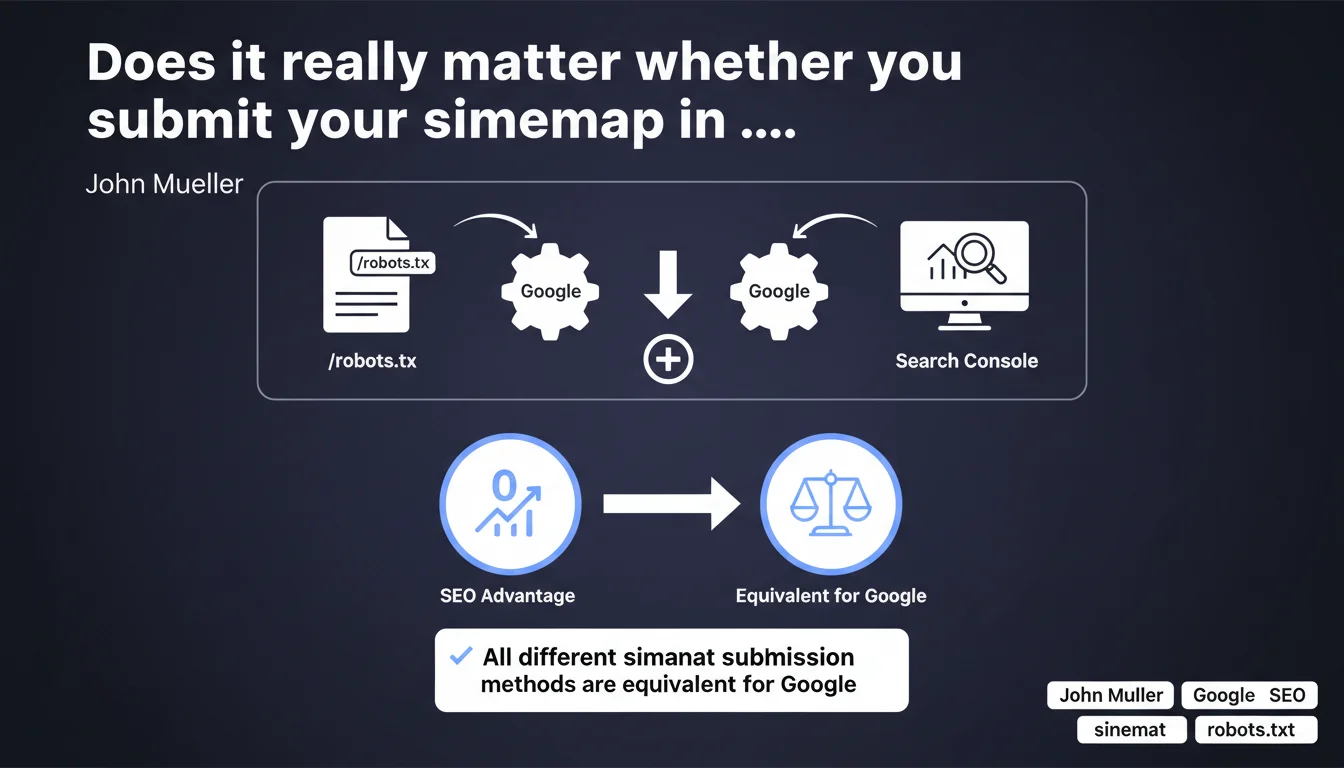
Google confirms that all sitemap submission methods are strictly equivalent. Declaring your sitemap in robots.txt, via Search Console, or through other means provides no additional SEO advantage — Google treats these signals identically.
What you need to understand
What are the different ways to submit a sitemap?
A sitemap can be submitted to Google in several ways. The most well-known remains Search Console, where you can enter the URL of the XML file in the dedicated section. But you can also declare your sitemap directly in the robots.txt file via the "Sitemap:" directive, or even let Google discover it automatically if it's mentioned in other crawled files.
Each method has its supporters. Some prefer robots.txt to centralize technical configuration, others prefer Search Console for tracking and coverage reports. The question that arises: does Google treat these methods differently?
Why is this Mueller clarification so important?
Because it ends a recurring debate in the SEO community. For years, some practitioners thought that submitting the sitemap via robots.txt gave a signal of "technical seriousness" or facilitated crawling. Others believed that Search Console offered priority processing.
Mueller puts it plainly: no method is favored. Google indexes and uses your sitemap in the same way, regardless of how it learned about it. The engine does not distinguish between these submission channels.
What does this change for your site's technical management?
Concretely? It means you can choose the method that best suits your workflow and your technical constraints. If your CMS automatically manages robots.txt, great. If you prefer to control everything from Search Console to have coverage reports at hand, that's equally valid.
What matters is that the sitemap is accessible, valid, and up to date. The submission channel has no impact on indexing speed or rankings — what counts is the quality of the content referenced in the sitemap and Google's ability to crawl it efficiently.
- All submission methods (robots.txt, Search Console, automatic discovery) are treated identically by Google
- No SEO advantage to favoring one method over another
- The choice should be based on your technical constraints and your monitoring needs
- What remains essential is the quality and validity of the sitemap, not its submission channel
SEO Expert opinion
Is this statement consistent with real-world observations?
Yes, and it confirms what many empirical tests already suggested. In practice, we observe that Google crawls and indexes the URLs from a sitemap with the same frequency, whether it was discovered via robots.txt or submitted in Search Console. Indexing delays do not differ significantly.
Where things sometimes break down — and Mueller doesn't mention this — is the visibility of errors. Search Console alerts you when a sitemap contains error URLs like 404s, redirects, or pages blocked by robots.txt. If you only declare the sitemap in robots.txt, you lose this diagnostic layer.
Are there cases where one method is preferable to another?
Let's be honest: even though Google treats all sitemaps the same way, Search Console remains the most practical option for operational tracking. Coverage reports allow you to quickly detect indexing issues, validate that your URLs are being accounted for, and track crawl evolution.
Conversely, declaring the sitemap in robots.txt has an advantage in certain technical contexts: if your infrastructure doesn't allow easy access to Search Console (sites under migration, complex multi-domain environments), robots.txt can serve as a reliable fallback. But this is not an SEO advantage — it's an organizational one.
What doesn't Mueller say in this statement?
What's missing is the nuance about multiple sitemaps and large-scale sites. Does Google treat identically a sitemap declared via robots.txt on a site with 50,000 pages and a segmented sitemap submitted in multiple files via Search Console? [To verify]
Similarly, Mueller doesn't specify whether the re-crawl frequency of robots.txt influences how quickly Google detects a sitemap update. We know robots.txt is crawled regularly, but not necessarily in real time. If you change your sitemap URL in robots.txt, Google might take several hours — or even days — to discover it, whereas manual submission in Search Console is nearly instantaneous.
Practical impact and recommendations
Which method should you choose to submit your sitemap?
Choose Search Console if you want operational tracking and detailed coverage reports. It's the most robust option for diagnosing indexing issues and monitoring crawl evolution. It also allows you to submit multiple segmented sitemaps if your architecture requires it.
Use robots.txt if you manage a complex site with access constraints to Search Console, or if you want to centralize all technical configuration in a single file. But keep in mind that you'll lose visibility into crawl errors.
Nothing prevents you from combining both: declare the sitemap in robots.txt so Google discovers it automatically, and also submit it via Search Console to benefit from reports. It's redundant, but not penalizing.
What errors should you avoid when managing sitemaps?
Don't multiply sitemaps unnecessarily. Some sites submit multiple versions of the same file (via robots.txt, Search Console, and even in HTML code), thinking it will speed up indexing. It doesn't help — Google crawls the sitemap once it knows about it, no matter how many times you declare it.
Also avoid submitting sitemaps containing URLs blocked by robots.txt or pages with noindex. Google will crawl these URLs, see that they're not indexable, and report errors to you in Search Console. This clutters your reports and wastes crawl budget.
Finally, don't leave an obsolete sitemap active. If you change your sitemap URL, remove the old declaration from robots.txt and Search Console. A sitemap that returns a 404 or redirect will generate unnecessary alerts.
How do you verify that my sitemap is being properly recognized?
In Search Console, go to the Sitemaps section. You should see the file status (last read date, number of discovered URLs, any errors). If Google hasn't crawled your sitemap in several weeks, that's a warning sign — either the file is inaccessible or it contains too many errors.
If you're using robots.txt, test your sitemap URL in a browser to verify it's accessible. Then use the "URL Inspection" tool in Search Console to verify that Google can properly crawl the URLs listed in your sitemap.
- Choose Search Console for operational tracking and detailed diagnostics
- Use robots.txt if your technical constraints require it, but anticipate the loss of visibility into errors
- Don't multiply declarations unnecessarily — one is enough
- Avoid submitting blocked or noindex URLs in the sitemap
- Regularly check your sitemap status in Search Console to detect crawl errors
- Remove old declarations if you change the sitemap URL
❓ Frequently Asked Questions
Faut-il soumettre le sitemap à la fois dans robots.txt et Search Console ?
Le sitemap soumis via robots.txt est-il crawlé moins souvent ?
Peut-on soumettre plusieurs sitemaps pour un même site ?
Que faire si Google ne crawle pas mon sitemap ?
Un sitemap améliore-t-il le positionnement dans les résultats ?
🎥 From the same video 29
Other SEO insights extracted from this same Google Search Central video · published on 14/01/2022
🎥 Watch the full video on YouTube →
💬 Comments (0)
Be the first to comment.