
Official statement
Other statements from this video 29 ▾
- □ Does a bloated robots.txt file really hurt your SEO rankings?
- □ Does it really matter whether you submit your sitemap in robots.txt or Search Console?
- □ Do H1-H6 heading tags really still impact Google rankings?
- □ Is a strict heading tag hierarchy really necessary for SEO rankings?
- □ How long does Google actually take to fully process a domain migration?
- □ Can a site migration really boost your SEO rankings or destroy them completely?
- □ Does Googlebot really crawl from just one place when indexing your geo-targeted content?
- □ Can a noindex tag on geolocalized pages wipe your entire website from Google search results?
- □ Should you really ditch geo-redirects for a simple dynamic banner?
- □ How many location pages can you create before Google penalizes you for spam?
- □ Should you redirect mobile users to your app—and what are the hidden SEO risks?
- □ Do you really need to translate your pages word-for-word for hreflang to work effectively?
- □ Does the domain directive in your Disavow file really help you bypass Google's 2MB limit?
- □ Should you noindex your internal search results pages to prevent spammers from creating backlinks?
- □ Does semantic HTML really boost your search rankings?
- □ Is AMP still a ranking factor in Google Search?
- □ Is AMP really a ranking factor for Google?
- □ Does removing AMP actually boost crawl on your regular pages?
- □ Should you test removing your Disavow file incrementally, or can you delete it all at once?
- □ Why do knowledge panels display differently across devices and search contexts?
- □ Does Google's synonym system really work without any human intervention?
- □ Should you really create a separate page for each location to implement Local Business schema correctly?
- □ Do you really need to mark up ALL your content with structured data?
- □ Do you really need to display all FAQ schema questions visibly on your page?
- □ Can hidden accordion content really show up in featured snippets?
- □ Why does Google deliberately choose not to index your entire website?
- □ Should you delete pages to boost your site's indexation?
- □ Does search volume of anchor text really impact the value of your internal links?
- □ Should you really add unique content to your e-commerce product pages?
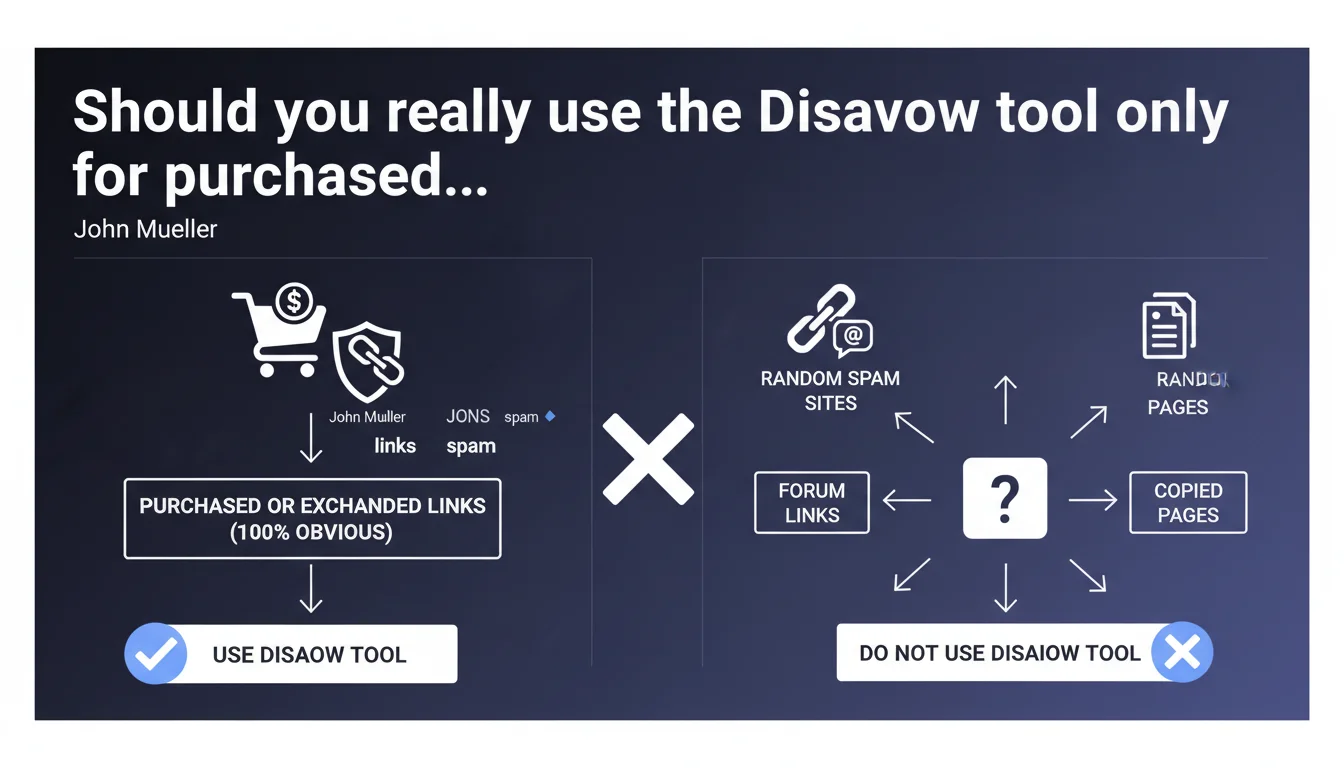
Google recommends limiting Disavow file usage to clearly purchased or exchanged links with absolute certainty. Random spam links, forum comments, or copied pages don't need to be disavowed — the algorithm knows how to ignore them.
What you need to understand
Why does Google restrict the use of the Disavow Tool?
Mueller's position is clear: the Disavow file is not a spam link vacuum cleaner. Google claims its algorithm already filters out the majority of spam links without manual intervention.
The underlying message? Disavowing indiscriminately risks doing more harm than good. By declaring natural links as spam, you can weaken your backlink profile without valid reason. Google wants to prevent SEOs from panicking and shooting themselves in the foot.
What does "100% obvious" mean in practice?
Mueller insists on absolute certainty. No gray area. A purchased link is one you have proof of: money exchanged, documented agreement, formalized service exchange.
A link from a sketchy directory or spam comment doesn't fall into this category — even if it smells bad. Google says it can handle that on its own. The question then becomes: do we trust them?
What does Google consider a "random" link to ignore?
The examples given are revealing: forums, copied pages, generic spam sites. These are links Google detects algorithmically as worthless.
Concretely, if you find your URL on 50 Russian video streaming sites without asking for anything, don't panic. Google claims to neutralize them automatically.
- Only use Disavow for documented purchased links
- Random spam links are supposed to be filtered by the algorithm
- Certainty must be absolute, not mere suspicion
- Excessive Disavow usage can weaken your link profile
- Google wants to limit "false positives" on the webmaster side
SEO Expert opinion
Is this position consistent with real-world observations?
Let's be honest: Google's theory doesn't always match reality. We've seen sites penalized by negative SEO campaigns, where thousands of toxic links caused rankings to plummet.
In those cases, mass disavowing sometimes helped recover traffic. So either Google is lying, or its algorithm has blind spots. [To verify] the actual capacity of the algorithm to ignore 100% of toxic links without intervention.
What nuances should be added to this recommendation?
The "100% obvious" line is fuzzy. A link exchange between two thematic sites with no money involved — is that a purchase? Technically no. But Google might view it as manipulation.
And what about old borderline SEO practices? Does a site acquisition with a questionable history deserve preventive cleanup? Mueller doesn't say. We're flying blind.
In what cases does this rule not apply?
First obvious case: active manual action. There, you have no choice — you must disavow anything that looks remotely like a manipulated link.
Second case: you inherit a site with a catastrophic backlink profile (detectable PBNs, over-optimized anchors). Waiting for Google to "handle it" could take months. Proactive cleanup can speed up recovery.
Practical impact and recommendations
What should you concretely do with your Disavow file?
If you have a Disavow file stuffed with hundreds of suspicious domains, don't empty it all at once. Google recommends caution, not a clean slate.
Analyze each entry: keep only links you're CERTAIN violate the guidelines (proof of purchase, tracked exchanges). For the rest, let Google do its job.
What mistakes should you absolutely avoid?
Don't disavow as a precaution. That's the worst practice. You risk cutting off natural links that positively contribute to your authority.
Also avoid disavowing entire domains without fine analysis. Sometimes a mixed site has a few spam links but also legitimate content that naturally cites you. Disavow at the URL level, not the domain level, except in extreme cases.
How to effectively audit your backlink profile?
Start with Search Console: identify abnormal spikes of new links. Check for over-optimized anchors (e.g., "cheap shoes Paris" on repeat).
Cross-reference with a third-party tool (Ahrefs, Majestic, SEMrush) to detect suspicious patterns: expired domains, identifiable blog networks, sitewide footer links.
- Audit your backlink profile at least every 3-6 months
- Keep in Disavow ONLY documented purchased links
- If you have doubt, DON'T add the link to the file
- Monitor abnormal spikes of incoming links (potential negative SEO)
- If a manual action occurs, prepare an exhaustive Disavow with documentation
- Document each disavowed link (date, reason, proof) for your internal tracking
❓ Frequently Asked Questions
Dois-je désavouer les liens provenant de commentaires spam sur des forums ?
Comment prouver qu'un lien a été acheté pour le désavouer ?
Le fichier Disavow peut-il nuire à mon SEO si je l'utilise mal ?
Que faire si je subis une attaque de negative SEO avec des milliers de liens pourris ?
Faut-il supprimer les anciens liens de mon fichier Disavow ?
🎥 From the same video 29
Other SEO insights extracted from this same Google Search Central video · published on 14/01/2022
🎥 Watch the full video on YouTube →
💬 Comments (0)
Be the first to comment.