
Official statement
Other statements from this video 29 ▾
- □ Does a bloated robots.txt file really hurt your SEO rankings?
- □ Does it really matter whether you submit your sitemap in robots.txt or Search Console?
- □ Do H1-H6 heading tags really still impact Google rankings?
- □ Is a strict heading tag hierarchy really necessary for SEO rankings?
- □ How long does Google actually take to fully process a domain migration?
- □ Can a site migration really boost your SEO rankings or destroy them completely?
- □ Does Googlebot really crawl from just one place when indexing your geo-targeted content?
- □ Can a noindex tag on geolocalized pages wipe your entire website from Google search results?
- □ Should you really ditch geo-redirects for a simple dynamic banner?
- □ How many location pages can you create before Google penalizes you for spam?
- □ Should you redirect mobile users to your app—and what are the hidden SEO risks?
- □ Do you really need to translate your pages word-for-word for hreflang to work effectively?
- □ Does the domain directive in your Disavow file really help you bypass Google's 2MB limit?
- □ Should you really use the Disavow tool only for purchased links?
- □ Should you noindex your internal search results pages to prevent spammers from creating backlinks?
- □ Does semantic HTML really boost your search rankings?
- □ Is AMP still a ranking factor in Google Search?
- □ Is AMP really a ranking factor for Google?
- □ Does removing AMP actually boost crawl on your regular pages?
- □ Should you test removing your Disavow file incrementally, or can you delete it all at once?
- □ Does Google's synonym system really work without any human intervention?
- □ Should you really create a separate page for each location to implement Local Business schema correctly?
- □ Do you really need to mark up ALL your content with structured data?
- □ Do you really need to display all FAQ schema questions visibly on your page?
- □ Can hidden accordion content really show up in featured snippets?
- □ Why does Google deliberately choose not to index your entire website?
- □ Should you delete pages to boost your site's indexation?
- □ Does search volume of anchor text really impact the value of your internal links?
- □ Should you really add unique content to your e-commerce product pages?
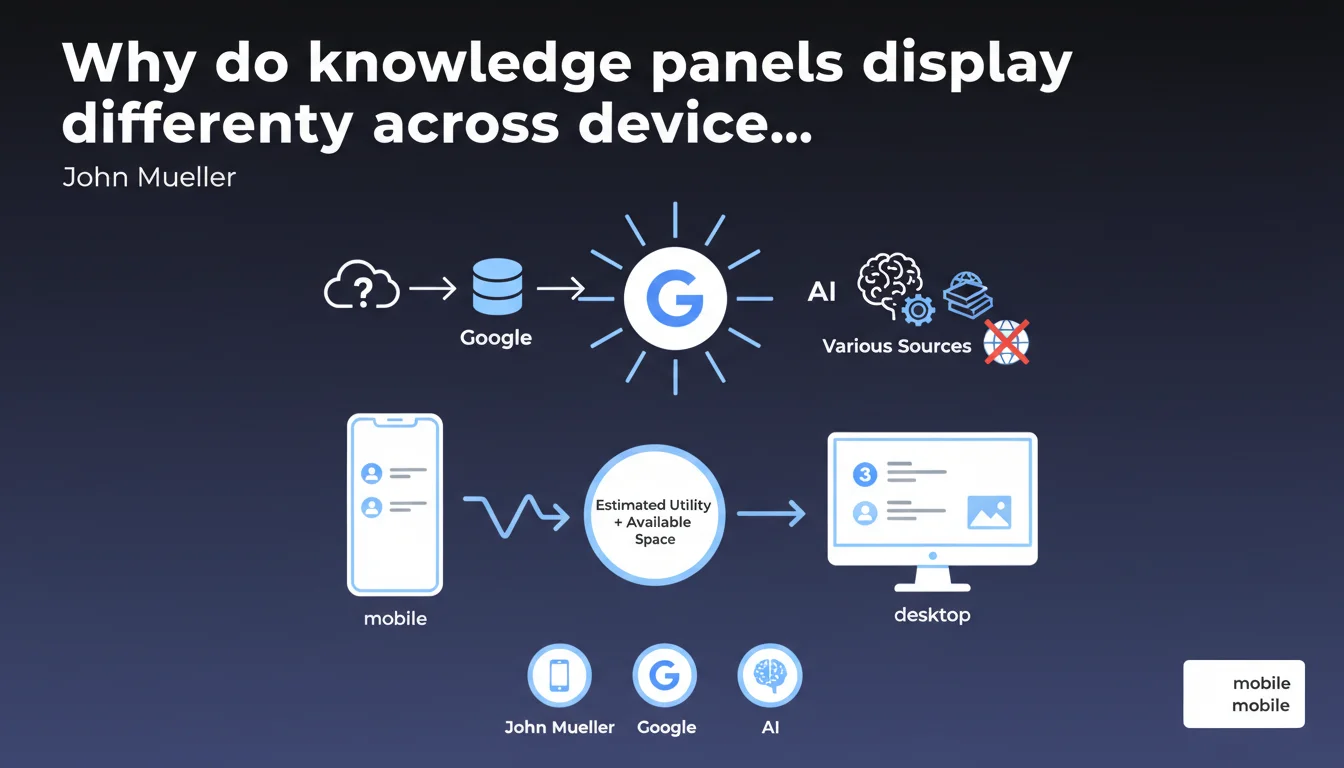
Knowledge panels vary between mobile and desktop based on available space and perceived user utility, with no single determining factor for their display. Google relies on multiple sources, not just Wikipedia. This variability complicates prediction of their appearance and requires a multi-source structured data approach.
What you need to understand
What really triggers the display of a knowledge panel?
Mueller confirms what many observe in the field: there is no universal rule that guarantees a knowledge panel's appearance. Contrary to popular belief, having a Wikipedia page is not an absolute prerequisite, even though it obviously helps.
Google evaluates multiple signals — entity authority, availability of structured data, consistency of information across sources — and decides case by case. The algorithm takes into account the search query context, the device used, and what it deems relevant for the user at that specific moment.
Why is there this difference between mobile and desktop?
The space constraint is obvious: a mobile screen cannot display the same volume of information as a desktop without degrading the user experience. Google therefore adapts the panel content based on available surface area.
But there's something more subtle. The user's supposed intent also plays a role. On mobile, Google often prioritizes practical information — hours, address, call button — where desktop displays more encyclopedic context. This logic of estimated utility is fuzzy, difficult to quantify, and that's where it gets tricky for us.
What sources does Google use beyond Wikipedia?
Mueller remains deliberately vague. We know that Wikidata, Freebase, proprietary databases and potentially other reliable third-party sources come into play. Google's objective is to cross-reference information to validate an entity's consistency.
For an SEO practitioner, this means that optimizing only your Wikipedia page (when you have one) is not enough. You need to work on the entity's presence across multiple recognized knowledge bases, ensure data structure consistency via Schema.org, and strengthen authority signals across the web.
- Knowledge panels have no single triggering criterion — it's a bundle of signals.
- Display varies according to device and query context, with an estimated utility logic that's difficult to predict.
- Wikipedia is not mandatory; Google cross-references multiple data sources to build its panels.
- Optimization comes through cross-source consistency and structured data, not isolated action.
SEO Expert opinion
Is this statement consistent with field observations?
Yes and no. We do observe that certain entities without Wikipedia pages obtain knowledge panels, particularly local businesses well-referenced on Google My Business with proper structured data. So far, nothing surprising.
But the explanation about estimated utility remains a black box. [To be verified]: how does Google measure this utility? What specific criteria? Mueller provides no exploitable detail. We remain in the fog, which complicates any predictive optimization strategy.
In which cases does this rule not apply?
There are notable exceptions. Ultra-dominant brands — Apple, Nike, Amazon — obtain massive knowledge panels across all devices, with nearly identical information volume. Available space seems less constraining when entity authority is overwhelming.
Similarly, certain informational queries on mobile sometimes display richer panels than on desktop, particularly when Google deems that the mobile user needs quick access to complex data. The adaptation logic is therefore not linear — it depends on query type and the assumed user profile.
What nuances should be added to this claim?
Saying that Wikipedia is not the only criterion is true. But it remains the strongest signal in 80% of observed cases for non-local entities. A well-sourced, active Wikipedia page with quality backlinks dramatically increases the chances of obtaining a rich panel.
Next, the notion of "varied sources" is fuzzy. Google does not disclose the exhaustive list or the relative weighting of each source. We know Wikidata counts, that official databases (company registers, scientific databases) are taken into account, but it's impossible to quantify their respective impact.
Practical impact and recommendations
What concretely should you do to optimize your chances of appearing?
First priority: ensure your entity consistency across all relevant platforms. Google cross-references data — if your name, address, and description vary from one source to another, you're complicating the algorithm's task.
Next, work on your structured data. Implement complete Schema.org markup (Organization, Person, LocalBusiness as applicable), with sameAs pointing to your official profiles (LinkedIn, Twitter, Wikidata if applicable). Verify markup validity with Google's testing tool.
Finally, if your entity permits, create or update your Wikidata presence. It's an open, structured database that Google uses massively. A well-researched Wikidata record with solid references significantly strengthens your visibility in knowledge graphs.
What mistakes should you absolutely avoid?
Don't rely on Wikipedia alone. Some think that a Wikipedia page guarantees a knowledge panel — it doesn't. If your page is poorly sourced, poorly linked, or if your entity lacks authority signals elsewhere on the web, Google may ignore this source.
Also avoid inconsistencies between mobile and desktop in your structured data. Some sites serve different markups depending on the device — a classic error that can disrupt entity indexing. Markup must be identical; it's Google that adapts the display, not you.
Another pitfall: neglecting Google My Business for local entities. It's often the primary source for local knowledge panels. An incomplete GMB profile, poorly categorized or with unmanaged negative reviews, reduces your display chances, even if everything else is perfect.
How do you verify that your entity is correctly recognized?
Test your brand queries on mobile and desktop, in private browsing, from different locations if relevant. Note display variations — that gives you clues about what Google prioritizes depending on context.
Use Google's Knowledge Graph Search API (if accessible) to verify if your entity is indexed in their database. Otherwise, search your entity name + "site:wikidata.org" to see if a Wikidata record exists and if it's complete.
Finally, audit your structured data with Google Search Console and third-party tools. Verify that all your identifiers (sameAs) point to active and consistent profiles. An abandoned LinkedIn profile or obsolete Wikipedia page can send negative signals.
- Harmonize name, description and contact information across all platforms (Wikipedia, Wikidata, GMB, social networks).
- Implement complete and valid Schema.org markup with sameAs pointing to official profiles.
- Create or optimize a Wikidata record with solid references and rich structured data.
- Test knowledge panel display on mobile and desktop in private browsing.
- Regularly audit structured data consistency via Search Console.
- Don't neglect Google My Business for local entities — it's often the primary source.
Optimizing knowledge panels relies on a coherent multi-source strategy, not a single lever. The complexity of these adjustments — between technical markup, management of third-party presences and cross-platform consistency — can quickly become time-consuming.
If your entity deserves maximum visibility in Google results and you lack internal resources to pilot these optimizations in a structured way, support from a specialized SEO agency can prove strategic. A thorough entity audit and customized action plan often unlock significant gains within a few months.
❓ Frequently Asked Questions
Wikipedia est-il obligatoire pour obtenir un knowledge panel ?
Pourquoi mon knowledge panel affiche-t-il moins d'informations sur mobile ?
Puis-je forcer l'affichage d'un knowledge panel en optimisant mes données structurées ?
Quelles sources externes dois-je prioriser pour renforcer mon entité ?
Comment savoir si Google a bien indexé mon entité dans son knowledge graph ?
🎥 From the same video 29
Other SEO insights extracted from this same Google Search Central video · published on 14/01/2022
🎥 Watch the full video on YouTube →
💬 Comments (0)
Be the first to comment.