
Official statement
Other statements from this video 29 ▾
- □ Un fichier robots.txt volumineux pénalise-t-il vraiment votre SEO ?
- □ Soumettre son sitemap dans robots.txt ou Search Console : y a-t-il vraiment une différence ?
- □ Les balises H1-H6 ont-elles encore un impact réel sur le classement Google ?
- □ Faut-il vraiment respecter une hiérarchie stricte des balises Hn pour le SEO ?
- □ Combien de temps faut-il réellement pour qu'une migration de domaine soit prise en compte par Google ?
- □ Une migration de site peut-elle vraiment booster votre SEO ou tout faire planter ?
- □ Googlebot crawle-t-il vraiment depuis un seul endroit pour indexer vos contenus géolocalisés ?
- □ Le noindex sur pages géolocalisées peut-il faire disparaître tout votre site des résultats Google ?
- □ Faut-il vraiment abandonner les redirections géolocalisées pour une simple bannière ?
- □ Faut-il créer des pages de destination pour chaque ville ou se limiter aux régions ?
- □ Faut-il rediriger les utilisateurs mobiles vers votre application mobile ?
- □ Faut-il vraiment traduire mot pour mot ses pages pour que le hreflang fonctionne ?
- □ Fichier Disavow : pourquoi la directive domaine permet-elle de contourner la limite de 2MB ?
- □ Faut-il vraiment utiliser le fichier Disavow uniquement pour les liens achetés ?
- □ Faut-il mettre en noindex ses pages de résultats de recherche interne pour bloquer les backlinks spam ?
- □ Le HTML sémantique booste-t-il vraiment votre référencement naturel ?
- □ AMP est-il encore un critère de ranking dans Google Search ?
- □ AMP est-il vraiment un facteur de classement pour Google ?
- □ Supprimer AMP boost-t-il le crawl de vos pages classiques ?
- □ Faut-il tester la suppression de son fichier Disavow de manière incrémentale ?
- □ Pourquoi les panels de connaissance s'affichent-ils différemment selon les appareils ?
- □ Le système de synonymes de Google fonctionne-t-il vraiment sans intervention humaine ?
- □ Faut-il vraiment créer une page distincte par localisation pour le schema Local Business ?
- □ Faut-il vraiment afficher toutes les questions du schema FAQ sur la page ?
- □ Le contenu masqué dans les accordéons peut-il vraiment apparaître dans les featured snippets ?
- □ Pourquoi Google ne veut-il pas indexer l'intégralité de votre site web ?
- □ Faut-il supprimer des pages pour améliorer l'indexation de son site ?
- □ Le volume de recherche des ancres influence-t-il vraiment la valeur d'un lien interne ?
- □ Faut-il vraiment ajouter du contenu unique sur vos pages produit en e-commerce ?
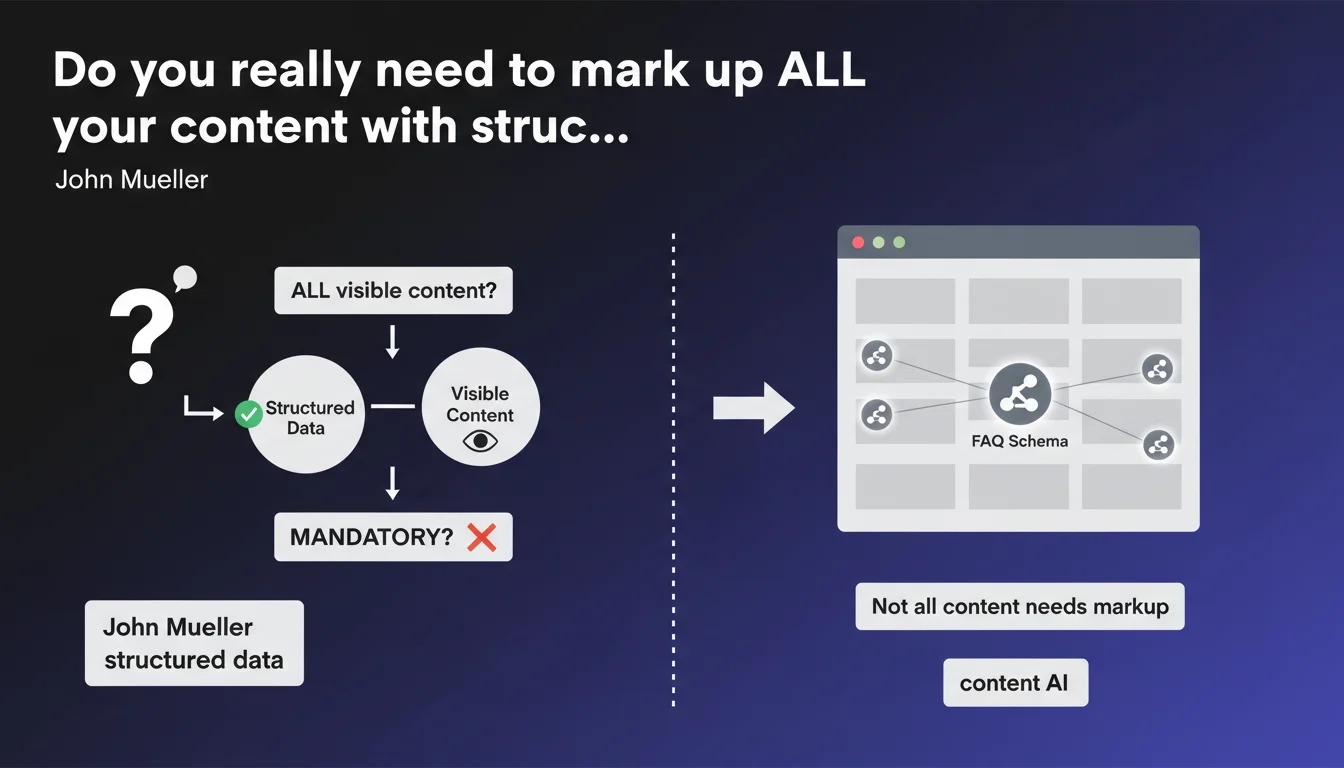
Google officially allows partial markup: you don't need to tag your entire content with structured data. If you have 20 FAQs on a page, marking up 5 is enough — as long as they remain visible. The requirement focuses on consistency between markup and displayed content, not on exhaustiveness.
What you need to understand
This statement from Mueller is cracking a widespread belief: that you must systematically tag the entirety of a content type as soon as you use a schema.
Many professionals apply binary logic — either you mark everything, or nothing. Google says the opposite: markup can be selective, as long as it accurately reflects what is visible.
What is Google's exact rule?
The constraint is straightforward: structured data must correspond to content that is actually displayed on the page. No invention, no hidden content.
Conversely, the reverse is not true — all visible content doesn't need to be marked. You choose what you highlight with the schema, within the limits of what is present.
Why does this nuance change everything?
It opens the door to a strategic approach to markup. Rather than mechanically tagging 20 identical FAQs, you select the 5 with the most potential for rich results.
Concretely, it means less unnecessary code, lower risk of errors, and better control over what is exposed to Google.
- Partial markup allowed: no obligation for exhaustiveness on a content type
- Consistency required: what is marked must be visible on the page
- Selective approach: prioritize high-potential content rather than defaulting to marking everything
- No hidden content: schema cannot be used to inject invisible content
SEO Expert opinion
Is this flexibility really new?
No — and that's precisely what makes this statement interesting. Google has never officially required exhaustive markup, but the SEO ecosystem has imposed this constraint on itself.
Schema.org guidelines remain vague on this point. Validation tools sometimes flag "missed opportunities" without it being a technical error. Result: many sites over-tag out of caution.
What's the trap in this statement?
Mueller doesn't specify how much markup is sufficient, or whether a minimum threshold exists. 5 FAQs out of 20, OK — but 1 out of 20? 2 out of 50?
Another gray area: what happens if marked content changes regularly (e.g., FAQ rotation based on context)? Does Google tolerate variance between crawls? [To be verified]
How does this rule align with rich results?
Google never guarantees rich snippet display, even with perfect markup. Here, selectivity becomes an advantage: you concentrate your efforts on content that truly deserves to be highlighted.
In practice, marking 5 ultra-relevant FAQs rather than 20 average ones can improve your chances of getting displayed — Google prioritizes quality of marked content, not quantity.
Practical impact and recommendations
What should you actually do on your existing pages?
Audit your pages with FAQ, Recipe, HowTo, or Product markup. Identify those where you've tagged systematically without thinking about the value of each element.
Ask yourself: among these 15 marked FAQs, which ones really have click potential in SERPs? Which are redundant or weak?
How do you choose which elements to mark?
Prioritize content that answers actual questions from your audience — cross-reference with your Search Console data. A marked FAQ matching a frequently asked question has a better chance of being displayed.
Avoid marking generic or duplicate content. If 3 FAQs say the same thing with different wording, keep only one in the schema.
- Take inventory of pages with FAQ, Recipe, HowTo, Product markup
- Identify marked elements that provide no differentiating value
- Cross-reference your marked FAQs with actual Search Console queries
- Test impact on rich results with Google's Rich Results Test
- Document your selection strategy to maintain consistency long-term
- Monitor impressions/clicks evolution after markup adjustments
This statement validates a qualitative approach to markup: 5 relevant, well-chosen elements beat 20 tagged by default. Focus your efforts on what makes sense for users and your visibility strategy.
Implementing structured data with strategic logic requires careful analysis of your content, SERP performance, and business goals. If you lack in-house resources or expertise to conduct this audit and prioritize effectively, guidance from a specialized SEO agency can save time and avoid missteps — especially on high-volume content sites where each markup choice has cumulative impact.
❓ Frequently Asked Questions
Si je marque seulement 3 FAQ sur 15, Google va-t-il me pénaliser ?
Puis-je alterner les FAQ marquées d'une semaine à l'autre ?
Le markup partiel s'applique-t-il aussi aux fiches produit ?
Faut-il retirer le markup des FAQ de faible qualité sur mes pages existantes ?
Google peut-il afficher en rich result une FAQ non marquée ?
🎥 From the same video 29
Other SEO insights extracted from this same Google Search Central video · published on 14/01/2022
🎥 Watch the full video on YouTube →
💬 Comments (0)
Be the first to comment.