
Official statement
What you need to understand
What's the Problem with Recipe Structured Data on Collection Pages?
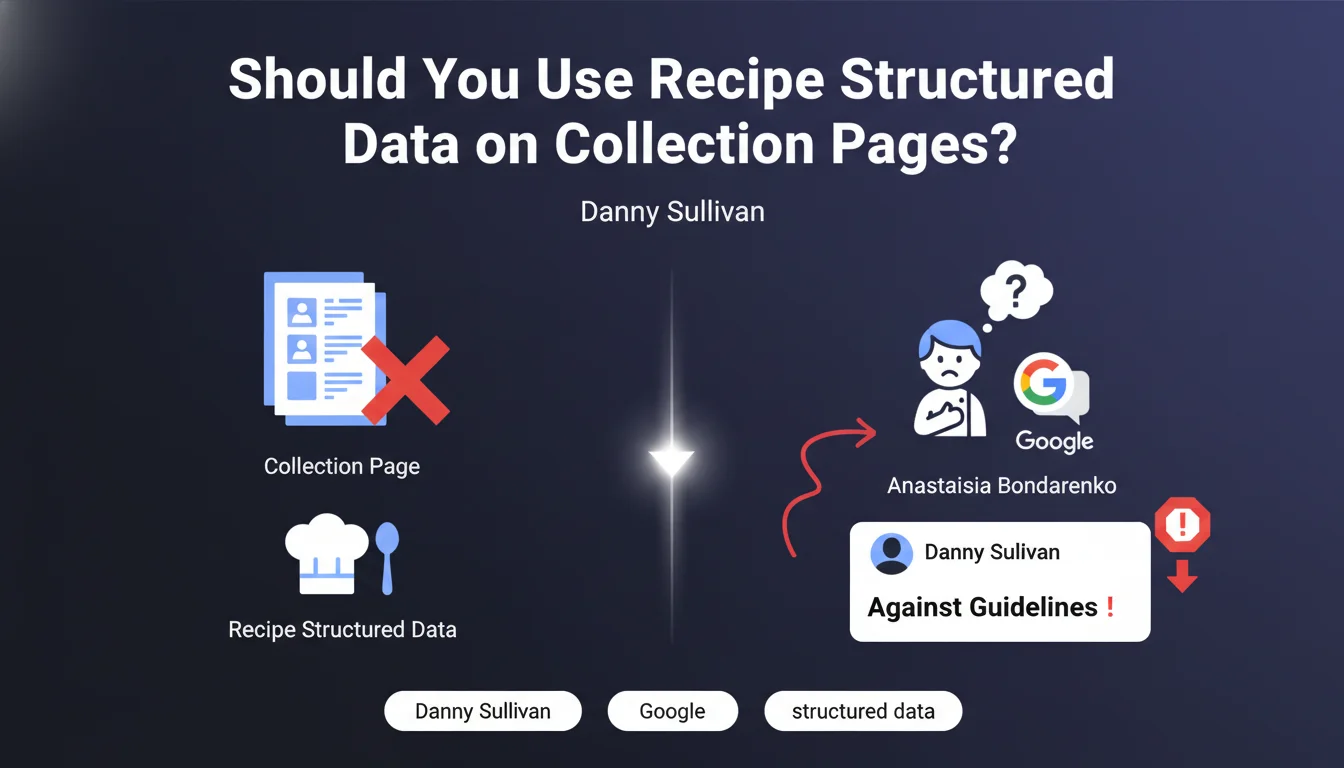
Google has clarified its position following an observation made by an SEO expert: some sites are using Schema.org Recipe markup on Collection-type pages that don't present a single recipe but rather a list or aggregation of recipes.
This practice is explicitly against Google's guidelines. Recipe structured data must be reserved exclusively for pages presenting a single complete recipe, with its ingredients and preparation steps.
Why Are Some Sites Misusing This Markup?
The improper use of Recipe structured data aims to obtain attractive rich snippets in search results, particularly star ratings, preparation times, and highlighted images.
These visual elements generate higher click-through rates, which pushes some sites to apply them even on pages that don't match the expected format.
- Recipe structured data is designed for individual recipes only
- Collection pages (lists, categories) should not use this markup
- Google acknowledges the problem but hasn't yet taken massive penalization measures
- Incorrect usage explicitly violates official guidelines
What Are the Legitimate Alternatives for Collection Pages?
For pages listing multiple recipes, Google offers other appropriate markup types such as CollectionPage or ItemList that allow proper structuring of this type of content.
These alternatives enable you to benefit from adapted rich display without breaking the rules, even if the rich snippets are less spectacular than those for individual recipes.
SEO Expert opinion
Is This Statement Consistent with Google's Observed Actions?
There's a significant gap between Google's official statement and the actual measures taken. The problem was already reported in October, and no visible penalization has been applied since.
This type of situation creates an environment of uncertainty: sites that follow the rules are disadvantaged in the short term compared to those who circumvent them, while the latter risk a delayed but potentially severe sanction.
What Real Risks Do Sites Using This Technique Face?
The main risk is the complete removal of rich snippets for the entire site, not just for the problematic pages. Google can apply a manual action that deprives the domain of all its enhanced displays.
Even more serious, this practice could lead Google to tighten its eligibility criteria for Recipe structured data, thus penalizing the entire ecosystem of legitimate recipe sites.
In What Context Might This Rule Seem Unclear?
Certain situations create gray areas: what about a page presenting a main recipe with suggested variations? Or a blog article incorporating a complete recipe within broader editorial content?
Google's rule is clear in principle: Recipe markup should only apply if the page's primary and sole objective is to present a specific recipe with all its execution details.
Practical impact and recommendations
What Should You Check Immediately on Your Recipe Site?
Audit all pages on your site that use Schema.org Recipe markup. Use Google's Rich Results Test tool to validate each implementation.
Verify that each marked-up page actually contains a complete individual recipe with ingredient list, numbered preparation steps, and detailed instructions.
- Identify all pages with Recipe markup via a technical crawl
- Verify that each page corresponds to ONE unique and complete recipe
- Remove Recipe markup from category, list, and collection pages
- Implement CollectionPage or ItemList tags for aggregation pages
- Test modifications with Google Rich Results Test tool
- Monitor Search Console to detect any structured data alerts
How Can You Fix Non-Compliant Implementation Without Losing Visibility?
The transition must be gradual and strategic. Start with the least performing pages to measure impact, then extend to other sections once the methodology is validated.
Systematically replace Recipe markup with appropriate alternatives: ItemList for recipe lists, CollectionPage for thematic categories, or Article if editorial content dominates.
Simultaneously optimize other click-through rate factors like titles, meta descriptions, and images to compensate for the potential loss of the most visible rich snippets.
Should You Wait for Google to Penalize or Act Preemptively?
The recommended approach is clearly preemptive. Sites that wait for a penalty risk a sudden traffic drop that's difficult to recover from, as Google's manual actions can take weeks to be lifted.
Adopting a compliant strategy now protects you against future updates and positions your site as a reliable source in Google's eyes, which can positively influence other ranking aspects.
💬 Comments (0)
Be the first to comment.