
Official statement
Other statements from this video 29 ▾
- □ Un fichier robots.txt volumineux pénalise-t-il vraiment votre SEO ?
- □ Soumettre son sitemap dans robots.txt ou Search Console : y a-t-il vraiment une différence ?
- □ Faut-il vraiment respecter une hiérarchie stricte des balises Hn pour le SEO ?
- □ Combien de temps faut-il réellement pour qu'une migration de domaine soit prise en compte par Google ?
- □ Une migration de site peut-elle vraiment booster votre SEO ou tout faire planter ?
- □ Googlebot crawle-t-il vraiment depuis un seul endroit pour indexer vos contenus géolocalisés ?
- □ Le noindex sur pages géolocalisées peut-il faire disparaître tout votre site des résultats Google ?
- □ Faut-il vraiment abandonner les redirections géolocalisées pour une simple bannière ?
- □ Faut-il créer des pages de destination pour chaque ville ou se limiter aux régions ?
- □ Faut-il rediriger les utilisateurs mobiles vers votre application mobile ?
- □ Faut-il vraiment traduire mot pour mot ses pages pour que le hreflang fonctionne ?
- □ Fichier Disavow : pourquoi la directive domaine permet-elle de contourner la limite de 2MB ?
- □ Faut-il vraiment utiliser le fichier Disavow uniquement pour les liens achetés ?
- □ Faut-il mettre en noindex ses pages de résultats de recherche interne pour bloquer les backlinks spam ?
- □ Le HTML sémantique booste-t-il vraiment votre référencement naturel ?
- □ AMP est-il encore un critère de ranking dans Google Search ?
- □ AMP est-il vraiment un facteur de classement pour Google ?
- □ Supprimer AMP boost-t-il le crawl de vos pages classiques ?
- □ Faut-il tester la suppression de son fichier Disavow de manière incrémentale ?
- □ Pourquoi les panels de connaissance s'affichent-ils différemment selon les appareils ?
- □ Le système de synonymes de Google fonctionne-t-il vraiment sans intervention humaine ?
- □ Faut-il vraiment créer une page distincte par localisation pour le schema Local Business ?
- □ Faut-il vraiment marquer TOUT son contenu en données structurées ?
- □ Faut-il vraiment afficher toutes les questions du schema FAQ sur la page ?
- □ Le contenu masqué dans les accordéons peut-il vraiment apparaître dans les featured snippets ?
- □ Pourquoi Google ne veut-il pas indexer l'intégralité de votre site web ?
- □ Faut-il supprimer des pages pour améliorer l'indexation de son site ?
- □ Le volume de recherche des ancres influence-t-il vraiment la valeur d'un lien interne ?
- □ Faut-il vraiment ajouter du contenu unique sur vos pages produit en e-commerce ?
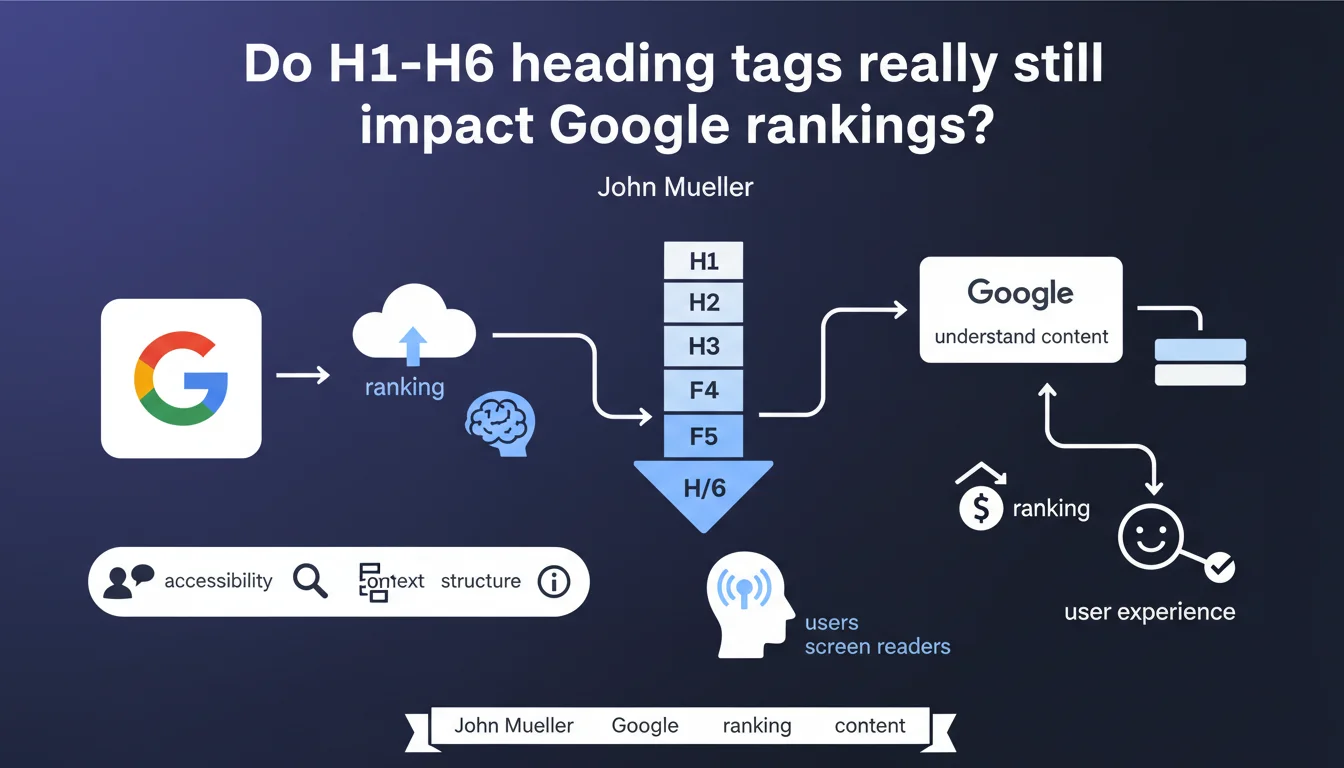
Google confirms that heading tags (H1, H2, etc.) primarily serve to understand the context and structure of a page's content. Direct SEO impact remains limited, but their role in accessibility and user experience justifies a logical hierarchy. Mueller downplays their importance for ranking while emphasizing their organizational utility.
What you need to understand
Does Google really use heading tags for SEO?
Yes, but not the way most SEOs imagine. Google analyzes H1-H6 tags to understand the semantic structure of a page, not to mechanically boost rankings. The algorithms use them as contextual signals — which section covers what topic, how information is organized.
Concretely, an H2 containing "Easy vegetarian recipes" helps Google identify that this portion of content deals with that specific subject. It's one signal among hundreds of others, far from being decisive on its own.
Why does Mueller emphasize accessibility rather than pure SEO?
Because the primary impact of heading tags concerns screen readers and user experience, not a hidden algorithmic bonus. A coherent H1 > H2 > H3 hierarchy allows visually impaired users to navigate content efficiently via keyboard shortcuts.
Google isn't saying headings are useless for SEO — it's resetting expectations. The obsession with having exactly one H1 with the main keyword repeated 3 times is often cargo cult behavior. Logical structure trumps forced optimization.
What's the difference between "understanding context" and "influencing rankings"?
That's the entire nuance of this statement. Understanding context means Google better grasps what each section covers, which can indirectly improve relevance for certain long-tail queries. But it doesn't generate a magical position boost.
The influence on rankings remains correlative, not causal. Well-structured pages with clear headings often have other qualities (dense content, logical organization, polished UX) that actually impact ranking. Heading tags are a symptom of quality, not the cause of success.
- Heading tags help Google map content, not valorize it directly
- Accessibility is Google's primary argument for their use
- Logical hierarchy beats keyword-stuffed optimization
- SEO impact exists but remains indirect and difficult to measure in isolation
SEO Expert opinion
Does this statement match real-world observations?
Partially. On already well-ranked sites, restructuring headings alone rarely generates measurable gains. A/B tests focused solely on H1-H6 show negligible organic traffic variations in 90% of cases.
However — and this is where Mueller remains vague — certain highly competitive niches show improvements when moving from chaotic structure (multiple H1s, hierarchy jumps) to clean architecture. Is this the direct effect of the tags or the overall page improvement that accompanies this cleanup? [To verify] because Google never provides isolated metrics on this factor.
What inconsistencies does this official position pose?
Google long avoided explicitly confirming that headings mattered, then published contradictory guidelines. Some official documents recommend using keywords in H1-H2, others minimize their importance entirely.
The reality? Google cannot ignore headings without losing semantic precision, especially since the BERT and MUM era. But admitting they have clear algorithmic weight would open the door to massive manipulation. Mueller thus chooses the "accessibility" angle — politically correct and defensible.
In what cases doesn't this statement fully apply?
Niche sites with few strong external signals (recent domains, weak backlinks) can benefit more from rigorous heading optimization. When Google lacks strong external context, it relies more on on-page signals — including semantic tags.
Conversely, on an authority site like an established media outlet, heading architecture becomes almost anecdotal against the weight of brand, backlinks and performance history. The impact of headings varies based on competitive context and site maturity.
Practical impact and recommendations
What should you concretely do with heading tags?
Forget the obsession with a single H1 stuffed with keywords. Focus on a logical hierarchy reflecting your content's natural organization. One H1 for the main title, H2s for major sections, H3s for subsections.
If your H1 doesn't contain the exact keyword but faithfully describes the topic, that's perfect. Google understands synonyms and overall context — forcing keyword stuffing into headings smells of crude optimization and can even degrade user experience.
What errors should you absolutely avoid?
Never skip hierarchy levels (H1 > H3 without intermediate H2). That breaks logical structure and complicates interpretation for screen readers, which can indirectly harm your SEO via degraded UX signals.
Also avoid purely decorative headings styled with CSS but without appropriate HTML tags. Google sees only source code — if your visual "title" is a simple <div class="big-text">, it loses all semantic weight.
How do you verify your heading structure is optimal?
Use tools like Screaming Frog or Sitebulb to audit hierarchy across all pages. Look for anomalies: pages without H1, multiple H1s, hierarchy jumps, duplicate headings across pages.
Also test with a screen reader (NVDA on Windows, VoiceOver on Mac). If navigating your content via headings seems chaotic or illogical, your structure needs revision — and Google will likely sense it too.
- One H1 per page, naturally describing the main topic
- Logical hierarchy without skipping levels (H1 > H2 > H3, not H1 > H3)
- Descriptive headings that actually summarize the section content
- No artificial keyword stuffing in heading tags
- Screen reader verification to validate assisted navigation
- Regular technical audits to detect inconsistencies site-wide
Heading tags aren't a miracle ranking lever, but they structure your content intelligibly for Google and users. Clean hierarchy improves accessibility, clarifies semantic context and avoids indirect UX penalties.
Implementing these optimizations on a medium or complex site can be technical, especially when reworking templates, auditing thousands of pages and prioritizing fixes. Working with a specialized SEO agency gets you a complete diagnosis and action plan suited to your specific context, without risking breaking critical elements during modifications.
❓ Frequently Asked Questions
Peut-on avoir plusieurs balises H1 sur une même page sans pénalité ?
Les mots-clés dans les balises H2-H3 améliorent-ils le ranking ?
Google pénalise-t-il les pages avec une hiérarchie heading chaotique ?
Faut-il optimiser les headings des pages de catégorie e-commerce ?
Les balises heading influencent-elles les featured snippets ?
🎥 From the same video 29
Other SEO insights extracted from this same Google Search Central video · published on 14/01/2022
🎥 Watch the full video on YouTube →
💬 Comments (0)
Be the first to comment.