
Official statement
Other statements from this video 20 ▾
- □ Do internal links in the header or footer really have less SEO value?
- □ Does Google really penalize a website that buys links in bulk?
- □ Do you really need technical perfection to rank well on Google?
- □ Does Google really crawl your site less when it perceives low quality?
- □ Is the 'Crawled, Currently Not Indexed' status really just a sign of poor website quality?
- □ Can invalid structured data penalize your SEO performance?
- □ Crawled vs Discovered: Are these two non-indexed statuses really the same thing?
- □ Can you really control which images Google displays in your search snippets?
- □ Is your franchise network losing visibility because of duplicate content across multiple domains?
- □ CCTLD, subdomain or subdirectory: which structure for international geotargeting?
- □ Does the 503 status code really protect your pages from deindexing during an outage?
- □ Will accidental dofollow links in your PR coverage actually hurt your rankings?
- □ Can you really use the address change tool to merge or split websites?
- □ Why are your structured data disappearing on your localized pages?
- □ Do structured data really improve rankings, or just how results are displayed?
- □ Will Google ever display Core Web Vitals badges directly in search results?
- □ Why Does Google Cause Position Fluctuations for Two Months After URL Restructuring?
- □ Does internal linking really outperform URL structure for SEO?
- □ Should you really spend time calculating internal PageRank to optimize your website?
- □ Can Google Really Identify the Main Language of a Multilingual Page Without Hurting Your SEO?
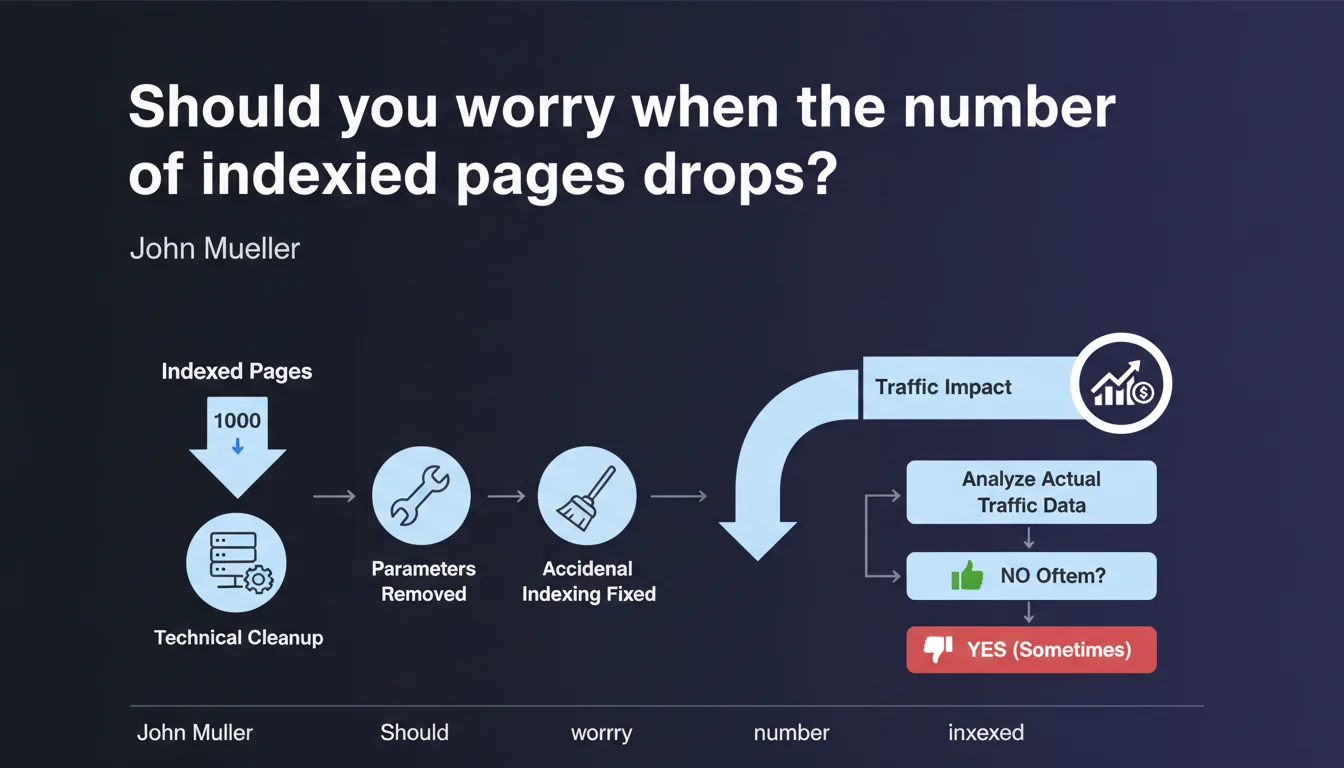
A drop in the number of indexed pages is not necessarily a red flag. Google confirms that this can simply reflect technical cleanup — removal of duplicate pages, misconfigured URL parameters, or low-quality content removed from the index. The key indicator remains organic traffic, not the indexed page count.
What you need to understand
This statement from John Mueller reminds us of a principle that SEO practitioners often misunderstand: the number of indexed pages is a secondary indicator, not a performance metric in itself.
Many consultants panic as soon as they see a drop in Google Search Console without checking if it actually has a real business impact.
Why does the number of indexed pages fluctuate?
Google constantly adjusts its index. A drop can result from positive technical corrections: removal of pages with poorly managed UTM parameters, elimination of e-commerce facets accidentally crawled, or cleanup of thin content.
In some cases, it's Google itself that decides to deindex pages deemed irrelevant or redundant. This doesn't necessarily mean a penalty — simply that the algorithm has reassessed the quality of these URLs.
What is the real metric to monitor?
Mueller insists: look at actual organic traffic. If your strategic pages continue to perform, a drop in the overall indexed total is just a technical detail.
Since crawl budget is limited, having 10,000 indexed pages of low quality is far worse than having 2,000 high-performing ones. Google never promised to index your entire site — only what deserves to be indexed.
- A drop in indexation is not a problem if traffic remains stable or grows
- Fluctuations can reflect beneficial technical cleanup
- Google can deindex pages deemed redundant or low-quality without any manual action on your part
- The number of indexed pages is an indicator, not a goal in itself
SEO Expert opinion
Is this statement consistent with real-world observations?
Yes, and it's even one of the rare points where Google's official discourse perfectly aligns with reality. We regularly see sites that gain traffic after a drop in indexation — often because they've cleaned up parasitic pages.
The problem is that Google provides no tool to clearly distinguish between a voluntary deindexation (healthy cleanup) and a forced deindexation (quality penalty). Search Console displays a global counter, period.
What nuances should we add?
Let's be honest: not all drops in indexation are harmless. If your e-commerce site goes from 5,000 to 500 indexed pages overnight, there's probably a real technical problem — broken robots.txt, accidental noindex tags, or worse, an algorithmic penalty.
Mueller is right in principle, but his wording leaves an enormous gray area. [To verify]: how do you distinguish between a "beneficial technical cleanup" and a quality degradation perceived by the algorithm? Google provides no objective criteria.
Another point: pages "with accidentally indexed parameters" are often symptoms of wobbly technical architecture. If Google crawled them, it's because your internal linking or facet management is lacking.
In what cases should you still worry?
If the drop in indexation is accompanied by a fall in traffic on strategic keywords, it's a clear signal of a problem. Same if entire categories disappear from the index for no apparent reason.
Mueller's advice is valid for normal fluctuations — not for sudden collapses. In that case, audit quickly: Screaming Frog crawl, server log verification, Search Console analysis segment by segment.
Practical impact and recommendations
What should you do concretely if the number of indexed pages drops?
First step: don't panic. Open Google Analytics (or your tracking tool) and check if overall organic traffic and traffic to key pages are affected. If everything is stable, the drop is probably technical and not qualitative.
Next, segment your Search Console analysis: which categories of pages have disappeared? Pagination URLs? Facets? Tracking parameters? If these are pages with no SEO value, it's even good news.
What mistakes should you avoid?
Don't force reindexation of pages that have no reason to be indexed. Manually submitting 3,000 low-quality URLs via the Indexing API will only irritate the algorithm.
Another trap: adding generic content to thin pages to "save indexation." If Google judged these pages irrelevant, a filler paragraph won't change anything — you need to rethink the information architecture or accept deindexing them properly.
How do you verify your site is healthy?
Audit your robots.txt file and meta robot tags. Check that you haven't accidentally blocked strategic sections. Crawl the site with Screaming Frog simulating Googlebot — compare the number of discovered URLs with the indexed number.
Analyze your server logs: is Google still crawling pages that disappeared from the index? If yes, it's a quality perception issue. If no, it's a technical accessibility problem.
- Check overall organic traffic before panicking
- Segment Search Console analysis by page type
- Identify deindexed pages: do they have real SEO value?
- Audit robots.txt, meta robots and canonicals
- Crawl the site simulating Googlebot
- Analyze server logs to see if Google still crawls the disappeared URLs
- If problem confirmed: fix technical blockers or improve content quality
❓ Frequently Asked Questions
Une baisse de 30% du nombre de pages indexées est-elle normale ?
Comment savoir si Google a désindexé des pages pour des raisons de qualité ?
Faut-il forcer la réindexation via l'API Indexing ?
Combien de pages un site e-commerce devrait-il avoir indexées ?
Les pages désindexées peuvent-elles être récupérées automatiquement ?
🎥 From the same video 20
Other SEO insights extracted from this same Google Search Central video · published on 21/01/2022
🎥 Watch the full video on YouTube →
💬 Comments (0)
Be the first to comment.