
Official statement
Other statements from this video 20 ▾
- □ Les liens internes dans le header ou le footer ont-ils moins de valeur SEO ?
- □ Google pénalise-t-il vraiment un site qui achète des liens en masse ?
- □ Faut-il vraiment viser la perfection technique pour bien ranker sur Google ?
- □ Pourquoi Google crawle-t-il moins votre site s'il le trouve de mauvaise qualité ?
- □ Le statut « Crawlée, actuellement non indexée » est-il vraiment un signal de qualité insuffisante ?
- □ Les données structurées invalides peuvent-elles pénaliser votre référencement ?
- □ Faut-il s'inquiéter d'une baisse du nombre de pages indexées ?
- □ Crawlée non indexée vs Découverte non indexée : vraiment équivalent ?
- □ Peut-on vraiment contrôler les images affichées dans les snippets Google ?
- □ Pourquoi Google pénalise-t-il le contenu dupliqué entre sites de franchises ?
- □ CCTLD, sous-domaine ou sous-répertoire : quelle structure pour le géociblage international ?
- □ Le code 503 protège-t-il vraiment vos pages de la désindexation en cas de panne ?
- □ Peut-on vraiment utiliser l'outil de changement d'adresse pour fusionner ou diviser des sites ?
- □ Pourquoi vos données structurées disparaissent-elles sur vos pages localisées ?
- □ Les données structurées améliorent-elles vraiment le référencement ou juste l'affichage ?
- □ Google va-t-il un jour afficher les Core Web Vitals directement dans les résultats de recherche ?
- □ Restructuration d'URL : pourquoi Google provoque-t-il des fluctuations pendant deux mois ?
- □ Le linking interne surpasse-t-il vraiment la structure d'URL pour le SEO ?
- □ Faut-il vraiment calculer le PageRank interne pour optimiser son site ?
- □ Google peut-il vraiment identifier la langue principale d'une page multilingue sans pénaliser votre SEO ?
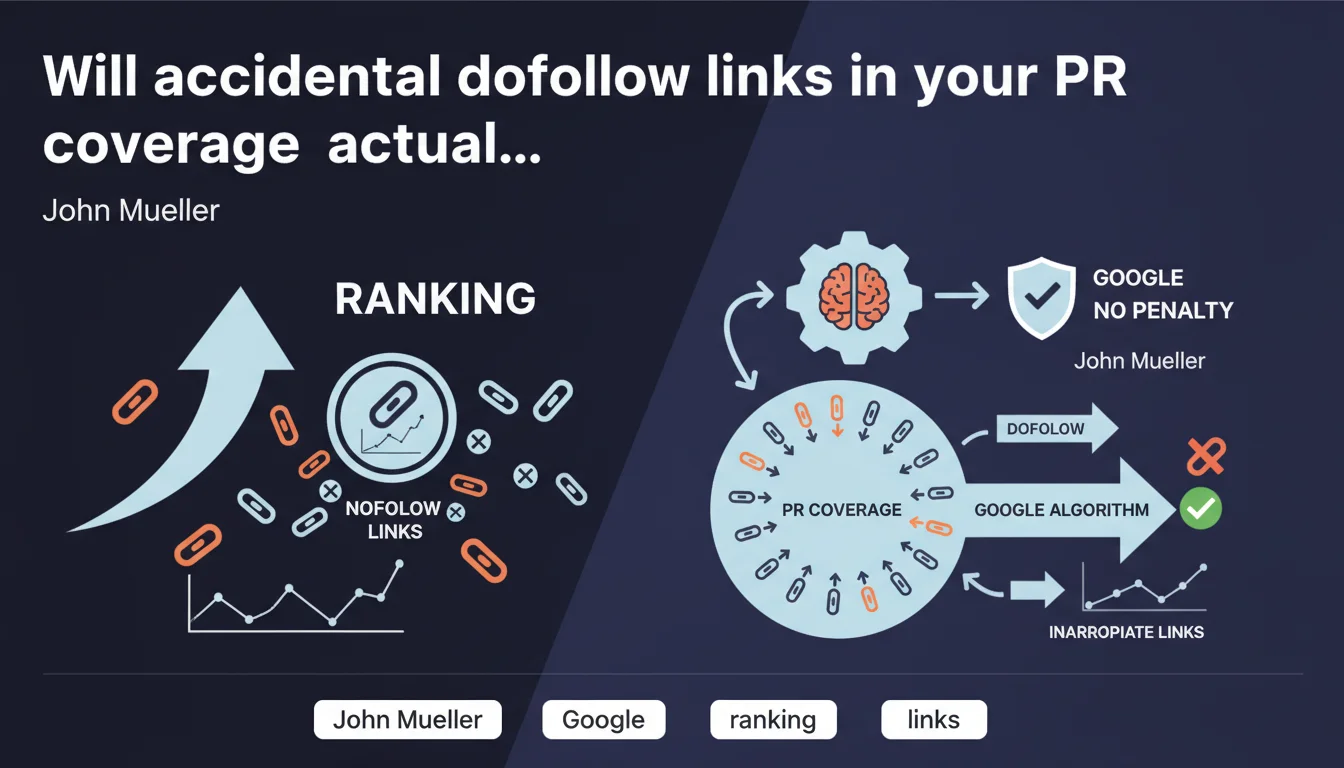
Google won't penalize you if a few dofollow links slip through your press release articles that are mostly correctly tagged with nofollow. The key: ensuring the majority is properly attributed and that algorithms can identify and handle inappropriate links. A pragmatic tolerance that reflects real-world conditions.
What you need to understand
Why does Google tolerate these accidental dofollow links?
John Mueller's position is first and foremost realistic. PR campaigns generate hundreds, sometimes thousands of links. Some editors forget nofollow, others apply it incorrectly, and still others modify the article after publication.
Google knows this. Rather than mechanically penalizing every time a PR link slips through as dofollow, algorithms evaluate the overall pattern. If 95% of your PR links are correctly attributed, the remaining 5% are perceived as noise, not as an attempt at manipulation.
What does "the majority" actually mean in concrete terms?
Mueller doesn't provide a specific threshold — classic move. But the phrase "if the majority" suggests we're talking about well over 50%, probably significantly higher to be safe.
The real safety signal is that algorithms can identify these links. If your PR links come from legitimate editorial sites, are contextually relevant, and aren't abusive in their anchor text, Google spots them without difficulty and can devalue them automatically if needed.
What are the risks if the balance tips?
If your profile shows 60% of links as dofollow from PR sources, that changes everything. Google may see this as a deliberate manipulation attempt — especially if anchors are optimized or if source sites are questionable.
The other risk: a manual action could be triggered if a human reviewer examines your backlink profile and finds you're systematically exploiting paid links in dofollow format.
- Google tolerates occasional errors, not deliberate strategies
- The majority of PR links must use nofollow or sponsored
- Algorithms identify and devalue inappropriate links without penalty if the overall pattern is healthy
- A clear imbalance can trigger manual action
SEO Expert opinion
Is this tolerance new or simply confirmed?
Nothing new here — it's a confirmation of what we've observed for years. Google has always distinguished between suspicious link profiles and "normal" profiles with a few anomalies.
What's changing is that Mueller is saying it explicitly. This helps reassure those who panic whenever a PR link escapes quality control. But careful: this statement doesn't justify dropping your guard.
In what cases does this rule not apply?
If your PR links systematically point to commercial pages with money anchors, you're outside the "accidental" framework. Google won't tolerate a manifestly calculated pattern, even if 51% of links are nofollow.
Another edge case: the source sites. If your "PR articles" come from content farms or grey-market platforms, the nofollow/dofollow status becomes secondary — the entire link is toxic.
What should you do if you inherit a polluted profile?
If your backlink profile shows a majority of PR links as dofollow — legacy of a previous agency or hasty strategy — start with a thorough audit. Identify sources, assess their legitimacy, contact editors to request nofollow conversion.
If some links can't be corrected, add them to your disavow file. But let's be honest: it's tedious, time-consuming, and often underestimated. [To verify] whether Google actually applies this tolerance to massively polluted profiles or if it mainly applies to "clean profiles with a few slip-ups."
Practical impact and recommendations
What specifically should you do to stay compliant?
First, systematize nofollow in your PR briefs. Make it explicit in contracts and editor guidelines, then verify after publication. If you work with a PR agency, ensure they understand the stakes — many don't make this their default practice.
Next, audit your backlink profile regularly. Use Ahrefs, SEMrush, or Majestic to spot new links and verify their attributes. A dofollow link appears? Contact the editor quickly.
What mistakes must you absolutely avoid?
Never assume "Google will understand" if most of your PR links are dofollow. This statement is tolerance for exceptions, not a green light for a lax strategy.
Another mistake: blending PR and guest posting without distinction. A guest article with natural editorial link, fine. A paid guest article with optimized anchor — that's sponsored content, so sponsored or nofollow is mandatory.
How do you verify your site is compliant?
- Export your complete backlink profile (Ahrefs, SEMrush)
- Filter links from identified PR campaigns
- Calculate nofollow/dofollow ratio — aim for >80% nofollow minimum
- Inspect dofollow links: editorial context, anchor text, source
- If a dofollow link is suspect, request correction or disavow
- Document your PR campaigns to justify yourself in case of manual action
❓ Frequently Asked Questions
Si 30% de mes liens RP sont en dofollow, est-ce un problème ?
Dois-je utiliser nofollow ou sponsored pour mes liens RP ?
Google peut-il ignorer automatiquement les liens RP dofollow sans me pénaliser ?
Un lien dofollow sur un média majeur sera-t-il dévalué par Google ?
Que faire si un éditeur refuse de passer mon lien en nofollow ?
🎥 From the same video 20
Other SEO insights extracted from this same Google Search Central video · published on 21/01/2022
🎥 Watch the full video on YouTube →
💬 Comments (0)
Be the first to comment.