
Official statement
Other statements from this video 20 ▾
- □ Les liens internes dans le header ou le footer ont-ils moins de valeur SEO ?
- □ Google pénalise-t-il vraiment un site qui achète des liens en masse ?
- □ Faut-il vraiment viser la perfection technique pour bien ranker sur Google ?
- □ Pourquoi Google crawle-t-il moins votre site s'il le trouve de mauvaise qualité ?
- □ Le statut « Crawlée, actuellement non indexée » est-il vraiment un signal de qualité insuffisante ?
- □ Les données structurées invalides peuvent-elles pénaliser votre référencement ?
- □ Faut-il s'inquiéter d'une baisse du nombre de pages indexées ?
- □ Crawlée non indexée vs Découverte non indexée : vraiment équivalent ?
- □ Peut-on vraiment contrôler les images affichées dans les snippets Google ?
- □ CCTLD, sous-domaine ou sous-répertoire : quelle structure pour le géociblage international ?
- □ Le code 503 protège-t-il vraiment vos pages de la désindexation en cas de panne ?
- □ Les liens dofollow accidentels dans vos RP vont-ils vous pénaliser ?
- □ Peut-on vraiment utiliser l'outil de changement d'adresse pour fusionner ou diviser des sites ?
- □ Pourquoi vos données structurées disparaissent-elles sur vos pages localisées ?
- □ Les données structurées améliorent-elles vraiment le référencement ou juste l'affichage ?
- □ Google va-t-il un jour afficher les Core Web Vitals directement dans les résultats de recherche ?
- □ Restructuration d'URL : pourquoi Google provoque-t-il des fluctuations pendant deux mois ?
- □ Le linking interne surpasse-t-il vraiment la structure d'URL pour le SEO ?
- □ Faut-il vraiment calculer le PageRank interne pour optimiser son site ?
- □ Google peut-il vraiment identifier la langue principale d'une page multilingue sans pénaliser votre SEO ?
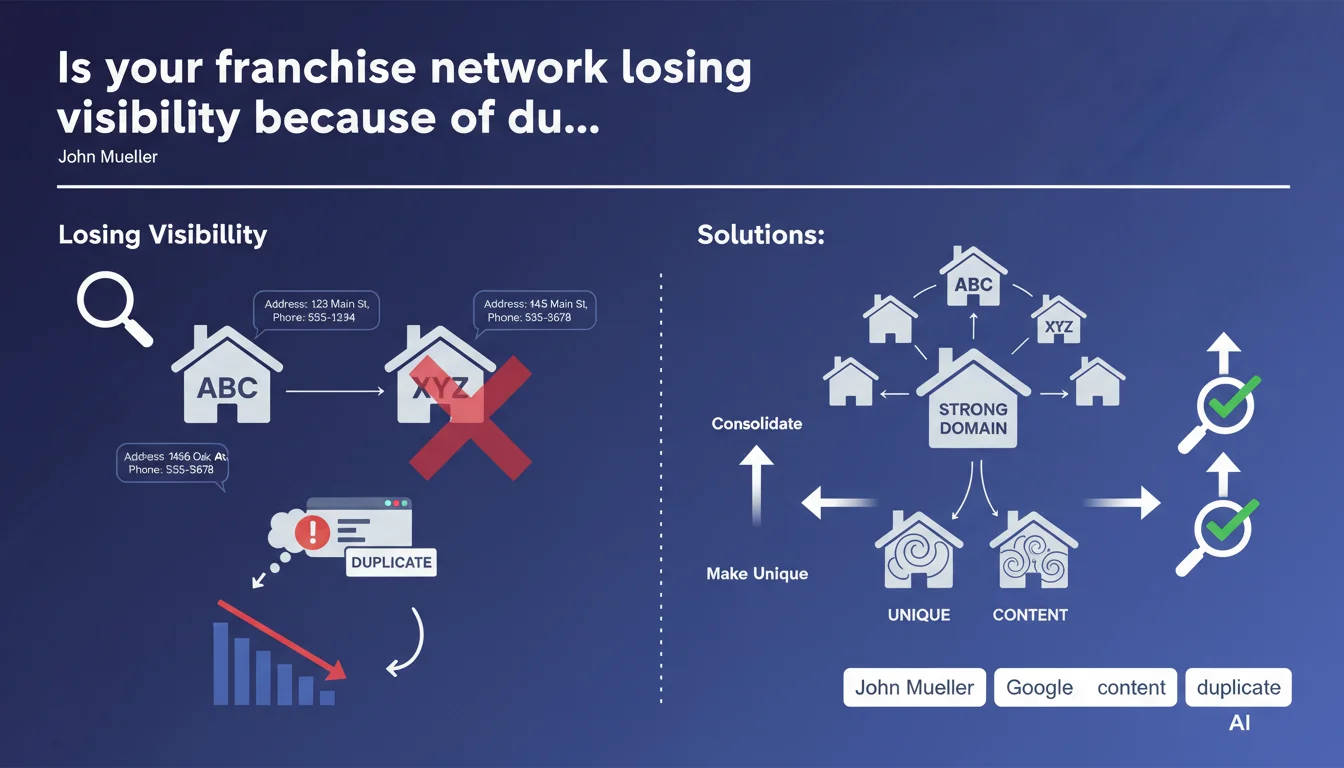
Google treats franchise websites with identical content (except for local coordinates) as duplicate content. Two solutions: consolidate all locations under a single strong domain, or create truly differentiated content for each location. Simply changing the address and phone number isn't enough.
What you need to understand
What exactly does Google hold against franchise websites?
The issue is crystal clear: dozens or hundreds of nearly identical websites that differ only by the address and phone number of each location. Each franchisee often has their own domain — franchise-paris.fr, franchise-lyon.fr, franchise-marseille.fr — with a standardized template.
Google detects this massive duplication. Its algorithm doesn't see the value in ranking 50 versions of the same content for 50 different cities. The search engine seeks informational diversity, not clones.
Why is this multi-domain approach counterproductive?
Each separate domain dilutes your overall authority. Instead of having one powerful site that concentrates all backlinks, reputation, and traffic, you scatter your efforts across dozens of weak properties.
Trust signals don't accumulate. A link to franchise-paris.fr doesn't help franchise-lyon.fr. Result: none of your sites truly emerge in competitive SERPs.
What actually happens in case of duplicate content?
Google won't necessarily penalize you in the form of a manual action. The search engine will simply choose one canonical version — usually the one it deems most authoritative — and ignore the others in its results.
Your other domains technically still exist, but they languish on page 5 or 6. You're investing in multiple sites for the visibility of one, at best.
- Duplicate content = Google selects one version and discards the others
- Diluted authority = each separate domain starts from zero in terms of signals
- Multiplied effort = maintaining multiple properties for marginal ROI
- Cannibalization risk = your own sites compete against each other on certain generic queries
SEO Expert opinion
Is this recommendation consistent with real-world observations?
Absolutely. We regularly see franchise networks where a single domain captures 80% of organic traffic, with others surviving mainly through local brand searches. When Google talks about consolidating to one strong domain, that's exactly the pattern we observe: high-performing multi-location sites use subdirectories (/paris/, /lyon/) or subdomains under a main domain.
The multi-domain strategy still works in some hyper-local or low-competition niches. But as soon as there's search volume and competition, consolidation consistently wins out.
What does "significantly unique content" actually mean?
Here, Google remains deliberately vague. [To verify] What proportion of content should differ? 30%? 50%? No official numbers.
What we observe: changing a few paragraphs or adding local testimonials generally isn't enough. The informational structure itself must vary — different angles, distinct formats, genuinely location-specific data. It's doable for 5-10 locations. For 200 franchises? Unrealistic without industrialization that often ends up... reproducing quasi-duplicates anyway.
In which cases can you keep multiple distinct domains?
If each franchise develops its own editorial positioning — its local blog, events, partnerships — and generates truly differentiated content, multiple domains remain defensible. But let's be honest: it's rare. Most franchises prioritize brand uniformity.
Another exception: international franchises with national extensions (.fr, .de, .es) and content that's genuinely translated and culturally adapted. There, Google understands the multi-domain logic.
Practical impact and recommendations
Should you prioritize a single domain or truly differentiate each site?
For 90% of franchise networks, the single domain is the pragmatic solution. You concentrate your SEO budget on one property, you accumulate authority, you simplify technical management. Each location gets its own dedicated page (or section) optimized for geolocation.
Large-scale content differentiation? Time-consuming, expensive, hard to maintain. Unless you have the editorial resources to produce authentic local content at scale — and that's not everyone's reality.
How do you structure a single domain for multiple locations?
Two approaches dominate: subdirectories (site.com/paris/, site.com/lyon/) or subdomains (paris.site.com, lyon.site.com). Subdirectories are generally preferred because they directly benefit from the root domain's authority.
Each location page must contain: complete coordinates, hours, location-specific photos, local customer reviews, interactive map. Ideally, add local content — store news, local team, nearby events. Even 2-3 authentic paragraphs make a difference.
What if you already have multiple domains live?
First, audit the current traffic and authority distribution. Identify your strongest domain — typically the one with the most quality backlinks and best traffic history. This becomes your target domain.
Then plan a gradual migration: 301 redirects from old domains to the new URLs on the main domain, transfer of differentiated content, update Google Business Profile listings. Monitor Analytics and Search Console for 3-6 months post-migration.
- Identify the most authoritative primary domain in your network
- Create a clear subdirectory structure for each location
- Produce a minimum of 200-300 words of unique local content per page
- Implement schema.org LocalBusiness markup with precise coordinates
- Set up permanent 301 redirects from old domains
- Update all local citations and GMB listings
- Monitor organic traffic and rankings during the transition
- Regularly create localized editorial content (blog, news)
❓ Frequently Asked Questions
Changer uniquement l'adresse et le téléphone sur chaque site suffit-il à éviter le contenu dupliqué ?
Les sous-domaines sont-ils aussi efficaces que les sous-répertoires pour un réseau de franchise ?
Peut-on garder plusieurs domaines si chaque franchise a son propre blog local actif ?
Combien de temps faut-il pour récupérer le trafic après une migration de plusieurs domaines vers un domaine unique ?
Faut-il supprimer les anciens domaines après la migration ?
🎥 From the same video 20
Other SEO insights extracted from this same Google Search Central video · published on 21/01/2022
🎥 Watch the full video on YouTube →
💬 Comments (0)
Be the first to comment.