
Official statement
Other statements from this video 20 ▾
- □ Les liens internes dans le header ou le footer ont-ils moins de valeur SEO ?
- □ Google pénalise-t-il vraiment un site qui achète des liens en masse ?
- □ Faut-il vraiment viser la perfection technique pour bien ranker sur Google ?
- □ Pourquoi Google crawle-t-il moins votre site s'il le trouve de mauvaise qualité ?
- □ Le statut « Crawlée, actuellement non indexée » est-il vraiment un signal de qualité insuffisante ?
- □ Les données structurées invalides peuvent-elles pénaliser votre référencement ?
- □ Faut-il s'inquiéter d'une baisse du nombre de pages indexées ?
- □ Crawlée non indexée vs Découverte non indexée : vraiment équivalent ?
- □ Peut-on vraiment contrôler les images affichées dans les snippets Google ?
- □ Pourquoi Google pénalise-t-il le contenu dupliqué entre sites de franchises ?
- □ CCTLD, sous-domaine ou sous-répertoire : quelle structure pour le géociblage international ?
- □ Le code 503 protège-t-il vraiment vos pages de la désindexation en cas de panne ?
- □ Les liens dofollow accidentels dans vos RP vont-ils vous pénaliser ?
- □ Peut-on vraiment utiliser l'outil de changement d'adresse pour fusionner ou diviser des sites ?
- □ Pourquoi vos données structurées disparaissent-elles sur vos pages localisées ?
- □ Les données structurées améliorent-elles vraiment le référencement ou juste l'affichage ?
- □ Google va-t-il un jour afficher les Core Web Vitals directement dans les résultats de recherche ?
- □ Restructuration d'URL : pourquoi Google provoque-t-il des fluctuations pendant deux mois ?
- □ Le linking interne surpasse-t-il vraiment la structure d'URL pour le SEO ?
- □ Google peut-il vraiment identifier la langue principale d'une page multilingue sans pénaliser votre SEO ?
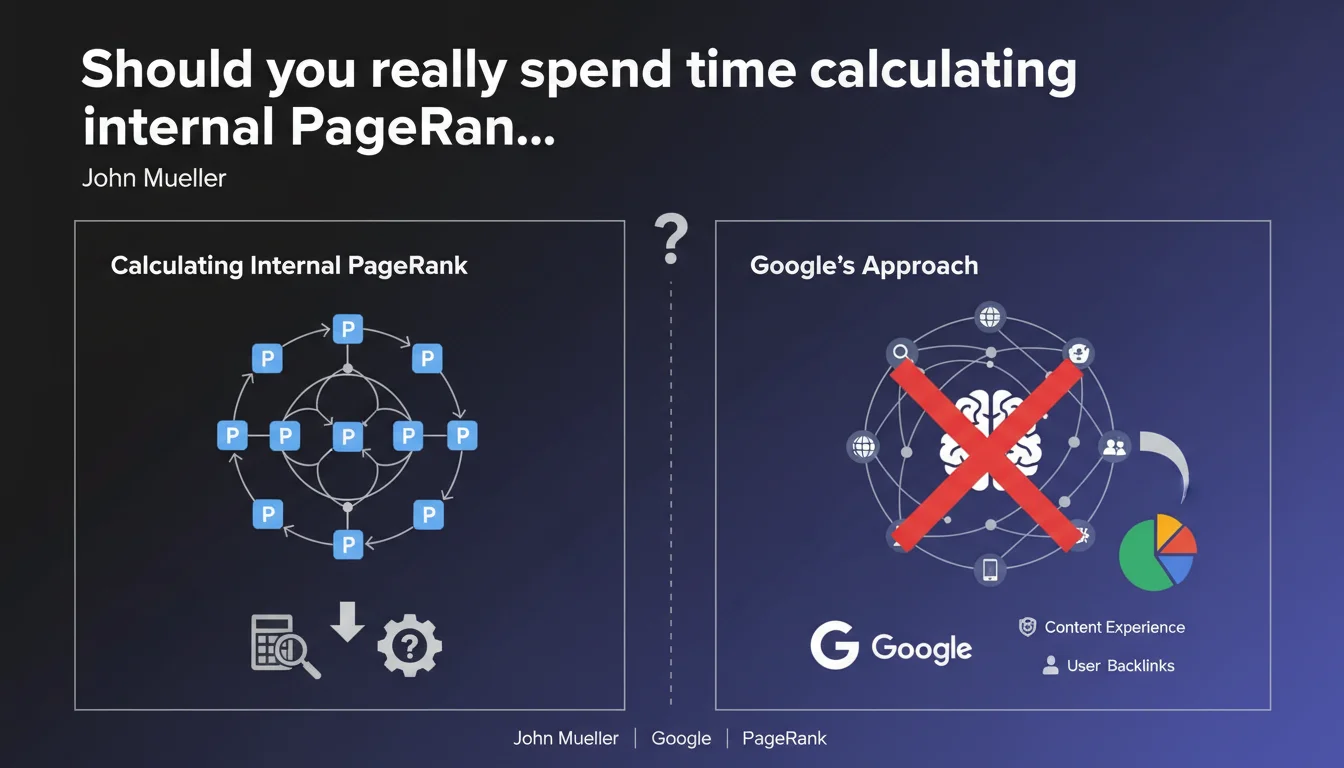
Google confirms that internal PageRank remains a signal used but its practical impact is limited. Tools that calculate internal PR don't reflect how the algorithm actually works, which combines hundreds of other factors. Bottom line: it's useful for understanding your site's internal linking structure, but not a decisive indicator for prioritizing your efforts.
What you need to understand
What exactly does "internal PageRank" mean?
The internal PageRank refers to the score calculated from a site's internal links, excluding external backlinks. The idea: identify which pages receive the most "link juice" through your internal linking structure.
Many SEO tools (Screaming Frog, OnCrawl, Botify) offer this calculation to help detect orphaned pages, poorly linked pages, or conversely, over-optimized ones. It's a metric for structural diagnosis — nothing more.
Why does Mueller say it's "not super critical"?
Because Google doesn't base its determination of page importance solely on PageRank. The search engine cross-references hundreds of signals: semantic relevance, search intent, freshness, user engagement, backlinks, content quality, and so on.
Internal PR gives a mechanical view of your internal linking, but completely ignores the semantic and contextual dimension that Google values today. A page with low internal PR can rank very well if it perfectly answers a specific query.
Does Google still use PageRank in 2025?
Yes. Mueller confirms that PageRank is still part of the algorithm. But it's one signal among many, and probably less decisive than before in the overall weighting.
The historical PR (from the toolbar, gone for years) was public and simplistic. The PR Google uses today is a much more sophisticated version, incorporating context and nuance — impossible to faithfully reproduce with a simple crawl.
- Internal PageRank remains a diagnostic tool useful for spotting structural problems.
- It does not reflect how Google actually evaluates a page's importance.
- Google combines PR with hundreds of other factors — PR alone isn't decisive.
- SEO tools calculate an approximation, not Google's actual PR.
SEO Expert opinion
Is this statement consistent with real-world observations?
Absolutely. In the field, we regularly see pages with mediocre internal PR performing very well in the SERPs if they target specific queries with quality content. Conversely, some hyper-linked pages stagnate because they add no value to users.
Internal linking remains crucial — let's be clear about that. But the strategic intent behind your linking matters more than its raw volume. Three contextual links from semantically close pages beat an avalanche of footer or sidebar links any day.
What nuances should we add to this statement?
Mueller says "not super critical," but that doesn't mean "useless." Internal PR remains relevant for identifying structural imbalances: orphaned pages, excessive depth, poorly planned silos.
Let's be honest: Google rarely communicates about the relative importance of signals. Saying "we also consider many other factors" is a classic dodge to avoid revealing the actual weighting. [To verify]: it's impossible to know how much weight PR still carries in the overall algorithm.
In what cases does internal PR remain truly useful?
For large sites with thousands of pages (e-commerce, media, directories), internal PR helps prioritize crawling and identify neglected pages. It's a quick filter for detecting where to concentrate your linking efforts.
For sites with 50-100 pages, frankly, a manual audit of the structure is plenty. Calculating internal PR becomes technical fetishism without real added value.
Practical impact and recommendations
What should you do concretely with this information?
Stop chasing a perfect internal PR score. Use it as a structural health indicator, not an SEO performance metric. Your goal: ensure every important page is accessible, logically linked, and contextually relevant.
Focus instead on the semantic relevance of your linking. A link from a thematically close page is worth more than ten links from off-topic pages. Anchor context matters tremendously.
What mistakes should you avoid after this statement?
Don't completely neglect internal linking on the grounds that "Google says it's not critical." That would be naive. Internal linking remains a major lever for crawl distribution and semantic consistency.
Also avoid over-investing in complex internal PR calculation tools if you don't have the SEO maturity to exploit that data. Before modeling PageRank flows, make sure you already have logical architecture and clean silos.
How do you verify that your linking strategy is solid?
- Audit click depth: all your strategic pages should be accessible in 3 clicks max from the homepage.
- Verify there are no orphaned pages (pages with no internal backlinks).
- Analyze anchor context: are they natural, descriptive, varied?
- Identify high-potential business pages that receive too few internal links.
- Cross-reference internal PR with crawl and indexation data in Search Console.
- Test the impact of linking adjustments on a sample of pages before rolling out changes widely.
❓ Frequently Asked Questions
Google utilise-t-il encore le PageRank en interne ?
Est-ce que calculer le PageRank interne sert encore à quelque chose ?
Faut-il arrêter d'optimiser le maillage interne ?
Quels outils permettent de calculer le PageRank interne ?
Le PageRank interne peut-il prédire les performances SEO d'une page ?
🎥 From the same video 20
Other SEO insights extracted from this same Google Search Central video · published on 21/01/2022
🎥 Watch the full video on YouTube →
💬 Comments (0)
Be the first to comment.