
Official statement
Other statements from this video 20 ▾
- □ Do internal links in the header or footer really have less SEO value?
- □ Does Google really penalize a website that buys links in bulk?
- □ Do you really need technical perfection to rank well on Google?
- □ Does Google really crawl your site less when it perceives low quality?
- □ Is the 'Crawled, Currently Not Indexed' status really just a sign of poor website quality?
- □ Can invalid structured data penalize your SEO performance?
- □ Should you worry when the number of indexed pages drops?
- □ Crawled vs Discovered: Are these two non-indexed statuses really the same thing?
- □ Can you really control which images Google displays in your search snippets?
- □ Is your franchise network losing visibility because of duplicate content across multiple domains?
- □ CCTLD, subdomain or subdirectory: which structure for international geotargeting?
- □ Does the 503 status code really protect your pages from deindexing during an outage?
- □ Will accidental dofollow links in your PR coverage actually hurt your rankings?
- □ Can you really use the address change tool to merge or split websites?
- □ Why are your structured data disappearing on your localized pages?
- □ Do structured data really improve rankings, or just how results are displayed?
- □ Will Google ever display Core Web Vitals badges directly in search results?
- □ Why Does Google Cause Position Fluctuations for Two Months After URL Restructuring?
- □ Does internal linking really outperform URL structure for SEO?
- □ Should you really spend time calculating internal PageRank to optimize your website?
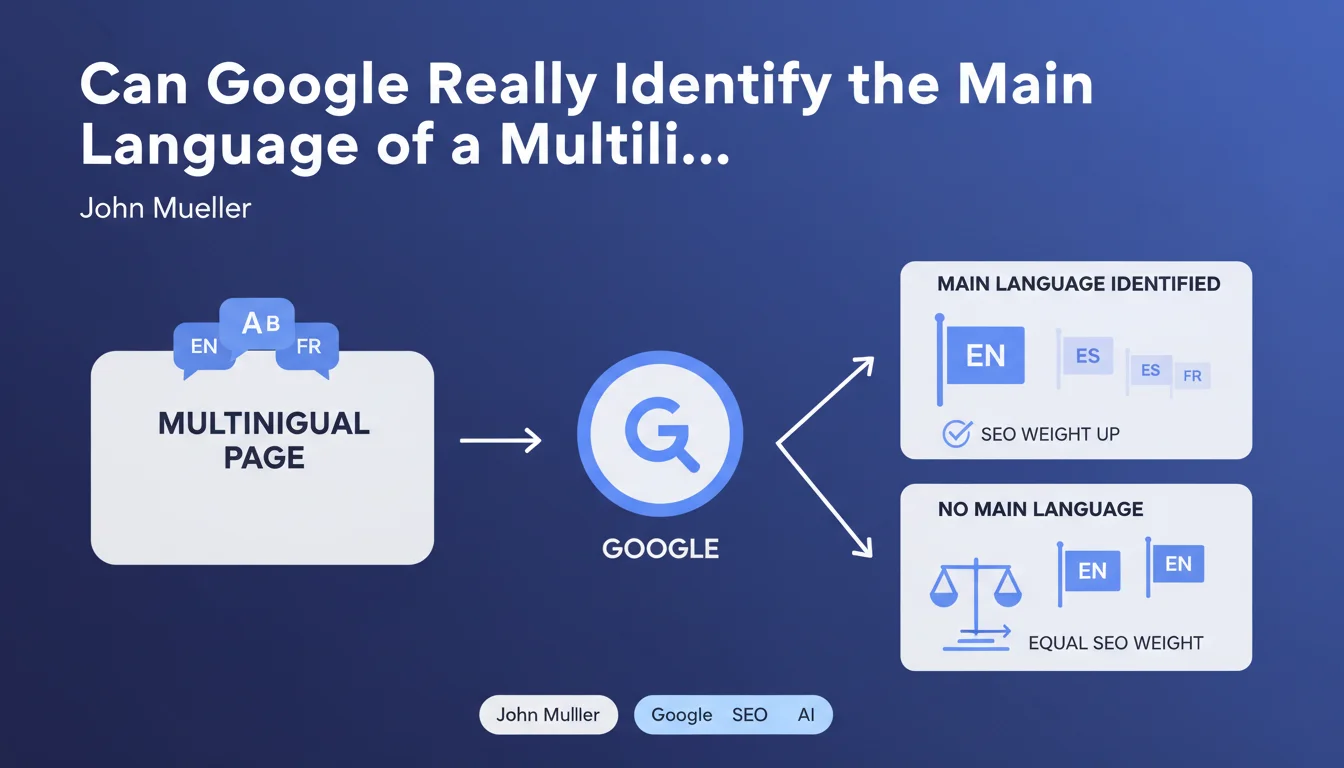
Google automatically determines the main language of a page, even if it contains terms in multiple languages. If no dominant language clearly emerges, multiple languages can be assigned simultaneously without diluting the SEO weight of the main language. This official statement formalizes a more flexible approach than many practitioners imagined.
What you need to understand
How Does Google Identify the Main Language of a Page?
Google's algorithm analyzes the text content to determine which language dominates a page. This recognition happens automatically, without requiring manual intervention via specific tags — although these remain recommended.
The engine examines linguistic density: if 80% of the content is in French with a few English terms ("marketing," "SEO"), the page will be classified as French-speaking. The algorithm is robust enough not to be disturbed by common foreign expressions or technical jargon.
What Happens When No Language Dominates?
In cases where content is truly bilingual or multilingual (for example, 45% French / 45% English / 10% Spanish), Google can assign multiple languages to the same page. This situation is rather rare in practice.
Contrary to popular belief, this multi-assignment does not dilute the "SEO weight" of the main language. The page can theoretically appear in search results for multiple languages without algorithmic penalty — at least according to this statement.
Why Does This Statement Contradict Certain Established Practices?
Many SEO professionals apply strict rules of language separation: one URL = one language, with hreflang to link the versions. This approach remains the safest and clearest for both Google and users.
Mueller's statement suggests that Google handles mixed content better than we think. But be careful — "handling better" doesn't mean "optimizing perfectly." Between what the algorithm can do and what you need to do to maximize performance, there's a gulf.
- Google automatically identifies the main language through text content analysis
- Isolated terms in other languages (jargon, expressions) don't disturb this identification
- In the absence of a dominant language, multiple languages can be assigned simultaneously
- This multi-assignment doesn't create a penalty on the "SEO weight" of each language
- Automatic recognition works, but hreflang and lang tags remain valuable signals
SEO Expert opinion
Is This Statement Really Applicable in All Contexts?
On paper, it's reassuring. In reality? It depends enormously on the type of content. A tech blog with a few Anglicisms will pass without issue. An e-commerce site with product descriptions mixing French and English almost equally — that's another story.
I've observed cases where Google indeed assigned multiple languages to a page — but with mediocre positioning results in all languages concerned. No technical penalty, certainly, but a dilution of perceived relevance. [To be verified] on larger volumes.
Should You Abandon Traditional Multilingual Best Practices?
Absolutely not. Let's be honest: this statement changes nothing about the fundamentals. If you're building a serious multilingual site, you always separate languages by distinct URL (subdomain, subdirectory, or ccTLD) and implement hreflang.
This flexibility from Google concerns rather edge cases: pages containing quotations, international brand names, universal technical terms. Don't take this statement as a green light to mix languages any which way.
What Are the Risks of Misinterpretation?
The main danger? Creating truly bilingual content thinking that "Google handles it." Even if technically the algorithm assigns languages correctly, you're creating a degraded user experience — and that's something Google eventually always penalizes indirectly.
Moreover, automatic recognition can fail on short content, highly technical pages, or similar languages (Spanish/Portuguese, Norwegian/Swedish). Never rely solely on automatism.
Practical impact and recommendations
Should You Modify Your Existing Multilingual Site Architecture?
No. If your site already follows best practices (separate URLs, correctly implemented hreflang, lang tags), don't touch anything. This statement doesn't challenge these standards — it simply clarifies how Google handles non-standard cases.
On the other hand, if you had doubts about certain pages containing occasionally mixed content (bilingual FAQ, quotations, proper names), Mueller's confirmation reassures you: no need to rewrite everything to eliminate every foreign term.
How to Verify That Google Correctly Identifies the Language of Your Pages?
Several methods — some obvious, others less so. Start with Search Console: verify which language versions your pages appear in. If a French page appears in English search results, investigate.
Next, inspect your server logs: where does Googlebot crawl from? What Accept-Language does it use for each page? A systematic mismatch reveals a detection problem.
- Maintain clear architecture: one URL = one target language
- Implement hreflang tags between equivalent language versions
- Add the lang attribute to the html tag of each page
- Monitor in Search Console impressions by country and language
- Avoid truly bilingual content (50/50) except for very specific justified cases
- Accept international technical terms without trying to translate everything artificially
- Test your pages with VPNs and different language settings to verify display
- Analyze logs to identify any gaps between detected language and target language
What Strategy Should You Adopt for New Multilingual Projects?
Always start with strict language separation. It's the only approach that guarantees control, measurability, and scalability. Use subdirectories (/fr/, /en/, /es/) for medium-sized sites, subdomains or ccTLDs for large international projects.
Google's ability to automatically identify the language of a page doesn't dispense with applying structural best practices. This algorithmic tolerance concerns edge cases, not global strategy. For complex projects requiring robust multilingual architecture, a professional approach remains essential — these technical optimizations involve delicate trade-offs between structure, UX, and performance that only in-depth expertise allows you to fully master.
❓ Frequently Asked Questions
Puis-je mélanger plusieurs langues sur une même page sans être pénalisé ?
Les balises hreflang et lang sont-elles encore nécessaires si Google détecte automatiquement la langue ?
Comment savoir si Google a correctement identifié la langue de mes pages ?
Faut-il traduire absolument tous les termes techniques internationaux ?
Quelle architecture choisir pour un nouveau site multilingue ?
🎥 From the same video 20
Other SEO insights extracted from this same Google Search Central video · published on 21/01/2022
🎥 Watch the full video on YouTube →
💬 Comments (0)
Be the first to comment.