
Official statement
Other statements from this video 20 ▾
- □ Do internal links in the header or footer really have less SEO value?
- □ Does Google really penalize a website that buys links in bulk?
- □ Does Google really crawl your site less when it perceives low quality?
- □ Is the 'Crawled, Currently Not Indexed' status really just a sign of poor website quality?
- □ Can invalid structured data penalize your SEO performance?
- □ Should you worry when the number of indexed pages drops?
- □ Crawled vs Discovered: Are these two non-indexed statuses really the same thing?
- □ Can you really control which images Google displays in your search snippets?
- □ Is your franchise network losing visibility because of duplicate content across multiple domains?
- □ CCTLD, subdomain or subdirectory: which structure for international geotargeting?
- □ Does the 503 status code really protect your pages from deindexing during an outage?
- □ Will accidental dofollow links in your PR coverage actually hurt your rankings?
- □ Can you really use the address change tool to merge or split websites?
- □ Why are your structured data disappearing on your localized pages?
- □ Do structured data really improve rankings, or just how results are displayed?
- □ Will Google ever display Core Web Vitals badges directly in search results?
- □ Why Does Google Cause Position Fluctuations for Two Months After URL Restructuring?
- □ Does internal linking really outperform URL structure for SEO?
- □ Should you really spend time calculating internal PageRank to optimize your website?
- □ Can Google Really Identify the Main Language of a Multilingual Page Without Hurting Your SEO?
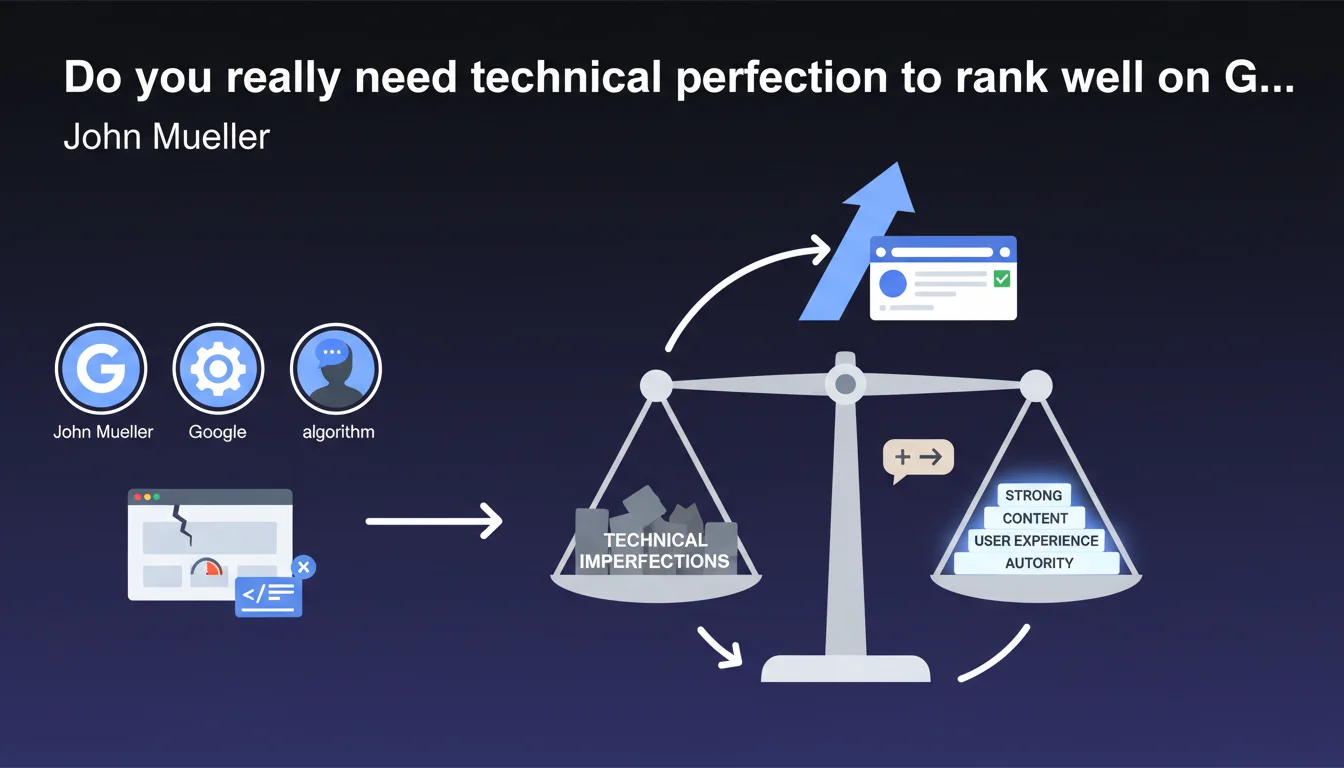
Google uses hundreds of ranking signals, and no site needs to be flawless on every criterion to rank well. Weaknesses in certain areas can be compensated by strengths elsewhere — the algorithm works through overall balancing, not by eliminating imperfections.
What you need to understand
Does Google really work through compensation between signals?
Yes. Google's algorithm isn't binary: it doesn't reject a site because it shows a specific technical or editorial weakness. Instead, it aggregates hundreds of signals — loading speed, content quality, link profile, user behavior, technical structure — and calculates an overall relevance score.
In practical terms? A site with mediocre internal linking but exceptional content can outrank a technically flawless but bland competitor. An e-commerce site that's slow but has a strong link profile and recognized expertise can compensate for Core Web Vitals shortcomings through other levers.
Do all ranking factors carry the same weight?
No, and that's where it gets complicated. Certain signals carry more weight than others depending on search query context. For transactional searches, E-E-A-T signal quality and content freshness take priority. For local searches, geographic proximity and user reviews become decisive.
Google doesn't disclose exact weightings or activation thresholds — which forces us to observe, test, and iterate. What Mueller is saying here is that there's room for maneuver: you're not out of the race if you score 3/10 on mobile speed, as long as you excel elsewhere.
What are the implications for pragmatic SEO strategy?
It means you should prioritize rather than aim for excellence everywhere. Identifying your strengths and reinforcing them can prove more profitable than fixing ten micro-technical defects. A niche site with unique content and a loyal audience can afford to be technically average — as long as user experience remains acceptable.
Conversely, a site weak on content won't catch up through perfect technical performance. The algorithm seeks overall consistency, not local perfection.
- No single signal guarantees good rankings — the whole picture counts
- Minor weaknesses aren't deal-breakers if the site excels elsewhere
- Signal weighting varies depending on search intent and industry
- It's more effective to strengthen your strengths than to fix all your weaknesses
- Google doesn't apply strict thresholds: it evaluates relative relevance against competitors
SEO Expert opinion
Is this statement consistent with real-world observations?
Overall, yes. We regularly see technically deficient sites that dominate their SERPs thanks to exceptional content or massive link profiles. Conversely, sites that are impeccable on PageSpeed Insights stagnate on page 3 due to lack of editorial relevance.
The problem is that Mueller remains deliberately vague on critical thresholds. Certain technical defects — massive orphaned pages, structural cannibalization, blocking robots.txt directives — can nullify the effects of other optimizations. Compensation works, but it has its limits. [To verify]: how far can a signal degrade before it becomes blocking?
What nuances should we add to this compensation logic?
Not all signals are equally compensatable. A YMYL site (health, finance) with E-E-A-T problems won't compensate through speed. A site penalized for link spam won't recover thanks to premium content as long as the profile isn't cleaned.
Another nuance: compensation works differently depending on search query competitiveness. On uncompetitive long-tail keywords, you can rank with a site that's average across the board. On ultra-competitive queries, any weakness becomes a relative disadvantage against competitors who tick all the boxes.
In what cases doesn't this rule apply?
When you're dealing with eligibility criteria rather than ranking criteria. A non-indexable site won't compensate for anything. A site without an SSL certificate will be downranked regardless. Manual or algorithmic penalties nullify the compensation logic: you're out of the game until resolved.
Similarly, if your site blatantly violates Google's Quality Rater Guidelines — deceptive content, intrusive ads, no author on YMYL content — no technical signal will save your visibility. Google has red lines, and Mueller only discusses what happens below those lines.
Practical impact and recommendations
What should you concretely do to optimize this compensation logic?
Start with a priority audit. Identify your 3-4 major levers — those where you can create a significant competitive gap — and concentrate your resources there. If your sector expertise is your asset, invest heavily in content rather than Core Web Vitals optimization.
Next, ensure your technical foundations are sound: indexability, clean URL structure, correct semantic markup, functional Mobile-First. You don't need perfection, but no blocking either. Once this foundation is set, strengthen your strengths rather than fix minor details.
What mistakes should you avoid when applying this principle?
Don't confuse compensation with neglect. Letting a signal deteriorate because "Google compensates" is a strategic mistake. Compensation works when you excel elsewhere — not when you're mediocre everywhere.
Another mistake: ignoring contextual signals. If you're in e-commerce, speed and mobile UX carry significant weight. If you're doing expertise blogging, content depth and E-E-A-T take priority. Adapt your strategy to your market context, not to a universal checklist.
How can you verify that your site is properly leveraging this logic?
Analyze your direct competitors in SERPs. Compare their technical, editorial, and backlink strengths/weaknesses. If a technically weaker competitor outranks you, they excel elsewhere — identify where and decide whether you can catch up or take a different approach.
Use Search Console to identify critical weak signals: orphaned pages, massive crawl errors, CTR drops. A weak signal affecting 5% of traffic deserves less attention than a medium signal affecting 50%.
- Identify your 3-4 major strategic levers and concentrate your efforts on them
- Guarantee a clean technical foundation (indexability, Mobile-First, HTTPS, structure)
- Benchmark competitors to understand which signals actually matter in your sector
- Prioritize optimizations with high relative impact rather than aiming for excellence everywhere
- Avoid neglecting a signal under the guise that "Google compensates" — compensation assumes excellence elsewhere
- Track the evolution of your weak signals to detect drift before it becomes blocking
❓ Frequently Asked Questions
Combien de facteurs de classement Google utilise-t-il exactement ?
Un site lent peut-il quand même bien se classer sur Google ?
Y a-t-il des signaux de classement non compensables ?
Comment savoir quels signaux prioriser pour mon site ?
La compensation entre signaux fonctionne-t-elle de la même manière sur toutes les requêtes ?
🎥 From the same video 20
Other SEO insights extracted from this same Google Search Central video · published on 21/01/2022
🎥 Watch the full video on YouTube →
💬 Comments (0)
Be the first to comment.