
Official statement
Other statements from this video 20 ▾
- □ Les liens internes dans le header ou le footer ont-ils moins de valeur SEO ?
- □ Google pénalise-t-il vraiment un site qui achète des liens en masse ?
- □ Faut-il vraiment viser la perfection technique pour bien ranker sur Google ?
- □ Pourquoi Google crawle-t-il moins votre site s'il le trouve de mauvaise qualité ?
- □ Le statut « Crawlée, actuellement non indexée » est-il vraiment un signal de qualité insuffisante ?
- □ Les données structurées invalides peuvent-elles pénaliser votre référencement ?
- □ Faut-il s'inquiéter d'une baisse du nombre de pages indexées ?
- □ Crawlée non indexée vs Découverte non indexée : vraiment équivalent ?
- □ Peut-on vraiment contrôler les images affichées dans les snippets Google ?
- □ Pourquoi Google pénalise-t-il le contenu dupliqué entre sites de franchises ?
- □ Le code 503 protège-t-il vraiment vos pages de la désindexation en cas de panne ?
- □ Les liens dofollow accidentels dans vos RP vont-ils vous pénaliser ?
- □ Peut-on vraiment utiliser l'outil de changement d'adresse pour fusionner ou diviser des sites ?
- □ Pourquoi vos données structurées disparaissent-elles sur vos pages localisées ?
- □ Les données structurées améliorent-elles vraiment le référencement ou juste l'affichage ?
- □ Google va-t-il un jour afficher les Core Web Vitals directement dans les résultats de recherche ?
- □ Restructuration d'URL : pourquoi Google provoque-t-il des fluctuations pendant deux mois ?
- □ Le linking interne surpasse-t-il vraiment la structure d'URL pour le SEO ?
- □ Faut-il vraiment calculer le PageRank interne pour optimiser son site ?
- □ Google peut-il vraiment identifier la langue principale d'une page multilingue sans pénaliser votre SEO ?
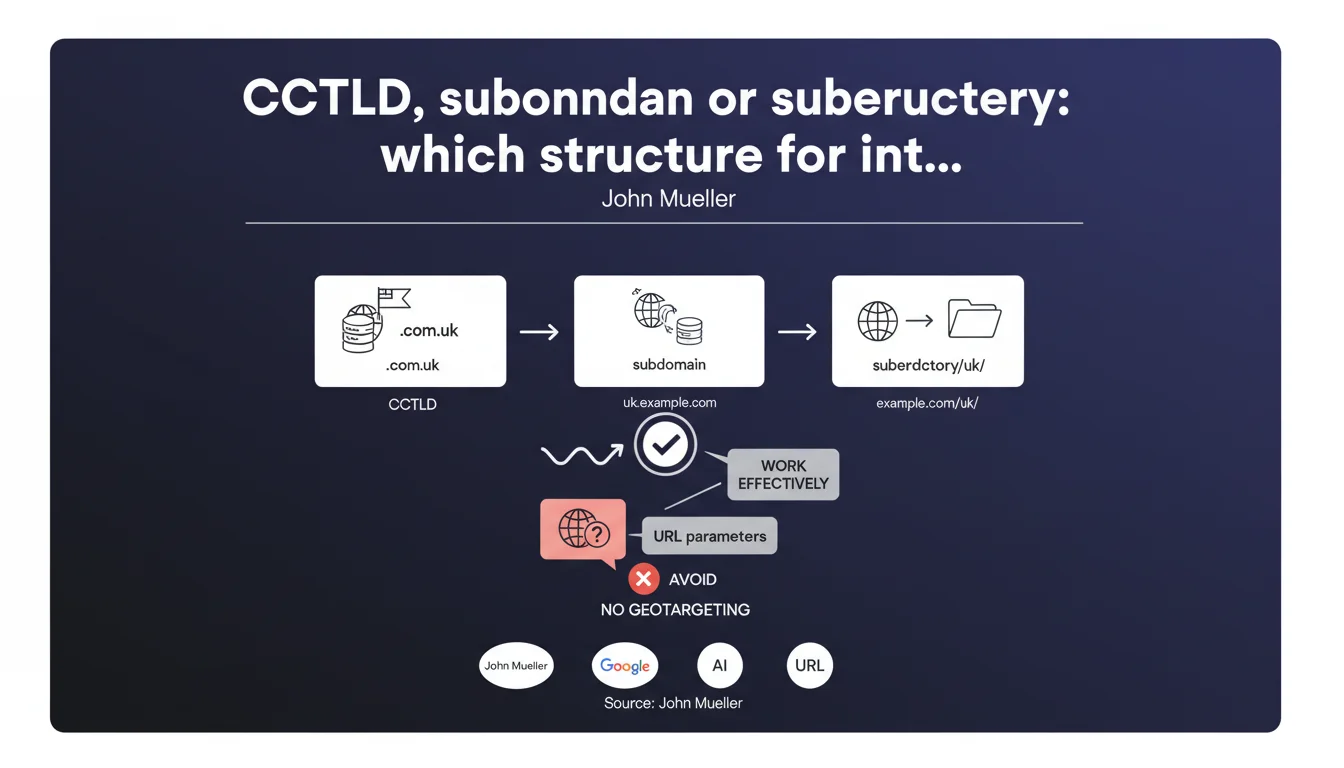
Google confirms that CCTLDs (.fr, .de) provide the clearest geographical signal, but subdomains (fr.site.com) and subdirectories (site.com/fr/) also work for international targeting. URL parameters (?country=fr) should be avoided entirely: Google cannot apply geotargeting to them.
What you need to understand
Why does Google distinguish between these three technical approaches?
Geotargeting allows Google to understand which language or geographical version of your site to present based on the user's location. CCTLDs (Country Code Top-Level Domains) like .fr or .co.uk send an unambiguous geographical signal: this domain clearly targets France or the United Kingdom.
Subdomains (fr.mysite.com) and subdirectories (mysite.com/fr/) require manual configuration via Search Console to indicate the targeted country. Google treats them differently but recognizes both as valid for international targeting.
What makes URL parameters incompatible with geotargeting?
URL parameters (mysite.com?country=fr) pose a structural problem: Google cannot assign geotargeting to them in Search Console. These URLs are perceived as dynamic variants of the same page, not as distinct geographical versions.
Result: it's impossible to signal to Google that this URL specifically targets France. The search engine cannot refine the geographical relevance of your content, which weakens your local visibility.
What real clarity does a CCTLD provide compared to other options?
A CCTLD requires no additional configuration. The geographical signal is intrinsic to the domain itself. Google interprets it automatically, without ambiguity.
For subdomains and subdirectories, you must manually configure targeting in Search Console, add appropriate hreflang tags, and maintain this consistency over time. More friction points, more risk of error.
- CCTLDs provide the strongest and most automatic geographical signal
- Subdomains and subdirectories work but require manual configuration via Search Console
- URL parameters are incompatible with Google geotargeting — absolutely avoid them
- The choice of structure impacts domain authority: subdirectories centralize signals on a single domain, while CCTLDs and subdomains fragment them
SEO Expert opinion
Does this statement really reflect real-world observations?
Yes, but it oversimplifies a more nuanced reality. On paper, Google claims that subdomains and subdirectories "also work." In practice, subdirectories are often preferred by large international platforms because they concentrate domain authority on a single root domain.
CCTLDs are indeed the clearest, but they require building authority for each domain separately. If you launch mysite.de, it starts at zero in terms of backlinks and trust — even if mysite.com is already well established. This cost is not mentioned by Mueller.
What are the unstated limitations of each approach?
CCTLDs complicate technical management: separate hosting, multiple SSL certificates, fragmented monitoring. They are ideal if you have local teams that manage each market autonomously. Otherwise, operational overhead can be heavy.
Subdomains (fr.site.com) are treated by Google as semi-distinct entities. They partially inherit authority from the main domain, but less directly than subdirectories. [To verify]: Google has never published quantified data on this authority transfer.
Subdirectories are technically simpler and centralize authority, but they can pose problems if you need to delegate technical management to local teams or third-party providers — a single domain, a single control point.
In what cases does this logic apply with nuances?
If your international strategy relies on identical translated content (no local adaptation), Google may struggle to differentiate versions even with correct geotargeting. The geographical signal does not compensate for lack of editorial uniqueness.
For multilingual sites serving multiple countries with the same language (French for France, Belgium, Switzerland), geotargeting alone is insufficient. You must combine geographical targeting and linguistic hreflang to prevent Google from mixing versions.
Practical impact and recommendations
What structure should I concretely choose for my international site?
If you have the technical and marketing resources to manage multiple independent domains, and you're targeting strong local anchoring (e.g., brand perceived as local in Germany), CCTLDs are the gold standard. Maximum geographical signal, enhanced user trust.
If you want to centralize domain authority and simplify technical management, subdirectories (site.com/fr/, site.com/de/) are the most efficient choice. A single domain, a single backlink profile to build, a single infrastructure to monitor. This is the dominant choice among international e-commerce and SaaS pure players.
Subdomains represent a compromise: relevant if you need to delegate technical management by market (separate servers, different CMSs, autonomous teams), but with a slight sacrifice of consolidated authority.
What technical mistakes must you absolutely avoid?
Never use URL parameters to differentiate geographical versions. Google is clear on this: no geotargeting possible. You lose a major lever for local visibility.
Don't configure geographical targeting in Search Console for subdomains and subdirectories. Without this configuration, Google will have to guess your intention — and it may get it wrong, especially if your content contains mixed geographical signals (e.g., French site hosted in the USA).
Forget hreflang or implement it poorly. A URL must point to all its language/geographical variants, including itself. Common errors: hreflang in conflict with Search Console targeting, incorrect language values (fr-FR instead of fr), non-reciprocal annotations.
How do you verify that your geotargeting is working correctly?
Check in Search Console (Settings > International Targeting) that each subdomain or subdirectory is properly associated with the correct country. No configuration = no clear signal for Google.
Use an hreflang validator to detect implementation errors: missing annotations, URLs in 404 errors, redirect loops, incorrectly formatted languages.
Test geographical visibility with location simulation tools (VPN, Google Ads Preview Tool) to verify that the correct version displays based on country. If you're targeting France and the generic .com version is ranking instead, your geotargeting is failing.
- Choose CCTLD if strong local anchoring and dedicated resources per market
- Prioritize subdirectories to centralize authority and simplify management
- Absolutely avoid URL parameters (?country=fr) for geographical targeting
- Configure country targeting in Search Console for subdomains and subdirectories
- Implement hreflang comprehensively and rigorously across all variants
- Verify consistency between hreflang, Search Console and URL structure
- Regularly audit hreflang errors via Search Console or third-party tools
❓ Frequently Asked Questions
Puis-je changer de structure géographique (passer de CCTLD à sous-répertoires par exemple) sans perdre mon référencement ?
Le hreflang est-il obligatoire si j'utilise des CCTLD pour le géociblage ?
Google traite-t-il vraiment les sous-domaines et sous-répertoires de manière équivalente pour le géociblage ?
Que faire si mon site utilise déjà des paramètres URL pour le ciblage géographique ?
Peut-on combiner plusieurs structures (CCTLD pour certains pays, sous-répertoires pour d'autres) ?
🎥 From the same video 20
Other SEO insights extracted from this same Google Search Central video · published on 21/01/2022
🎥 Watch the full video on YouTube →
💬 Comments (0)
Be the first to comment.