
Official statement
What you need to understand
What's the fundamental difference between ccTLD and gTLD?
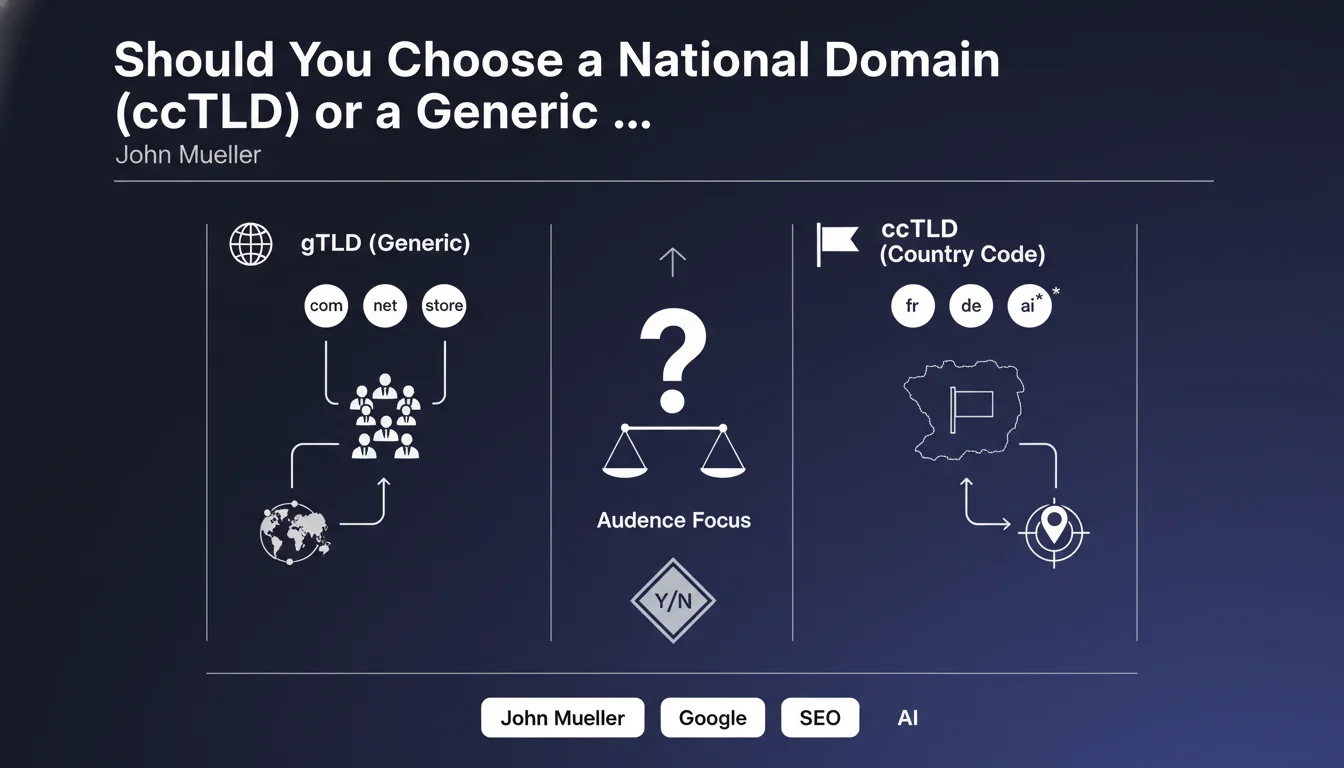
ccTLDs (Country Code Top-Level Domains) are extensions tied to a specific country like .fr, .de, or .be. Google interprets them as a strong geographic signal for local targeting.
gTLDs (Generic Top-Level Domains) like .com, .net, or .store have no default geographic anchoring. They enable a more neutral and flexible international positioning.
Why does Google place so much importance on this distinction?
The search engine uses the domain extension as one of the geolocation signals to determine a site's relevance in local results. A .fr site will naturally benefit in French searches.
This classification directly influences how Google distributes the geographic visibility of your content across its different national versions.
What does the risk of spammed extensions actually mean?
Some cheap extensions (.tk, .ml, .ga) have been massively exploited by spammers. Google may apply algorithmic suspicion to these domains.
Choosing such an extension means starting with a trust handicap, even if your content is legitimate and high-quality.
- ccTLDs send a strong geographic signal to Google for local targeting
- gTLDs offer international neutrality without predefined geographic anchoring
- Some ultra-cheap extensions are associated with spam and can damage your credibility
- The extension choice must align with your market strategy (local vs international)
- The .ai extension was just reclassified as a gTLD, losing its geographic anchoring to Anguilla
SEO Expert opinion
Is this recommendation still relevant in 2024?
John Mueller's statement remains fundamentally valid, but it deserves some nuance. With improved geographic targeting parameters in Search Console, a .com can rank very well in a local market.
However, the ccTLD retains a psychological advantage with local users. A .fr site inspires more trust among French audiences than a generic .com, even if Google treats them equally with proper settings.
In which cases does this rule not fully apply?
For established international brands, a .com remains the preferred choice as it conveys a global image. Amazon, Microsoft, or Apple don't suffer from not using ccTLDs.
Tech startups often opt for creative extensions (.io, .ai, .tech) that are part of their brand identity. In this context, the negative SEO impact is offset by branding.
Is the risk of spammed extensions really measurable?
My experience shows that the impact is real but indirect. Google doesn't apply automatic penalties, but these extensions do indeed concentrate low-quality content.
The real risk lies in user perception. A free .tk or .xyz domain generates immediate distrust, impacting click-through rates and therefore indirectly affecting SEO through behavioral signals.
Practical impact and recommendations
How do you concretely choose between ccTLD and gTLD for your project?
First ask yourself about your primary market. If you're only selling in France with few short-term international ambitions, .fr is the most obvious and effective choice.
For a multi-country strategy, a .com with subdirectories (/fr/, /de/, /es/) or subdomains (fr.example.com) offers more economical centralized management than multiple ccTLDs.
If your brand is inseparable from a specific extension (.io for tech, .store for e-commerce), prioritize brand consistency while rigorously optimizing other geographic signals.
What mistakes should you absolutely avoid in this choice?
Never choose an extension solely for its attractive price. The few euros saved will cost you in lost credibility and ranking difficulty.
Avoid changing extensions mid-course unless absolutely necessary. A domain change, even with perfect 301 redirects, always causes a temporary visibility loss.
Don't use a ccTLD if you're not actually targeting that country. A .de for a French-language site targeting the French market will create counterproductive algorithmic confusion.
What should you implement after choosing your extension?
- Configure geographic targeting in Google Search Console if you're using a gTLD
- Verify the consistency of your signals: content language, currency, address, local phone number
- Implement hreflang tags correctly if you're managing multiple language versions
- Secure domain variants (.fr + .com) to protect your brand and avoid confusion
- Monitor your extension's reputation in anti-spam tools to anticipate potential issues
- Analyze the geographic distribution of your traffic to validate that your choice matches your objectives
💬 Comments (0)
Be the first to comment.