
Official statement
What you need to understand
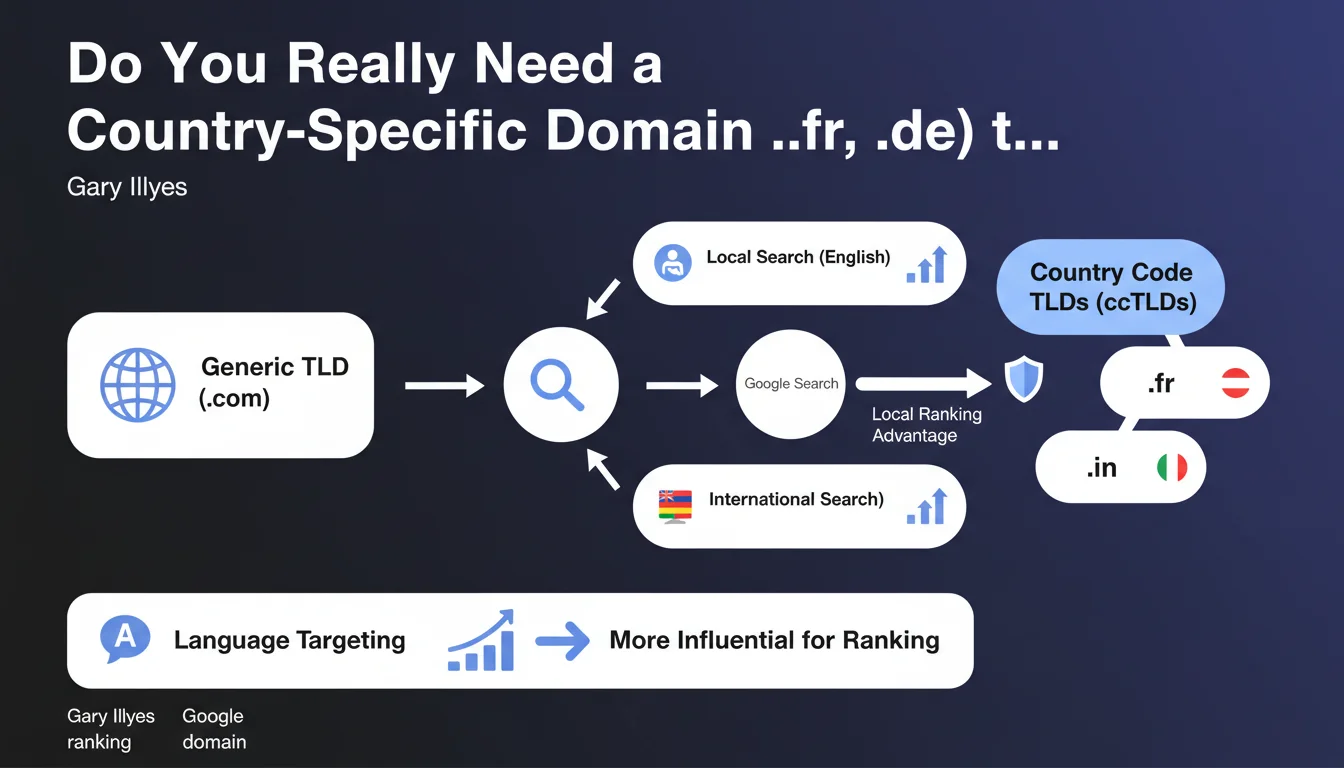
Google has officially confirmed that country code top-level domains (ccTLDs like .fr, .de, .in, or .kr) benefit from a favorable geolocation signal in local search results.
Concretely, when a user performs a search from France with French language settings, a site with a .fr extension will have a slight algorithmic advantage compared to an equivalent .com. This signal indicates to Google a presumed geographic relevance.
However, this statement also specifies that this is not an absolute or determining factor. A generic domain like .com can rank perfectly well if other local relevance signals are present: content in the local language, geolocated servers, local link profile, Google Business Profile, etc.
- ccTLDs provide a geographic signal directly identifiable by Google
- Language targeting remains more influential than domain extension alone
- A well-optimized .com can outperform a poorly optimized ccTLD
- This factor adds to other cumulative geolocation signals
SEO Expert opinion
This official position indeed corresponds to field observations over several years. ccTLDs offer a geographic relevance shortcut, but never constitute a ranking guarantee on their own.
In practice, we observe that well-internationalized .com domains with a /fr/ structure, correct hreflang tags, local hosting, and geolocated content perform just as well, if not better. The ccTLD becomes decisive primarily in highly competitive markets where every micro-signal counts.
For single-country businesses, starting directly with a ccTLD remains relevant. For international structures, a .com with a well-designed multilingual architecture often remains more judicious.
Practical impact and recommendations
- Audit your current situation: Assess whether your current domain (.com, .fr, etc.) matches your actual geographic ambitions
- For new single-country projects: Opt directly for the ccTLD of the target market (.fr for France, .de for Germany, etc.)
- For existing international .com sites: Don't consider migration unless undertaking a major strategic overhaul; instead strengthen other local signals
- Reinforce your geolocation signals: local hosting, content in native language, local address mentions, link profile from the target country
- Optimize your Google Business Profile: often more impactful than domain extension for local visibility
- Use hreflang tags correctly: for multilingual .com sites, this is your best ally for geographic targeting
- Configure Search Console: specify geographic targeting for gTLDs (.com, .org) via international settings
- Never sacrifice domain authority: an authoritative .com is better than a new ccTLD without history
Implementing a coherent geolocation strategy requires precise technical expertise, particularly regarding multilingual architecture, redirects, hreflang tags, and the trade-off between migration and optimization. These structural decisions have long-term implications for your visibility. For projects with international stakes or complex situations, support from a specialized SEO agency helps avoid costly mistakes and build a sustainable architecture adapted to your development ambitions.
💬 Comments (0)
Be the first to comment.