
Official statement
What you need to understand
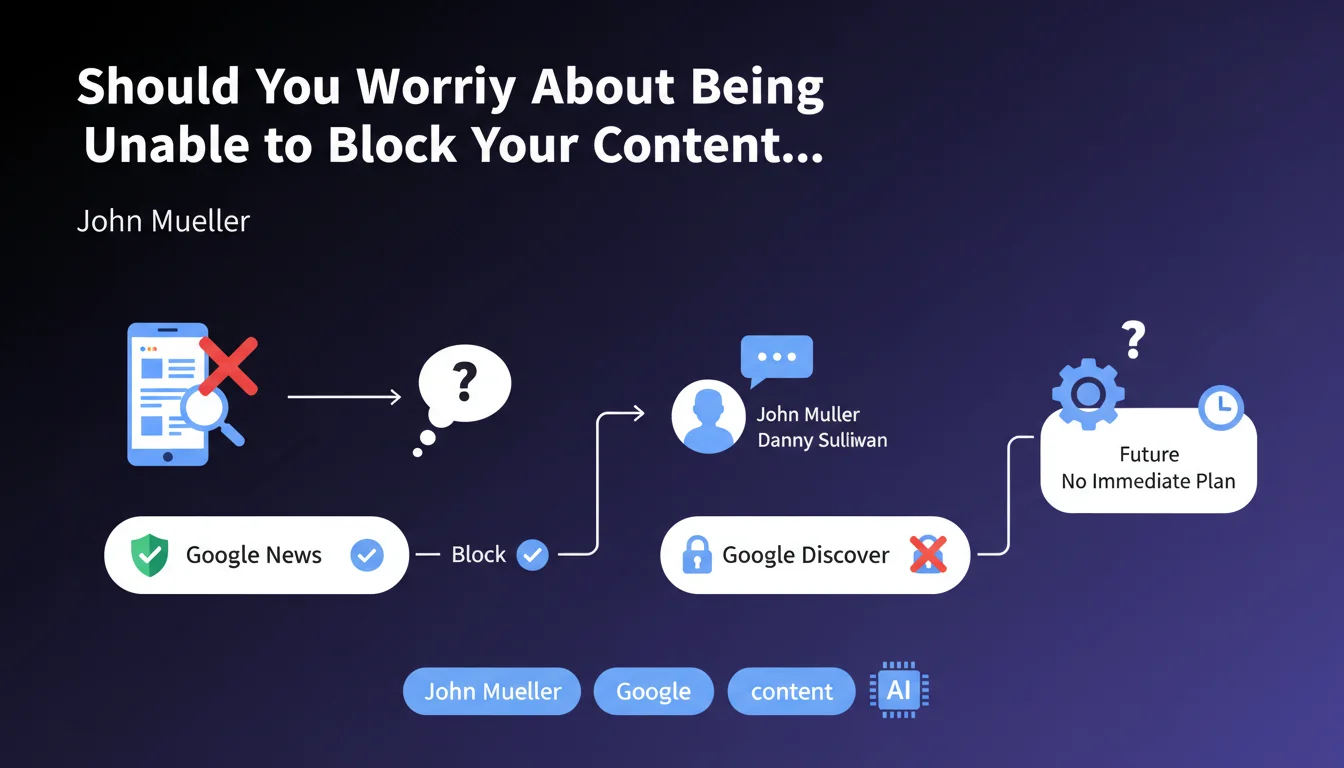
Google Discover is a personalized recommendation feed that displays content to users without them performing an active search. Unlike Google News, there is currently no mechanism allowing publishers to specifically block their content from this platform.
This situation poses a concrete problem: certain content may appear in Discover even when it doesn't align with Google's strict guidelines for this type of distribution. Sites may thus see their reputation affected or their traffic disrupted without any possibility of control.
Danny Sullivan and John Mueller acknowledge the potential usefulness of such a feature. However, no development is planned in the short term, leaving publishers in a waiting situation.
- No current control over presence in Discover, unlike Google News
- Google acknowledges the need but without any timeline commitment
- Risk for sites hosting content that doesn't comply with Discover guidelines
- Publishers must adapt their strategy accordingly
SEO Expert opinion
This statement reflects a problematic asymmetry in the Google ecosystem. While publishers can control their presence in Google News via specific tags, the absence of a similar mechanism for Discover creates a difficult-to-manage gray zone.
In practice, I observe that Discover favors evergreen, visually attractive, and engaging content. Sites that occasionally produce more sensitive, temporary, or experimental content find themselves exposed without a safety net. This situation is particularly delicate for media outlets that mix different types of content.
Google's position suggests that Discover is considered a privileged acquisition channel that they want to keep open by default. A solution will likely emerge eventually, but only in response to growing pressure from major publishers.
Practical impact and recommendations
- Audit your existing content to identify potentially problematic articles that could appear in Discover
- Establish strict editorial guidelines aligned with Google Discover quality criteria (E-E-A-T, quality visuals, engaging content)
- Systematically optimize your images: Discover is highly visual, with high-quality images (minimum 1200px width recommended)
- Use noindex sparingly only for content you absolutely don't want indexed, knowing this will also exclude it from classic Search
- Monitor your analytics to quickly detect traffic spikes from Discover and identify patterns of selected content
- Prioritize overall quality over quantity: every published piece of content can potentially appear in Discover
- Document incidents if certain content causes problems in Discover and report them through official Google channels to strengthen demand for a solution
- Prepare a crisis management strategy in case unwanted content generates massive traffic from Discover
Strategic management of presence in Google Discover requires a sophisticated editorial and technical approach, particularly for multi-topic sites or those with high publication volumes. These cross-optimizations between editorial quality, technical performance, and guideline compliance can prove complex to orchestrate internally.
For organizations looking to maximize Discover opportunities while minimizing risks, support from a specialized SEO agency can facilitate the implementation of adapted editorial governance and effective monitoring of these emerging acquisition channels.
💬 Comments (0)
Be the first to comment.