
Official statement
Google's strategy is to be able to highlight content from small publishers or lesser-known sites that don't necessarily have the authority required to rank high in traditional search.
Barry Schwartz, from Search Engine Roundtable, analyzes that this decoupling is probably the main cause of the massive influx of spam (and low-quality AI content) currently on Discover. By not using all the strict quality/trust signals from Search to filter content, Google has lowered the barrier to entry, making Discover easier to manipulate for new domains than classic SERPs.
What you need to understand
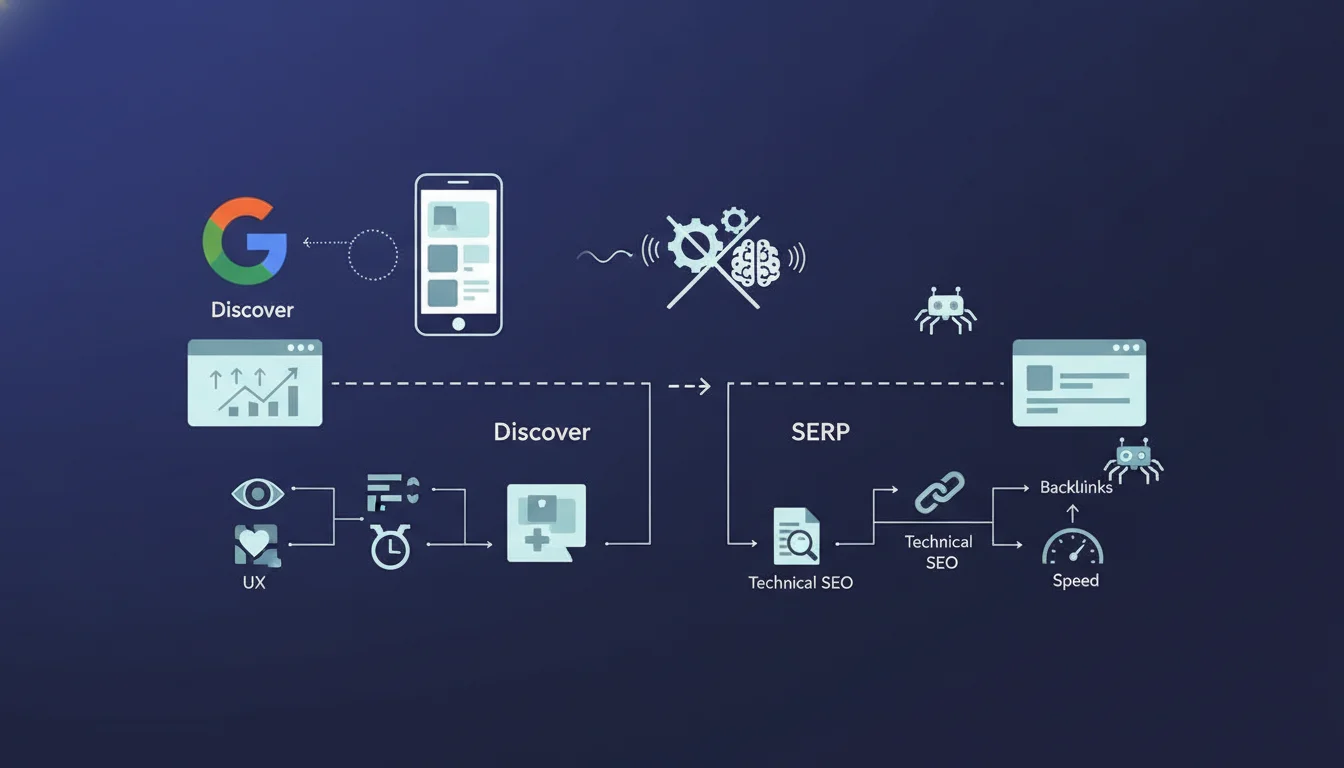
During an official conference in Zurich, Google revealed major information that challenges years of SEO beliefs: Google Discover and classic search results operate according to largely decoupled algorithms. Concretely, this means that content can perform exceptionally well in Discover without ranking properly in traditional SERPs, and vice versa.
This revelation explains why some sites with modest domain authority manage to generate millions of impressions via Discover, while they struggle to position themselves on competitive queries in classic search. Google states that this strategy aims to give visibility to smaller or lesser-known publishers, thus creating an alternative traffic opportunity.
However, this algorithmic differentiation has unexpected consequences. By not applying all the quality and trust signals used for classic Search ranking, Google has inadvertently created an attack surface more vulnerable to spam and low-quality AI-generated content. With the barrier to entry being lower, new domains can more easily manipulate Discover than traditional search results.
- Discover and Search use distinct algorithms with minimal alignment
- Core Updates don't uniformly impact both platforms
- Domain authority carries less weight in Discover than in classic search
- This difference explains the current influx of spam and AI content on Discover
- Opportunity for small publishers to gain visibility without strong authority
SEO Expert opinion
This official statement confirms what many SEO practitioners had been observing empirically for several months. Discover traffic patterns indeed no longer corresponded to Core Update fluctuations, and some sites penalized in SERPs continued to thrive on Discover. This consistency between field observations and official communication strengthens the credibility of the information.
However, several important nuances should be noted. The term "decoupling" doesn't mean a total absence of commonalities. Google certainly still uses shared signals such as content freshness, user engagement, or certain aspects of E-E-A-T. The decoupling probably concerns the relative importance of these signals and the absence of certain strict quality filters. Furthermore, this opening of Discover to small publishers remains conditional on the feature being activated by users and their declared interests.
Practical impact and recommendations
- Audit your Discover and Search performance separately in Google Search Console to identify content that performs differently on each channel
- Optimize specifically for Discover: eye-catching high-quality visuals, emotional and engaging titles, news content or evergreen content refreshed regularly
- Don't neglect your traditional SEO even if you're performing well on Discover: both channels are complementary and target different user intents
- Prioritize user engagement (reading time, interactions) which seems to be a strong signal for Discover, possibly more than domain authority
- Test content on niche topics where you don't have the authority to rank in classic Search: Discover can offer you alternative visibility
- Stay vigilant about quality: even though Discover is currently more permissive, Google will eventually strengthen its anti-spam filters on this platform
- Invest in original and impactful images: since Discover is very visual, graphic quality is decisive for CTR
- Avoid manipulation strategies based on generic AI content: the current opportunity risks closing quickly with retrospective penalties
- Document your experiments: create test content specifically for Discover to identify patterns that work in your niche
Implementing a differentiated strategy for Discover while maintaining excellence in your traditional SEO represents a complex challenge requiring in-depth expertise and rigorous analytical monitoring. If you want to fully exploit this new paradigm without dispersing your internal resources, support from a specialized SEO agency can prove judicious for structuring a coherent approach, precisely measuring impacts on each channel, and continuously adapting your strategy to the algorithmic evolutions of these two now-distinct ecosystems.
💬 Comments (0)
Be the first to comment.