
Official statement
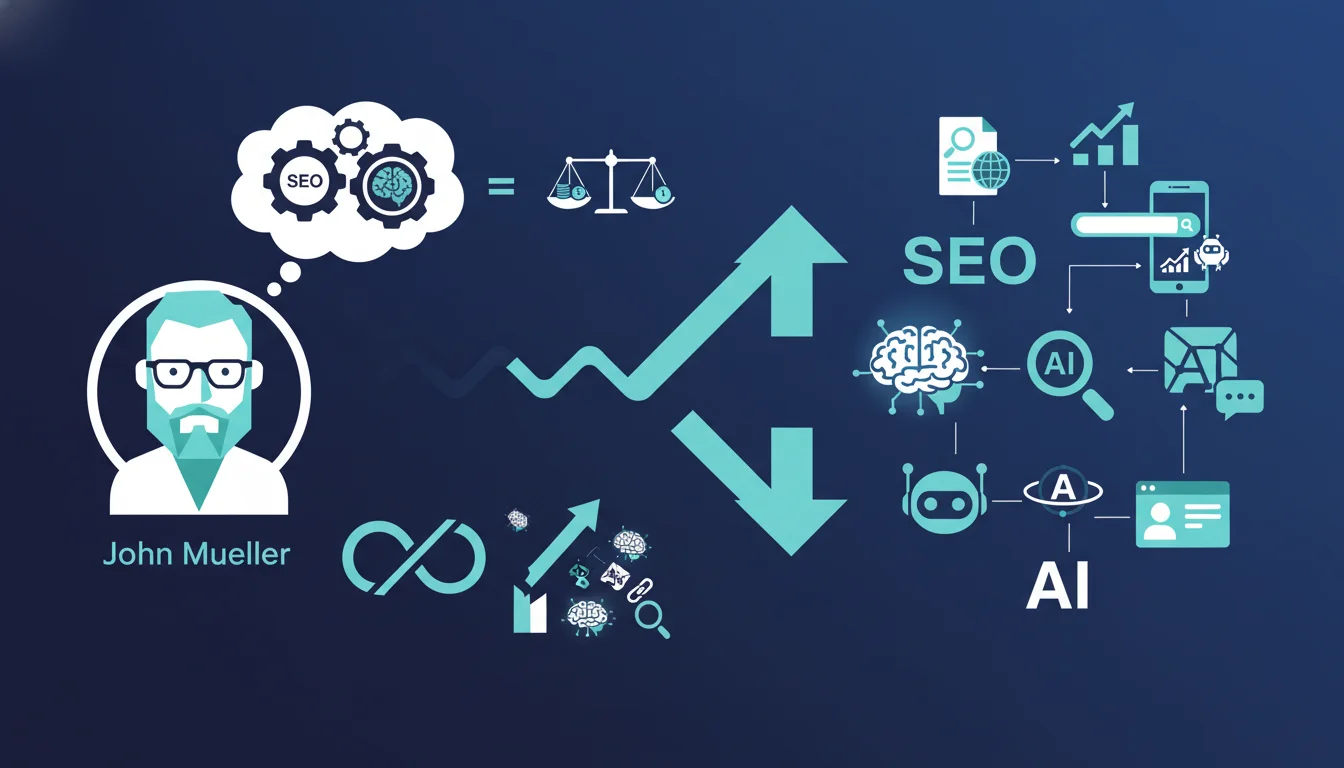
Furthermore, John Mueller strongly emphasizes the need to examine audience metrics before reorganizing your strategy. He recommends understanding what percentage of your audience uses AI tools, what percentage uses Facebook, and what that means for your time allocation. In essence, he transforms the GEO question into a budget allocation problem.
What you need to understand
Google's John Mueller recently reframed the terminological debate around GEO (Generative Engine Optimization), this new term referring to optimization for AI search engines like ChatGPT, Gemini or Perplexity.
According to him, the question is not whether the term GEO is valid or not, but rather how to intelligently allocate your resources among different acquisition channels.
Mueller explicitly acknowledges that AI is not going away and that it's legitimate to think about how your site can create value in an ecosystem where AI plays an increasing role. But be careful, this doesn't mean you should put all your eggs in this emerging channel's basket.
- The channel name matters little: SEO, GEO, or other, it's effectiveness that counts
- AI is a lasting reality that must be integrated into your strategic thinking
- Audience metrics should guide your decisions, not trends
- Budget allocation must be proportional to the actual usage of each channel by your audience
SEO Expert opinion
Mueller's position is particularly pragmatic and consistent with what we observe in the field. Too many companies rush into new channels for fear of missing the boat, without analyzing whether their audience is actually present there.
The important nuance concerns technology adoption cycles. If your audience consists of early adopters or tech professionals, the use of AI engines may already be significant. Conversely, for general public or senior audiences, traditional SEO remains largely dominant.
In technical B2B sectors, we're already seeing that some informational queries are migrating to AI assistants, while transactional searches remain on Google. You must therefore segment your strategy by intent type.
Practical impact and recommendations
- Analyze your Analytics data to identify where your qualified traffic actually comes from today
- Set up specific tracking to measure mentions of your brand in AI responses (tools like Profound or BrightEdge)
- Survey your audience directly through polls to understand their usage of different engines
- Maintain your SEO fundamentals: quality content, E-E-A-T, user experience - these elements also benefit GEO
- Experiment progressively with AI-optimized formats (structured FAQs, structured data, factual and cited content)
- Allocate your budget proportionally: if 2% of your traffic comes from AI, don't dedicate 50% of your resources to it
- Reassess quarterly the distribution of your efforts based on metrics evolution
- Don't sacrifice current ROI for hypothetical future volumes, find the balance
Implementing this multi-channel strategic approach requires sharp analytical skills and constant monitoring of technological developments. The complexity lies in finding the balance between innovation and immediate profitability.
For companies looking to structure this transition without dispersing their resources, support from a specialized SEO agency can prove valuable. An external expert perspective allows you to obtain an objective diagnosis of your actual priorities and implement a personalized strategy that optimizes your short-term return on investment while preparing for future developments.
💬 Comments (0)
Be the first to comment.