
Official statement
Other statements from this video 7 ▾
- □ Does Google really treat internal links as a UX signal for Googlebot?
- □ Does Googlebot really discover your pages through internal links?
- □ Why is the HTML <a> element with an href attribute absolutely essential for Google's crawling?
- □ Why does Google insist that links should remain real HTML links?
- □ Is meaningful anchor text still a decisive SEO lever in 2024?
- □ How do you strike the right balance with internal linking without overdoing it?
- □ Why does Google keep emphasizing internal links as the backbone of site crawlability and content discovery?
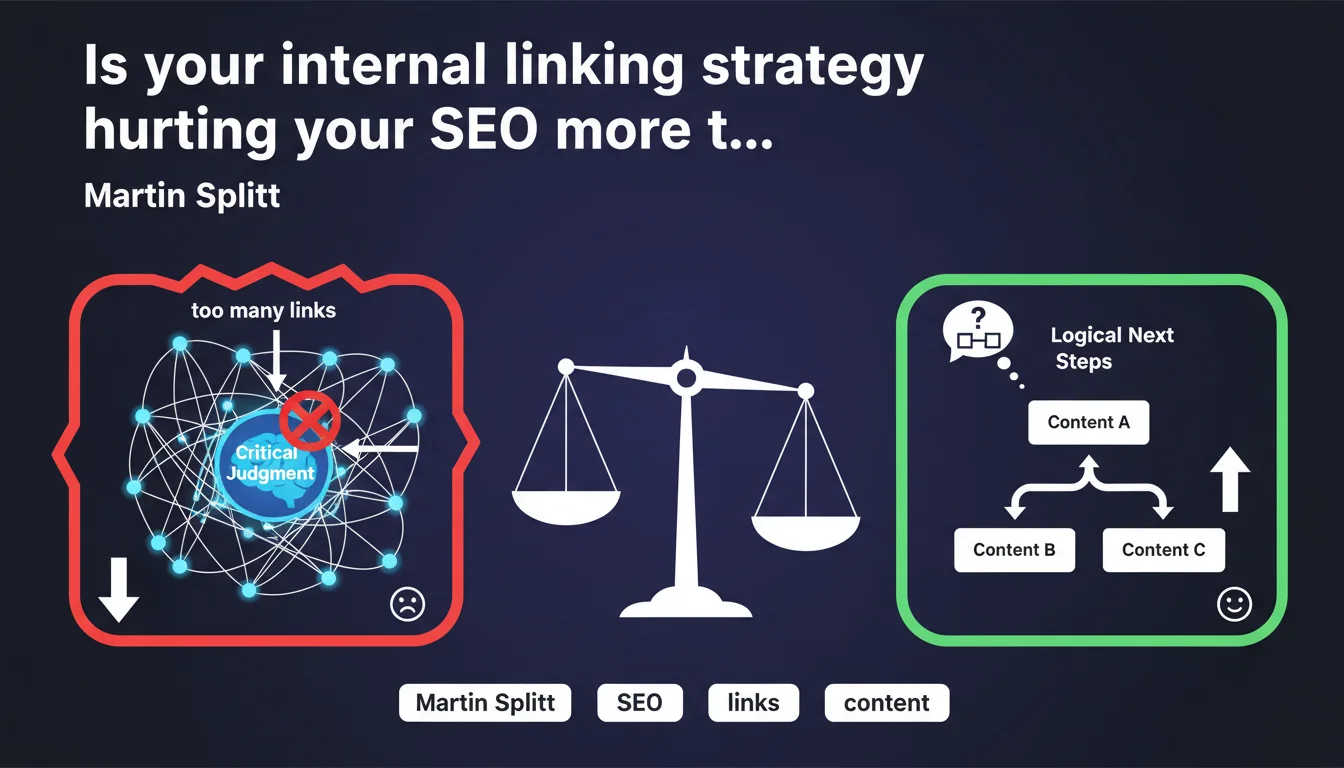
Martin Splitt warns against over-optimizing internal linking: multiplying links everywhere doesn't improve rankings. The recommended approach relies on user logic and contextual relevance rather than sheer volume of links.
What you need to understand
Does Google have a specific threshold for internal links you shouldn't exceed?
The statement sets no precise figure. Splitt deliberately stays vague about what concretely constitutes an "abuse". What he emphasizes is that accumulating links without editorial logic dilutes their value — a principle we've observed for years with PageRank sculpting.
The signal is clear: Google detects artificial patterns. A footer with 50 identical links on every page, anchor text stuffed with keywords, "similar articles" blocks generated without discretion — all these patterns probably trigger algorithmic filters.
What does "next logical steps" in the user journey really mean?
Splitt calls for thinking about internal linking as a narrative pathway. On a product page, a link to a comparison page or buying guide makes sense. To 15 different categories in the same block? Less so.
This approach aligns with behavioral signals: if users rarely click on a link, it's because it doesn't provide contextual value. Google has this data — and likely uses it to weight the importance of internal links.
How do you distinguish strategic internal linking from penalizing over-optimization?
The line remains blurry. What seems established: anchor text diversity and thematic coherence provide protective benefits. A link inserted naturally in a relevant paragraph carries more weight than a generic link in a widget repeated identically across 10,000 pages.
- Avoid blocks of identical links repeated on every page (bloated footer, overloaded sidebar)
- Favor contextual links inserted within editorial content
- Vary anchor text based on actual semantic context
- Ask yourself for each link: "Would a real user click here?"
- Limit "similar articles" automation without filtering by actual relevance
SEO Expert opinion
Is this directive consistent with real-world observations?
Yes and no. On massive e-commerce sites, you regularly see architectures saturated with internal links ranking well — as long as they serve a functional navigation logic. The problem emerges when linking becomes incoherent: orphaned pages next to over-optimized hubs, repetitive anchor text, forced links without relevance.
What really penalizes is obvious manipulative patterns. A client saw technical pages lose rankings after injecting 30 identical "recommended" links into each article — rolling back restored traffic in three weeks.
What nuances should we add to this recommendation?
Splitt doesn't distinguish between different site types. A news outlet publishing 200 articles daily doesn't operate under the same logic as a 50-page corporate site. On large sites, faceted navigation structurally requires more links — it's not abuse if it's functional.
Another point: the statement ignores technical contexts. A site with limited crawl budget sometimes must ration internal links to avoid wasting exploration on secondary pages. It's not just a matter of "editorial judgment"; it's also a technical constraint.
In what cases does this rule not apply strictly?
Complex architecture sites (marketplaces, directories, comparison tools) need dense linking to function properly. Removing links "on principle" can destroy UX and discoverability of deep content.
Likewise, some ultra-competitive sectors (finance, health, tech) require tight linking to distribute authority across key pages. Blindly reducing link count without analyzing impact on crawl and ranking would be counterproductive.
Practical impact and recommendations
What should you audit first on your site?
Start by identifying repetitive blocks: footer, sidebar, global navigation. Use a crawler (Screaming Frog, Oncrawl) to spot pages receiving abnormally high numbers of internal links — often admin or technical pages you don't want to push.
Then analyze your link anchor text. If you see 500 occurrences of the same text pointing to one page, that's a red flag. Google knows it's not natural.
What errors should you absolutely avoid in your internal linking?
Never create systematic links without relevance filtering. WordPress plugins like "Related Posts" showing 10 random articles per category? That's exactly what Splitt condemns.
Also avoid over-optimized identical anchors repeated endlessly. "Cheap car insurance" linking 200 times to the same page from every blog article is pure spam.
- Map internal links through a complete site crawl
- Remove "similar articles" blocks not filtered by actual thematic relevance
- Vary anchor text based on the real context of each source page
- Limit footer/sidebar links to essentials (legal, contact, structural pages)
- Verify each added link answers: "Where does the user want to go next?"
- Test the impact of progressive reduction: remove 20% of least-clicked links and monitor traffic changes
- Analyze internal click-through rates via Google Analytics or heatmaps to validate assumptions
❓ Frequently Asked Questions
Combien de liens internes maximum par page Google tolère-t-il ?
Les liens en footer sont-ils considérés comme du spam par Google ?
Doit-on supprimer les blocs « articles similaires » automatiques ?
Un site avec beaucoup de pages doit-il limiter son maillage interne ?
Comment mesurer si mon maillage interne est trop dense ?
🎥 From the same video 7
Other SEO insights extracted from this same Google Search Central video · published on 23/07/2024
🎥 Watch the full video on YouTube →
💬 Comments (0)
Be the first to comment.