
Official statement
Other statements from this video 8 ▾
- □ Does duplicate content really penalize your site on Google?
- □ Is duplicate content really slowing down your site's crawl rate?
- □ Should you really worry about duplicate content alerts in Google Search Console?
- □ Does Google really ignore your canonical tags? Here's why it happens more often than you think
- □ Should you prioritize the HTML tag or HTTP header to declare a canonical URL?
- □ Should you really redirect all non-canonical URLs with 301s for SEO?
- □ Why does merging similar pages boost your SEO even without duplicate content issues?
- □ Should you really merge your pages to boost your SEO performance?
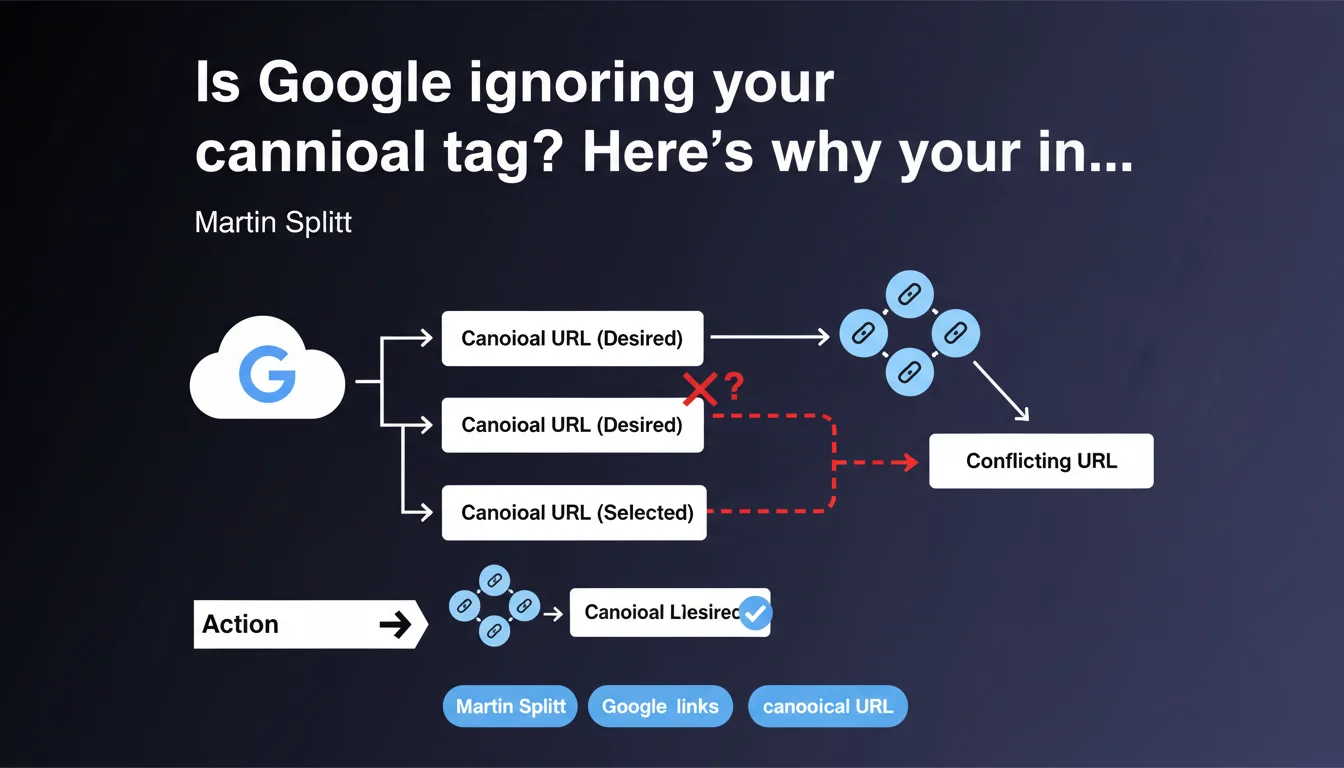
Google often picks a different canonical URL than the one you declare because your internal links point to another URL. The fix: correct your internal linking structure so it consistently points to the URL you want indexed. The signal from internal links carries significant weight in Google's canonical decision.
What you need to understand
What causes this conflict between the canonical tag and Google's choice?
Google considers multiple signals when determining which URL should be treated as canonical — the canonical tag is just one signal among many. When your internal links massively point to a different URL than the one declared via the tag, you're creating a glaring contradiction in the signals sent to the search engine.
Let's be frank: Google will logically prioritize what your site shows through its internal links rather than what a tag declares. If your entire architecture points toward page-example.html but your canonical declares page-example, you're sending contradictory signals.
Why does internal linking carry so much weight in this decision?
Internal links are a strong behavioral signal. They indicate which URL you genuinely consider important and relevant to your users. Google assumes you wouldn't build your entire internal linking structure toward a URL if it wasn't the one you want to promote.
The canonical tag can be added by mistake, generated incorrectly automatically, or misconfigured. Internal links — especially when consistent across your entire site — represent a more reliable structural intention.
When does this problem manifest most frequently?
This conflict typically appears on sites with URL variations: tracking parameters, mixed HTTP/HTTPS versions, inconsistent trailing slashes, www vs non-www. You declare one canonical version, but your menus, footers, and breadcrumbs point to another variant.
E-commerce sites are particularly exposed with filters and sorting: the canonical product page is declared without parameters, but category links generate URLs with ?sort=price or ?filter=color.
- Google prioritizes internal links over the canonical tag when there's a conflict
- Linking structure consistency is a strong behavioral signal
- The problem primarily affects sites with technical URL variations
- Check Google Search Console to identify ignored canonicals
SEO Expert opinion
Is this finding consistent with real-world observations?
Absolutely, completely. I've seen this scenario dozens of times: a site properly declares its canonicals, but Google picks different ones instead. Auditing the internal linking structure consistently reveals that 80% of internal links point to the non-canonical variant.
What's interesting — and what the analysis doesn't specify — is the tolerance threshold. How many contradictory internal links does it take for Google to switch? [To verify] based on my observations, even 20-30% of internal links to another URL can be enough to create an ambiguity that Google resolves... not always in your favor.
What nuances should we add to this rule?
First point: not all internal links carry equal weight. A link from your main menu or header likely counts more than a link from a footer packed with links. Primary navigation sends a stronger structural signal.
Second nuance — and this is where it gets tricky: what happens when your internal links are clean but Google still picks another URL? The analysis only addresses one scenario, but canonical issues can stem from other signals: historical redirects, massive external backlinks to a variant, contradictory sitemaps.
In which cases does this fix not solve the problem?
When the conflict originates elsewhere. I've seen sites with impeccable internal linking but ignored canonicals because of uncleared 302 temporary redirects, or URL variations indexed for years with an established traffic history.
If you have regional or language versions with hreflang markup, internal linking alone isn't enough — your entire structure (hreflang, canonical, internal links) needs to be consistent. A single contradictory signal, and Google makes its own decision.
Practical impact and recommendations
What should you concretely do to fix this issue?
First, identify the URLs where Google chooses a different canonical than the one you declared. Go to Google Search Console > Indexation > Pages, and look for the "Another URL selected as canonical" section. Export the complete list.
Next, for each problematic URL, audit your internal linking. Use Screaming Frog, Oncrawl, or similar crawling tools to list all internal links pointing to this URL and its variants. Identify which version receives the most links.
Correct all internal links so they exclusively point to your declared canonical version. Menus, footers, breadcrumbs, editorial links, pagination — everything must be consistent. A properly configured CMS can resolve 90% of the problem.
What mistakes should you absolutely avoid?
Don't fix only visible links. JavaScript-generated links, links in structured data, pagination links — everything counts. I've seen sites fix their menus but forget the rel="next" and rel="prev" tags that pointed to different variants.
Avoid creating redirect chains to "fix" the problem. If your internal links point to URL-A which redirects to URL-B declared as canonical, you've solved nothing — you've just added latency and diluted internal PageRank.
How do you verify that the fix works?
After making corrections, crawl the site again to confirm 100% of internal links point to canonical URLs. Not 95%, not 98% — 100%. Next, submit the corrected URLs to Google via Search Console and wait for a re-crawl.
Monitor progress in Search Console over 4-6 weeks. Google won't reassess instantly. If after two months canonicals are still being ignored despite clean linking, dig deeper into other signals: external backlinks, sitemaps, historical redirects.
- Export URLs with ignored canonicals from Google Search Console
- Crawl the site to audit all internal links
- Fix internal linking to point 100% to the canonical version
- Check JavaScript links, structured data, pagination
- Avoid redirect chains
- Re-crawl after fixes to validate complete consistency
- Submit corrected URLs and monitor for 4-6 weeks
❓ Frequently Asked Questions
Combien de temps faut-il pour que Google prenne en compte les corrections de maillage interne ?
Est-ce que corriger uniquement 80% des liens internes suffit ?
Que faire si Google ignore toujours ma canonical après correction du maillage ?
Les liens en JavaScript comptent-ils autant que les liens HTML classiques ?
Faut-il rediriger les anciennes URL vers la version canonique ?
🎥 From the same video 8
Other SEO insights extracted from this same Google Search Central video · published on 12/11/2024
🎥 Watch the full video on YouTube →
💬 Comments (0)
Be the first to comment.