
Official statement
Other statements from this video 8 ▾
- □ Does duplicate content really penalize your site on Google?
- □ Is duplicate content really slowing down your site's crawl rate?
- □ Should you really worry about duplicate content alerts in Google Search Console?
- □ Should you prioritize the HTML tag or HTTP header to declare a canonical URL?
- □ Is Google ignoring your canonical tag? Here's why your internal links might be to blame
- □ Should you really redirect all non-canonical URLs with 301s for SEO?
- □ Why does merging similar pages boost your SEO even without duplicate content issues?
- □ Should you really merge your pages to boost your SEO performance?
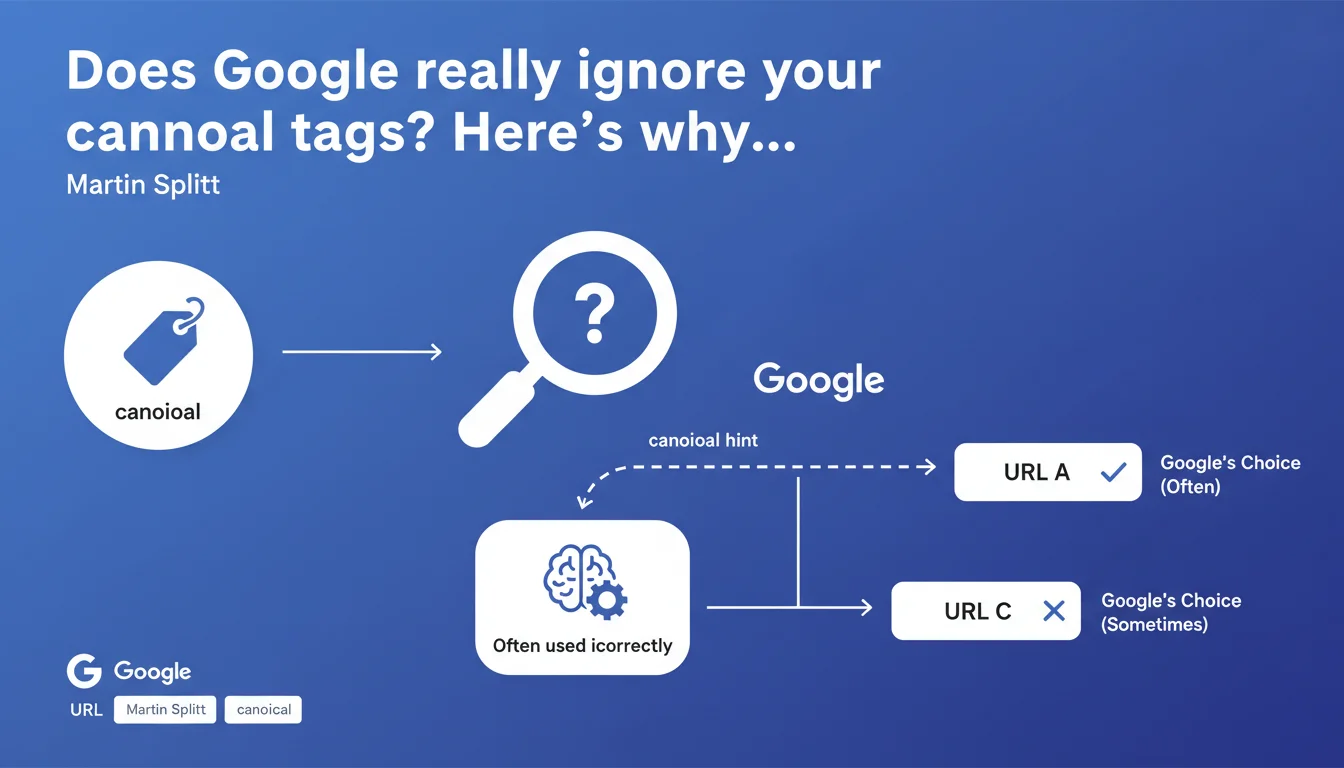
Google treats the canonical tag as a simple hint, not as a binding directive. The search engine reserves the right to choose a different URL than the one specified, particularly because this tag is massively misused by webmasters. In practice: your canonical can be ignored even if you haven't made any technical errors.
What you need to understand
What's the actual difference between a signal and a directive?
A directive is a strict instruction that Google commits to following systematically — like robots.txt or the meta noindex tag. A signal (or hint) is a clue that Google takes into consideration but can discard if other signals contradict it.
Martin Splitt is clear on this: the canonical tag belongs to the second category. Google analyzes it, weighs it, but doesn't guarantee it will respect it. This distinction changes everything about how you should approach managing duplicate content.
Why doesn't Google trust the canonicals you declare?
The issue is statistical: Google observes that the majority of canonical tags are misconfigured. Poorly configured CMS, failing plugins, development errors, conflicts between desktop and mobile versions — the scenarios are countless.
Faced with this reality, Google decided never to take a canonical at face value. The engine cross-references this information with other signals: internal link structure, backlink distribution, content consistency, user signals. If these elements contradict your canonical, Google will choose a different URL.
What are the other signals that Google prioritizes?
Google doesn't disclose its exact weighting — understandably, that would hand over the keys to the vault. But we know several factors compete with your declared canonical.
- Internal links: if 90% of your links point to URL A while your canonical designates URL B, Google will likely prioritize A
- Backlinks: a URL that receives massive external links has a better chance of being considered canonical
- Content consistency: if two pages are nearly identical but one contains significant additional content, it may be preferred
- User signals: engagement, bounce rate, CTR — Google observes how visitors interact with each version
- XML sitemap: URLs present in the sitemap carry more weight than those that aren't
SEO Expert opinion
Is this approach consistent with what we observe in the real world?
Absolutely. Any SEO professional who regularly audits sites has already encountered this phenomenon: a perfectly configured canonical technically, yet Google still indexes another version of the page.
The classic case? An e-commerce site with product variants (color, size) where the canonical points to the generic product sheet, but Google prefers to index the red variant because it receives 80% of the backlinks. Frustrating, but logical: Google follows actual popularity signals, not your stated intentions.
When does Google actually respect the canonical?
Let's be honest: Google respects the majority of well-configured canonicals. It's not because it's a signal that it's systematically ignored — it's just that it's not guaranteed.
When all signals converge — declared canonical, coherent internal links, no contradicting backlinks, aligned sitemap — Google typically follows your directive. The problem arises when there's conflict between signals. And that's when Google decides based on its own logic.
Should you stop using the canonical tag altogether?
No. This declaration doesn't say the canonical is useless — it says it's not sufficient on its own. This is a critical distinction.
The canonical remains a strong signal that Google considers. Not using one amounts to letting Google decide alone, without even giving your input. That would be foolish. What you need to remember: the canonical is necessary but not sufficient. It must be accompanied by overall consistency of all signals across your site.
Practical impact and recommendations
How do you ensure Google respects your canonicals?
The answer comes down to one word: consistency. Your canonical tag must be aligned with every other signal you send to Google. If you declare that a URL is canonical, your entire site must confirm it.
In practice? Verify that your internal links point overwhelmingly to the canonical version, that your sitemap contains only these URLs, and that your redirects are clean. A technical audit identifies these inconsistencies — and they're frequent, even on well-maintained sites.
What critical mistakes must you absolutely avoid?
Certain configurations are red flags for Google. A canonical pointing to a 404 page or a 301 redirect, for instance, will be systematically ignored — Google has no reason to trust an instruction that absurd.
Another classic pitfall: canonical chains. Page A canonicalizes to B, which canonicalizes to C. Google hates that. Each page must point directly to the final version. No intermediaries.
- Verify that the canonical always points to an accessible URL (200)
- Ensure there are no canonical chains (A → B → C)
- Check that internal links overwhelmingly favor the canonical URL
- Verify that the XML sitemap contains only canonical URLs
- Audit backlinks to detect if a non-canonical version receives more links
- Use Search Console to identify indexed URLs different from the declared canonical
- Avoid conflicts between canonical and hreflang (both should point to coherent versions)
How do you monitor whether Google respects your canonicalization choices?
Search Console remains your best ally. The "Coverage" tab tells you which URLs are indexed — compare with your declared canonicals. If you see major discrepancies, your signals are contradictory.
Regular crawls with Screaming Frog or Oncrawl also help detect inconsistencies before Google exploits them against you. And that's where the challenge lies: between technical audits, error fixes, internal architecture overhauls, and long-term monitoring, properly managing canonicalization requires time and specialized expertise. If you find Google systematically ignores your canonicals despite your efforts, it may be wise to bring in a specialized SEO agency for an in-depth diagnosis and tailored support.
❓ Frequently Asked Questions
Google peut-il ignorer ma canonical même si elle est techniquement parfaite ?
Comment savoir quelle URL Google a choisi comme canonique pour mes pages ?
Faut-il mettre une canonical sur toutes les pages, même celles sans doublon ?
Si Google ignore ma canonical, est-ce forcément une erreur de ma part ?
La canonical a-t-elle un impact sur le PageRank et l'autorité transmise ?
🎥 From the same video 8
Other SEO insights extracted from this same Google Search Central video · published on 12/11/2024
🎥 Watch the full video on YouTube →
💬 Comments (0)
Be the first to comment.